
Pest Control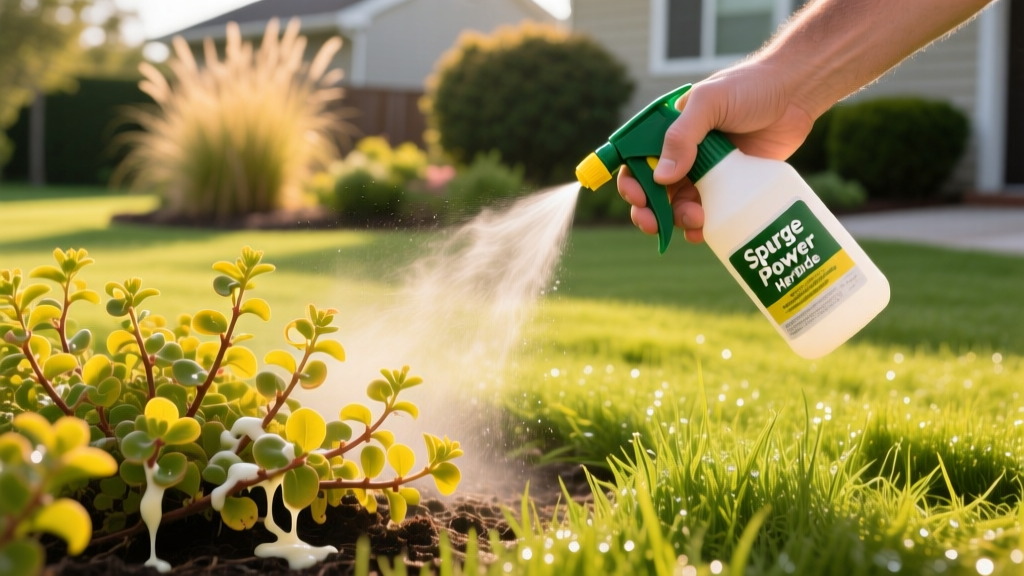
Using Spurge Power Herbicide for Spotted and Prostrate Spurge Control
The Challenge of Spurge in Turfgrass
Prostrate spurge (Euphorbia maculata) and spotted spurge (Euphorbia prostrata) are among the most aggressive, mat-forming broadleaf weeds that invade residential lawns. These summer annuals thrive in compacted soil, heat-stressed turf, and thin grass canopies, quickly choking out desirable grasses. Because spurge develops a deep taproot and a waxy leaf cuticle, standard off-the-shelf weed killers often fail to penetrate the foliage, resulting in incomplete kill and rapid regrowth. For targeted, highly effective spot-treatments, Spurge Power herbicide (manufactured by PBI Gordon) remains an industry-standard formulation specifically engineered to overcome these biological defenses.
Accurate Identification: Spurge vs. Look-Alikes
Before mixing any chemical treatment, accurate identification is critical. Homeowners frequently confuse spurge with two other common lawn invaders: purslane and prostrate knotweed. Misidentification leads to improper herbicide selection and wasted product.
- The Milky Sap Test (Spurge vs. Purslane): If you snap the stem of the suspected weed, prostrate and spotted spurge will immediately exude a milky white, latex-like sap. Purslane, which has thick, fleshy, succulent-like leaves and reddish stems, contains clear sap. According to NC State TurfFiles, this milky sap is the definitive hallmark of the Euphorbia genus.
- The Node Sheath Test (Spurge vs. Knotweed): Prostrate knotweed features a distinct, papery sheath (called an ocrea) wrapping the stem at the joints (nodes). Spurge stems are smooth and lack this sheath.
Active Ingredients and Mode of Action
Spurge Power is a premium, three-way selective broadleaf herbicide. Its efficacy stems from a synergistic blend of three active ingredients, each targeting different physiological pathways in the weed:
- 2,4-D (Amine): A synthetic auxin that causes uncontrolled, unsustainable cellular growth, ultimately leading to vascular tissue collapse.
- Mecoprop-p (MCPP): Highly effective against tough, waxy broadleaves like spurge and clover that often resist 2,4-D alone.
- Dicamba: Provides both foliar and limited soil residual activity, ensuring the weed absorbs the chemical through both its leaves and shallow root zone.
This specific trio is highly lethal to spurge but, when applied at correct rates, is safe for most established cool-season turfgrasses and specific warm-season varieties.
Turfgrass Safety Matrix
Not all grasses tolerate three-way herbicides equally. Applying Spurge Power to sensitive warm-season grasses will result in severe phytotoxicity, yellowing, and potential turf death. Always cross-reference your lawn type before application.
| Turfgrass Species | Safety Rating | Application Notes |
|---|---|---|
| Kentucky Bluegrass | Safe | Standard label rates apply. |
| Tall Fescue & Fine Fescue | Safe | Standard label rates apply. |
| Perennial Ryegrass | Safe | Standard label rates apply. |
| Common Bermuda & Zoysia | Safe (with caution) | Apply only when fully greened out and actively growing. Avoid during spring green-up transition. |
| St. Augustine & Centipede | UNSAFE | Do not use. Will cause severe damage. Use Atrazine or Penoxsulam instead. |
| Bahia & Dichondra | UNSAFE | Do not use. Highly susceptible to 2,4-D and Dicamba injury. |
Exact Mixing Rates and the Surfactant Requirement
The most common reason Spurge Power fails to kill spurge is the omission of a surfactant. Spurge leaves are coated in a hydrophobic waxy cuticle. Without a surfactant, the water-based herbicide beads up and rolls off the leaf, wasting the chemical.
⚠️ Critical Mixing Rule: Never use household dish soap as a surfactant. Dish soaps contain degreasers and salts that can strip the waxy cuticle off your desirable turfgrass, causing chemical burn. Always use a dedicated Non-Ionic Surfactant (NIS).
Spot-Treatment Mixing Protocol (1-Gallon Pump Sprayer)
For precise spot-treatment of spurge patches, calibrate your 1-gallon handheld sprayer using the following measurements:
- Spurge Power Herbicide: 1.5 fluid ounces (approx. 3 tablespoons).
- Non-Ionic Surfactant (NIS): 0.5 teaspoons (approx. 2.5 ml) per gallon of water.
- Water: Fill to the 1-gallon mark.
Cost Analysis: A 2.5-gallon jug of PBI Gordon Spurge Power retails for approximately $160 to $180 in 2026. At 1.5 oz per gallon, one jug yields over 210 gallons of mixed solution, bringing your chemical cost down to roughly $0.08 per gallon of ready-to-spray solution—vastly more economical than hiring professional lawn services at $12 to $18 per visit.
Step-by-Step Application Strategy
Timing and environmental conditions dictate the success of your spot-treatment. Dicamba, one of the active ingredients, is highly volatile in high heat and can drift onto neighboring ornamental plants if applied incorrectly.
- Check the Forecast: Ensure no rain is expected for at least 6 hours post-application (Spurge Power is rainfast in 4 to 6 hours). Ensure wind speeds are below 5 mph to prevent drift.
- Monitor Temperatures: Apply only when daytime temperatures are between 65°F and 85°F. As noted by University of Minnesota Extension, applying broadleaf herbicides containing Dicamba when temperatures exceed 85°F drastically increases the risk of volatilization, where the chemical turns into a gas and damages nearby trees and garden beds.
- Spray Technique: Use a fan-nozzle tip on your sprayer. Spray the spurge until the leaves are uniformly wet, but stop before the liquid begins to drip onto the soil. Over-spraying wastes product and increases soil residual buildup.
- Add a Tracking Dye (Optional): Adding a few drops of blue turf-marking dye to your tank helps you see exactly which weeds have been treated, preventing accidental double-application which can burn the surrounding grass.
Common Failure Modes and Troubleshooting
Even with the right chemical, poor execution leads to surviving weeds. Review these common edge cases:
- Treating Drought-Stressed Weeds: If the lawn is dry and the spurge is wilting, the weed's stomata (leaf pores) will be closed to conserve moisture. The herbicide will not be absorbed. Fix: Water the lawn deeply 24 hours before application to ensure the weeds are actively growing and translocating fluids.
- Mowing Too Soon: Mowing immediately after spraying removes the treated leaf tissue before the systemic chemicals can travel down to the taproot. Fix: Wait a minimum of 48 hours after spraying before mowing the lawn.
- Treating Mature, Seeding Plants: Late-summer spurge that has already dropped seeds is difficult to kill and guarantees a new crop next year. Fix: Focus on early summer (June/July) applications when the plants are young and vegetative. For late-season mature plants, hand-pulling is often more effective than chemical control.
Post-Application Lawn Care
After successfully treating the spurge, the bare spots left behind are prime real estate for new weed seeds. To prevent reinvasion, lightly rake the dead spurge mats out of the turf 10 to 14 days after application (once the weeds have completely turned brown and crispy). Overseed the bare areas with a high-quality, turf-type tall fescue or Kentucky bluegrass blend, and apply a starter fertilizer to encourage rapid canopy closure. A thick, dense turf canopy is the ultimate biological defense against future spurge germination.

