
Pest Control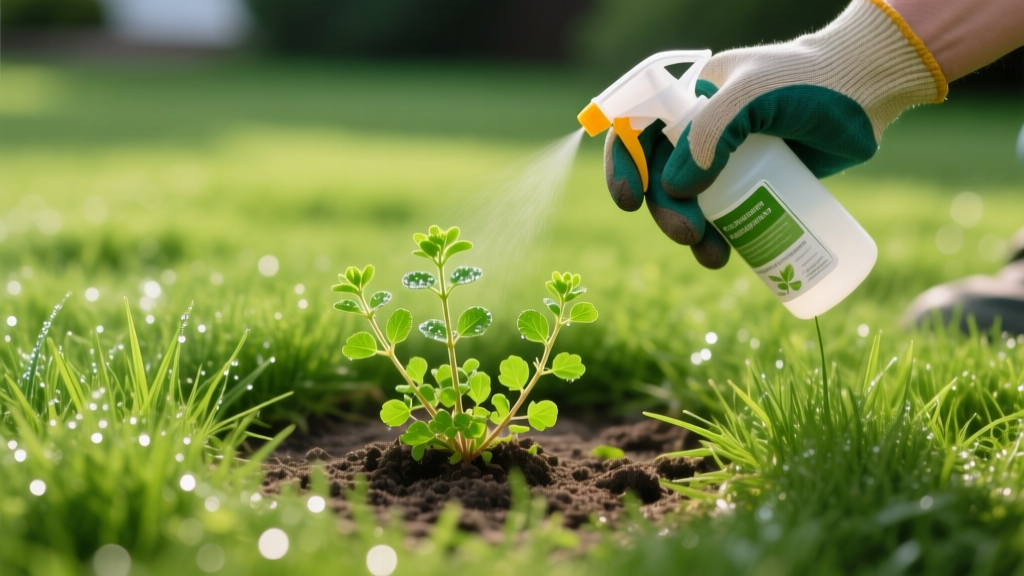
Best Spurge Weed Killer Options for Lawn Spot Treatment
The Biology of Spurge: Why It Resists Standard Herbicides
Spotted spurge (Euphorbia maculata) and prostrate spurge (Euphorbia supina) are aggressive summer annuals that germinate when 2-inch soil temperatures consistently hit 60°F. Unlike broadleaf weeds with deep taproots, spurge develops a shallow but highly fibrous root system that allows it to thrive in compacted, poor-quality soil where turfgrass struggles. According to the UC Statewide IPM Program, a single spurge plant can produce up to 45,000 seeds in a single season, making rapid spot-treatment critical before the plant sets seed.
The primary challenge in killing spurge lies in its leaf structure. The leaves are covered in a thick, waxy cuticle designed to retain moisture in high-heat environments. When standard aqueous herbicide solutions hit this cuticle, the droplets bead up and roll off onto the soil, rendering the treatment useless. Overcoming this physical barrier requires specific chemical combinations and application techniques.
⚠️ Toxicity Warning: All Euphorbia species exude a milky latex sap containing diterpene esters when the stem is broken. This sap is a severe contact dermatitis irritant and is toxic to pets if ingested. Always wear 4-mil nitrile gloves and long sleeves during manual removal or close-range spot spraying.
Post-Emergent Spurge Weed Killer Comparison Matrix
Selecting the right spurge weed killer depends on your grass type, the size of the infestation, and your budget. Systemic synthetic auxins (like 2,4-D and dicamba) are the industry standard, but combining them with a PPO inhibitor (like carfentrazone) accelerates the burn-down process significantly.
| Product / Active Ingredients | Speed of Action | Turf Safety | Approx. Cost (2026) |
|---|---|---|---|
| SpeedZone Broadleaf (2,4-D, MCPP, dicamba, carfentrazone) |
24–48 hours (rapid burn-down) | Safe for most cool/warm-season grasses (check label for St. Augustine) | $45 / pint |
| Ferti-lome Weed-Out (2,4-D, dicamba, quinclorac) |
7–14 days (slower systemic kill) | Excellent for Bermudagrass and Zoysia; avoid on Floratam St. Augustine | $25 / quart |
| Celsius WG (Thiencarbazone, iodosulfuron, dicamba) |
14–21 days (highly effective on mature plants) | Specifically formulated for warm-season southern lawns | $140 / 10 oz (yields 100+ gallons) |
| Ortho WeedClear (2,4-D, dicamba, quinclorac) |
5–10 days | Safe for most residential lawns; widely available at big-box stores | $20 / gallon (RTU) |
The Surfactant Requirement: Do Not Skip This Step
Applying a spurge weed killer without a surfactant is the most common reason for treatment failure. Water has a high surface tension (approximately 72 dynes/cm). The waxy cuticle of the spurge leaf repels this high-tension liquid. By adding a Non-Ionic Surfactant (NIS) like Southern Ag Surfactant or Hi-Yield Spreader Sticker, you reduce the surface tension to roughly 30 dynes/cm. This causes the herbicide droplet to flatten, spread across the leaf surface, and penetrate the stomata.
Mixing Ratio: Add 1 teaspoon (approx. 5 ml) of NIS per gallon of mixed herbicide. Always add the surfactant last to prevent excessive foaming in the sprayer tank.
Step-by-Step Spot Treatment Protocol
For isolated spurge patches (under 10% of total lawn area), spot treatment is more economical and environmentally responsible than broadcast spraying. Follow this exact protocol for maximum efficacy:
- Calibrate the Sprayer: Use a 1-gallon or 2-gallon pump sprayer. Swap the standard cone nozzle for a flat-fan nozzle (e.g., TeeJet 8002VS). A flat-fan pattern ensures even coverage and drastically reduces off-target drift.
- Mix the Solution: For SpeedZone, mix 1.5 fl oz of herbicide per gallon of water. Add the water first, then the herbicide, agitate gently, and add the NIS last.
- Pressurize to 20–30 PSI: Do not over-pump the sprayer. High pressure creates fine mist droplets that can drift onto desirable ornamental plants and cause severe phytotoxicity.
- Apply to the Point of Runoff: Spray the spurge mat until the leaves are uniformly wet and just beginning to drip. Ensure you cover the center taproot area where the plant stores energy.
- Wait 48 Hours Before Mowing: Allow the systemic herbicides adequate time to translocate from the leaves down into the root system. Mowing too soon removes the treated foliage and halts the kill process.
Pre-Emergent Defense: Stopping Spurge Before It Starts
While post-emergent spurge weed killers handle active infestations, the University of Minnesota Extension emphasizes that pre-emergent herbicides are the most cost-effective long-term strategy. Spurge seeds require light and warmth to germinate. Creating a chemical barrier in the top 1-inch of soil prevents the radicle from establishing.
Top Pre-Emergent Active Ingredients for Spurge
- Prodiamine (Barricade 65 WDG): Apply at a rate of 0.185 to 0.415 oz per 1,000 sq ft. Provides up to 4 months of residual control. Cost: ~$60 per pound.
- Dithiopyr (Dimension 2EW): Unique among pre-emergents because it offers early post-emergent control of spurge seedlings up to the 3-leaf stage. Apply at 0.5 to 0.75 fl oz per 1,000 sq ft. Cost: ~$110 per 2.5 quarts.
Timing is critical: Apply pre-emergents when 2-inch soil temperatures reach 55°F for 3 to 5 consecutive days. In most transitional and northern zones, this falls between mid-April and early May. Water the product in with 0.25 to 0.5 inches of irrigation within 48 hours to activate the soil barrier.
Organic and Non-Chemical Spot Treatments
For homeowners managing edible landscapes, pet-heavy yards, or those strictly avoiding synthetic herbicides, organic spot treatments can suppress spurge, though they require higher labor inputs and lack systemic root-killing capabilities.
Horticultural Vinegar (20% Acetic Acid)
Standard 5% household vinegar is ineffective against mature spurge. You must use 20% to 30% horticultural acetic acid. This acts as a contact desiccant, burning the waxy cuticle and dehydrating the plant tissue within hours. However, because it does not translocate to the roots, the spurge will likely resprout from the taproot within 10 to 14 days, requiring 2 to 3 repeat applications. Warning: 20% acetic acid is highly corrosive and requires full PPE, including a respirator and face shield.
Thermal Weeding (Flame Weeding)
Using a propane-powered flame weeder to apply intense heat (approx. 1,500°F) for 1 to 2 seconds per plant boils the water inside the spurge's cells, causing them to rupture. This method is highly effective for spurge growing in driveway cracks or sidewalk pavers where turfgrass damage is not a concern. It is not recommended for use in dormant Bermudagrass or dry lawns due to severe fire risks.
Manual Extraction
Because spurge has a relatively shallow taproot compared to dandelions, manual extraction is viable for small patches. Use a stand-up weeder with a deep V-notch claw (such as the Fiskars Stand-Up Weeder) to pry the central crown from the soil. This must be done before the plant flowers; once the tiny pink cyathia blooms appear, disturbing the plant can inadvertently scatter thousands of seeds across the lawn.

