
Pest Control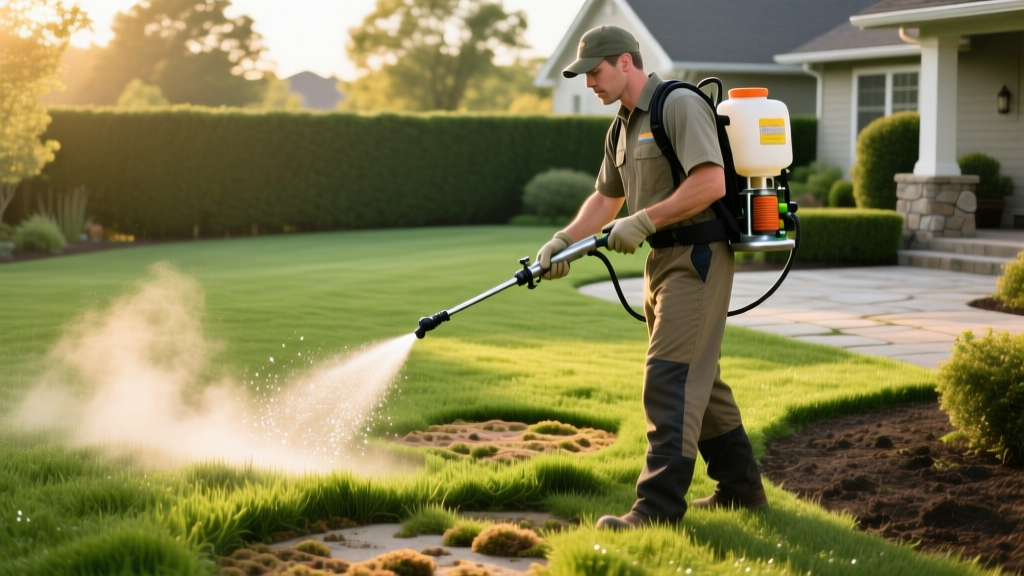
Applying Fungicides for Lawns: A Step-by-Step Protocol
Fungal pathogens like Rhizoctonia solani (Brown Patch) and Clarireedia jacksonii (Dollar Spot) can decimate a turf canopy in under 72 hours when humidity and temperature thresholds align. Applying fungicides for lawns is not a simple 'spray and pray' operation; it requires precise calibration, accurate pathogen identification, and strict adherence to resistance management protocols. Misapplication leads to wasted chemical, phytotoxicity, and accelerated fungicide resistance.
This protocol outlines the exact mechanical and chemical procedures for diagnosing, calibrating, and applying turf fungicides, utilizing current 2026 industry standards and active ingredients.
Phase 1: Pathogen Diagnosis and Active Ingredient Selection
Before mixing any chemical, you must identify the specific pathogen. Fungal diseases are broadly categorized into foliar (leaf-infecting) and soil-borne (root/crown-infecting). According to NC State Extension's TurfFiles, misidentifying a soil-borne disease like Pythium Root Rot as a foliar issue like Dollar Spot will result in total treatment failure, as the active ingredient will never reach the infection zone.
Targeted Fungicide Matrix
Select your active ingredient based on the specific pathogen and your turfgrass species. The table below outlines professional-grade and high-end consumer options, including current estimated costs per 1,000 square feet.
| Disease | Pathogen | Active Ingredient (FRAC Code) | Example Product | Est. Cost / 1k sq ft |
|---|---|---|---|---|
| Brown Patch | Rhizoctonia solani | Azoxystrobin (FRAC 11) | Syngenta Heritage SC | $0.05 - $0.09 |
| Dollar Spot | Clarireedia jacksonii | Propiconazole (FRAC 3) | Honor Guard PPZ 41.8 | $0.02 - $0.04 |
| Pythium Root Rot | Pythium spp. | Cyazofamid (FRAC 21) | Segway Fungicide | $0.15 - $0.22 |
| Rust | Puccinia spp. | Myclobutanil (FRAC 3) | Spectracide Immunox | $0.06 - $0.10 |
⚠️ Preventative vs. Curative Rates: Fungicide labels list two application rates. Preventative rates (lower) are applied before symptoms appear when environmental conditions favor disease. Curative rates (higher) are applied when lesions are already visible. Never exceed the maximum annual application rate listed on the label, regardless of disease pressure.
Phase 2: Sprayer Calibration Mathematics
The most common failure mode in DIY lawn care is ignoring carrier volume. If a label dictates '0.5 oz per 1,000 sq ft', that chemical must be mixed into the exact volume of water your sprayer uses to cover 1,000 sq ft. If your sprayer outputs 2 gallons per 1,000 sq ft, you mix 0.5 oz into 2 gallons. If it outputs 1.5 gallons, you mix 0.5 oz into 1.5 gallons.
Step-by-Step Backpack Sprayer Calibration
- Mark the Area: Measure out exactly 1,000 square feet on your lawn or driveway (e.g., a 20 ft x 50 ft rectangle).
- Fill with Water: Fill your backpack sprayer with a known quantity of plain water (e.g., 2 gallons). Mark the water level on the tank with a sharpie.
- Spray the Area: Spray the 1,000 sq ft area at your normal walking pace, using your standard nozzle pressure and spray pattern.
- Measure the Deficit: Refill the sprayer back to your sharpie mark using a measuring cup. The exact ounces of water required to refill the tank is your output per 1,000 sq ft.
- Calculate the Mix: If you used 24 ounces of water to refill the tank, your carrier volume is 24 oz per 1,000 sq ft. Mix your fungicide dose into that exact 24 oz volume for every 1,000 sq ft you plan to treat.
Phase 3: The Application Protocol
Proper application requires managing the physical environment of the turf canopy to ensure maximum active ingredient uptake.
Pre-Application Prep
- Mowing: Mow the lawn 24 hours prior to application. If treating an active foliar disease, bag the clippings to physically remove infected tissue and prevent spreading spores via the mower deck.
- Canopy Moisture: Ensure the grass is completely dry before spraying. Applying contact fungicides to a wet canopy dilutes the chemical and causes uneven distribution.
- PPE Requirements: Wear chemical-resistant nitrile gloves (minimum 14 mil thickness), long pants, closed-toe shoes, and safety glasses. Liquid concentrates easily absorb through standard cotton gardening gloves.
Tank Mixing Order (W-A-L-E-S)
To prevent chemical lock-up and nozzle clogging, follow the W-A-L-E-S mixing protocol:
- Wettable powders (if using)
- Agitate (shake or stir the tank)
- Liquid flowables (SC or flowable concentrates)
- Emulsifiable concentrates (EC liquids)
- Surfactants or adjuvants (added last)
Spraying and Watering-In
Spray during early morning or late evening when wind speeds are below 5 mph and temperatures are under 85°F to prevent rapid evaporation and drift.
💧 The Watering-In Decision: Soil-borne diseases (like Spring Dead Spot or Pythium) require the fungicide to be washed into the root zone. Apply 1/4 inch of irrigation immediately after spraying. Foliar diseases (like Dollar Spot or Rust) require the chemical to remain on the leaf blade. Do NOT water in foliar treatments; allow the canopy to dry completely.
Phase 4: Resistance Management and FRAC Codes
Fungi mutate rapidly. Repeated use of the same chemical class will select for resistant pathogen strains, rendering the product useless. The Fungicide Resistance Action Committee (FRAC) categorizes fungicides by their mode of action.
According to Penn State Extension, turf managers must rotate FRAC codes to preserve chemical efficacy.
'Single-site fungicides, such as those in FRAC groups 3 (DMIs) and 11 (QoIs), are highly prone to resistance. They must be tank-mixed or alternated with multi-site contact fungicides (like FRAC group M5, Chlorothalonil) to delay resistance development.' — Penn State Turfgrass Pathology Guidelines
Rotation Framework
- Application 1: FRAC 11 (e.g., Azoxystrobin) - Targets cellular respiration.
- Application 2: FRAC 3 (e.g., Propiconazole) - Targets sterol biosynthesis.
- Application 3: FRAC 7 (e.g., Fluxapyroxad) - Targets succinate dehydrogenase.
- Rule: Never apply more than two consecutive applications of the same FRAC group before rotating.
Troubleshooting Common Application Failures
Even with perfect calibration, environmental variables can compromise efficacy. Use this diagnostic matrix to identify post-application failures.
| Symptom | Probable Cause | Corrective Action |
|---|---|---|
| Disease continues spreading 48 hours post-spray | Curative rate was too low, or pathogen is resistant to the chosen FRAC code. | Verify label for curative dosage. Rotate to a different FRAC group immediately. |
| Leaf tip burn / phytotoxicity | Application made during high heat (>85°F) or tank mix concentration was too high due to miscalibration. | Water deeply to dilute soil concentration. Recalibrate sprayer before next use. |
| Fungicide washes off after 12 hours | Heavy rainfall occurred before the product had time to dry and bind to the leaf cuticle. | Add a non-ionic surfactant or spreader-sticker to the tank mix to improve rainfastness. |
Applying fungicides for lawns successfully relies entirely on the intersection of accurate diagnosis, mechanical precision during calibration, and strict adherence to chemical rotation. By treating the application process as a measured scientific protocol rather than a casual chore, you protect both your turf canopy and the long-term viability of the active ingredients you rely on.

