
Pest Control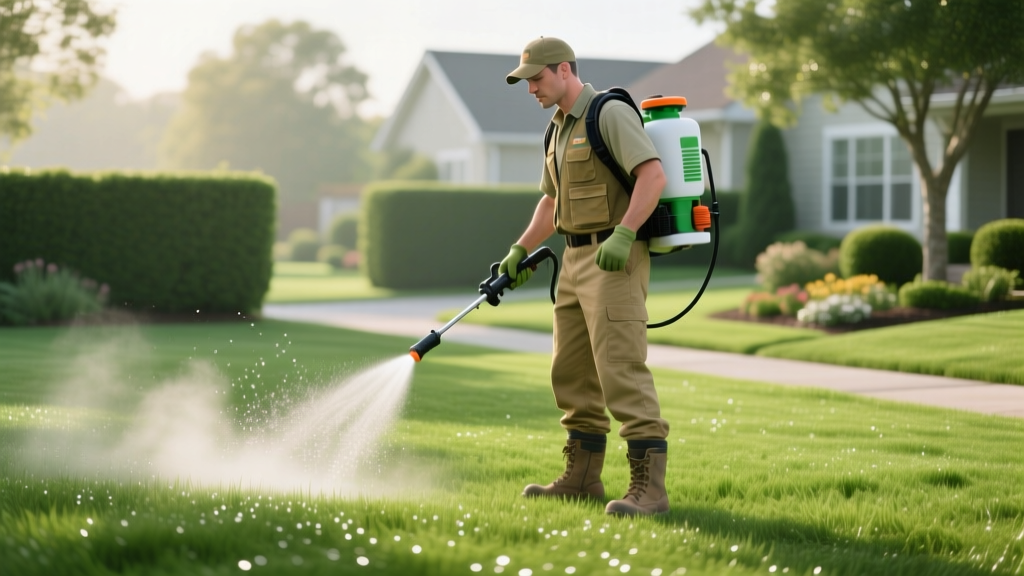
How to Apply Lawn Fungicide: Step-by-Step Disease Treatment
Identifying the Fungal Threat Before Treatment
Fungal pathogens like Rhizoctonia solani (Brown Patch) and Sclerotinia homoeocarpa (Dollar Spot) can destroy a turf canopy in under 48 hours when humidity exceeds 85% and nighttime temperatures remain above 65°F. Applying a lawn fungicide is not a reactive 'spray and pray' operation; it requires precise diagnosis, correct active ingredient selection, and strict environmental timing. Misidentifying a fungal disease as drought stress or nematode damage will result in wasted chemicals and irreversible turf loss.
Before mixing any chemicals, inspect the lawn at dawn. Look for cobweb-like mycelium on the grass blades, distinct circular lesions with dark borders, or 'frog-eye' patterns in the turf canopy. According to the NC State Extension Turffiles, accurate identification of the specific pathogen dictates whether you need a contact or systemic fungicide, as well as the required carrier volume for application.
Warning: Never apply a lawn fungicide to drought-stressed grass. Fungicides require active plant growth and adequate soil moisture to translocate effectively. Applying systemic chemicals to dormant or severely heat-stressed turf can cause phytotoxicity and worsen the decline.
Selecting the Right Chemistry: Systemic vs. Contact
The efficacy of your treatment hinges on matching the fungicide's mode of action to the disease's location. Contact fungicides remain on the leaf surface and protect against spore germination, while systemic fungicides are absorbed into the plant tissue to stop active infections from within.
| Active Ingredient | FRAC Code | Type | Target Diseases | Est. Cost (Pro Grade) |
|---|---|---|---|---|
| Azoxystrobin (Heritage SC) | 11 | Systemic | Brown Patch, Pythium, Fairy Ring | $140 - $160 / gallon |
| Propiconazole (Banner MAXX) | 3 | Systemic | Dollar Spot, Rust, Leaf Spot | $35 - $45 / pint |
| Chlorothalonil (Daconil) | M5 | Contact | Dollar Spot, Anthracnose | $60 - $80 / gallon |
| Thiophanate-methyl (Cleary's 3336) | 1 | Systemic | Spring Dead Spot, Snow Mold | $90 - $110 / jug |
Information Gain - The FRAC Rule: The Fungicide Resistance Action Committee (FRAC) assigns numbers based on the chemical's mode of action. Pathogens mutate rapidly; applying an FRAC 11 fungicide (like Azoxystrobin) twice in a row will breed resistant fungal strains. You must rotate FRAC codes every 14 to 21 days. Alternate an FRAC 11 with an FRAC 3 (like Propiconazole) to maintain long-term efficacy.
Equipment Calibration and Preparation
The most common reason lawn fungicide applications fail is poor calibration. Hose-end sprayers are entirely unsuitable for turf disease management because they cannot deliver the precise 2.0 gallons of carrier volume per 1,000 square feet required to penetrate the thatch layer.
Required Equipment Specifications
- Sprayer: 4-gallon backpack sprayer (e.g., Chapin 1949 or Solo 456).
- Nozzle: Flat fan nozzle, specifically a TeeJet 8002 or 110-02. Avoid cone nozzles, which cause uneven distribution.
- Pressure: Maintain a steady 40 PSI. Pump the sprayer consistently to avoid pressure drops that alter droplet size.
- Adjuvant: Non-Ionic Surfactant (NIS). Many systemic labels require a surfactant at 0.25% v/v (roughly 1 teaspoon per gallon) to break the surface tension of the water, allowing the chemical to coat the waxy grass blade and penetrate the cuticle.
The Step-by-Step Application Protocol
Follow this exact sequence to ensure maximum canopy coverage and root-zone penetration.
- Mow and Bag: Mow the lawn to its standard height, but use a bagger to collect the clippings. Fungal spores harbor in decaying organic matter; removing clippings physically reduces the pathogen inoculum load before you spray.
- Calculate the Mix: For a standard 4,000 sq. ft. treatment area using Propiconazole 14.3 (rate: 0.2 oz per 1,000 sq. ft.), you will need 0.8 oz of chemical mixed into 8 gallons of water (to achieve the 2 gal/1,000 sq. ft. carrier rate). Since most backpacks hold 4 gallons, split this into two full tanks.
- Mix the Solution: Fill the tank halfway with clean water. Add the required liquid or wettable powder fungicide. Agitate gently. Add the NIS surfactant last to prevent excessive foaming, then fill the tank to the 4-gallon line.
- Execute the Spray Pattern: Walk at a steady pace of roughly 3 miles per hour. Hold the wand 18 to 24 inches above the turf canopy. Overlap each pass by 50% to ensure no streaks are missed. Fungal pathogens exploit untreated micro-zones rapidly.
- Wash Down: Immediately upon finishing, rinse the tank, wand, and nozzle with clean water. Fungicide residue left in the sprayer can crystallize and clog the TeeJet nozzle or cross-contaminate future herbicide applications.
Pro Tip: Apply lawn fungicides in the early morning or late evening. UV degradation breaks down certain active ingredients (like Chlorothalonil) rapidly in direct midday sun, and high midday temperatures increase the risk of leaf burn when using emulsifiable concentrates.
Post-Application Watering and Maintenance
The 'watering in' phase dictates whether your treatment cures the disease or wastes your money. The University of Georgia Extension emphasizes that irrigation timing must match the fungicide type:
- Systemic Fungicides (Root/Crown Diseases): If treating Take-All Root Rot or Spring Dead Spot, you must irrigate immediately after application. Apply 0.1 to 0.2 inches of water to wash the chemical off the leaf blade and down into the thatch and root zone where the pathogen resides.
- Systemic Fungicides (Foliar Diseases): For Brown Patch or Dollar Spot, allow the spray to dry completely on the leaf (usually 2 to 4 hours) before irrigating. The plant will absorb the chemical through the stomata and cuticle during this drying window.
- Contact Fungicides: Do not water for at least 24 hours. Contact chemicals must remain on the exterior of the leaf to form a protective barrier against incoming spores.
Troubleshooting Common Failure Modes
If the disease continues to spread 7 to 10 days after application, review this troubleshooting matrix to identify the operational failure.
| Symptom | Probable Cause | Corrective Action |
|---|---|---|
| Brown spots expanding rapidly post-spray | Wrong FRAC code / Pathogen resistance | Switch to a different FRAC group immediately (e.g., from FRAC 11 to FRAC 3). |
| Chemical washed away; poor efficacy | Irrigated too soon or heavy rain occurred | Reapply contact fungicide; ensure 24-hour dry window. Check weather radar. |
| Turf blade tips show yellowing/burn | Phytotoxicity from surfactant or heat | Reduce NIS surfactant rate; avoid spraying when ambient temp exceeds 85°F. |
| Disease only cured in center of yard | Poor sprayer overlap / pressure drops | Calibrate nozzle; maintain 50% overlap and steady 40 PSI walking speed. |
'Fungicides are a scalpel, not a hammer. They will not cure a lawn that is suffering from severe soil compaction, improper mowing heights, or chronic overwatering. Cultural practices must be corrected simultaneously, or the pathogen will simply return the moment the chemical residual expires.'
By adhering to precise calibration metrics, respecting FRAC rotation schedules, and matching your post-application watering to the specific mode of action, you can effectively halt turf diseases and preserve the structural integrity of your lawn's canopy.

