
Pest Control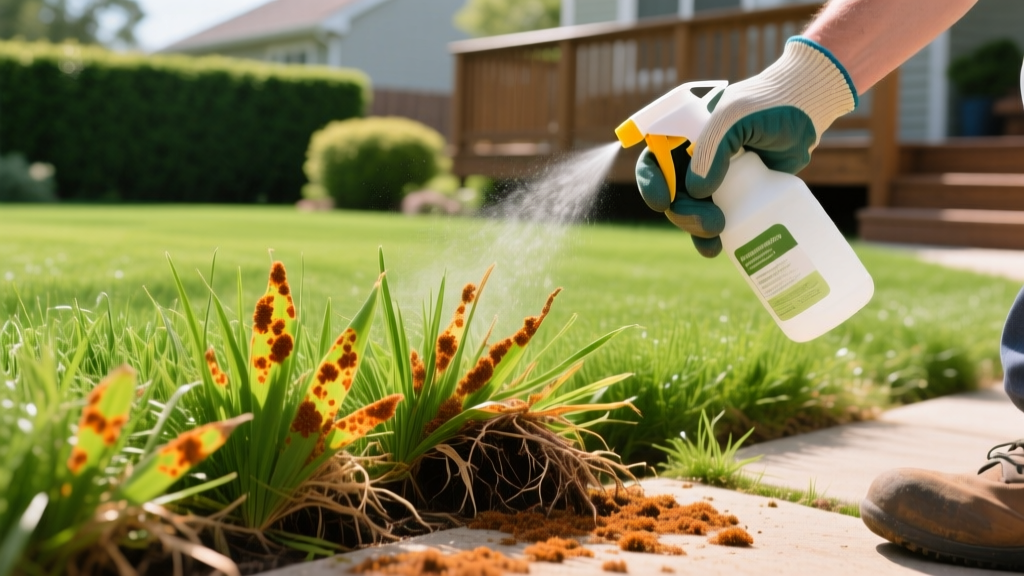
Step-by-Step Lawn Rust Treatment: Identify, Treat, and Prevent
Lawn rust, caused by various Puccinia fungal species, is a foliar disease that severely compromises turfgrass photosynthesis. While rarely fatal on its own, it weakens the grass canopy, leaving your lawn highly vulnerable to secondary stressors like drought, winter kill, and more aggressive pathogens like brown patch. Effective lawn rust treatment requires a sequenced approach: accurate diagnosis, immediate cultural correction, targeted nutritional pushes, and precise chemical intervention when necessary.
Step 1: Confirm the Diagnosis with the Paper Test
Before applying any lawn rust treatment, you must differentiate Puccinia from visually similar diseases like red thread (Laetisaria fuciformis) or dollar spot. Rust initially presents as yellow flecks on the leaf blades, which mature into raised, orange-red or yellowish pustules that rupture to release spores.
The White Paper Diagnostic Test:
- Pluck 3 to 5 grass blades exhibiting the yellow-orange discoloration.
- Fold a piece of clean white printer paper in half.
- Rub the grass blades firmly between the folds of the paper.
- If the paper is stained with a distinct, powdery orange or rust-colored streak, you have confirmed a rust infection. Red thread will leave no powdery residue, and dollar spot lesions are typically bleached white with a distinct brown border.
According to turfgrass pathology research from Penn State Extension, rust spores are easily dispersed by wind, mowing equipment, and even the shoes of homeowners, making early identification critical to containing the outbreak.
Step 2: Alter Mowing and Irrigation to Starve the Fungus
Rust fungi require extended periods of leaf wetness (typically 8 to 12 hours) and moderate temperatures (68°F to 85°F) to germinate and infect leaf tissue. Your first cultural defense is to disrupt this microclimate.
Mowing Protocols During an Outbreak
- Bag the Clippings: Normally, mulching clippings is recommended for nutrient recycling. During an active rust outbreak, you must bag and dispose of clippings to physically remove millions of spores from the turf canopy.
- Mow Frequently: Never remove more than 1/3 of the grass blade in a single pass. Removing the upper 1/3 of the blade physically removes the sporulating pustules before they can release spores.
- Sanitize Equipment: Wash your mower deck with a 10% bleach solution or a commercial quaternary ammonium disinfectant after mowing an infected zone to prevent cross-contamination to healthy turf.
Irrigation Adjustments
Shift your irrigation schedule to the pre-dawn hours (between 4:00 AM and 6:00 AM). This ensures the grass blades dry rapidly once the sun rises, depriving the fungus of the mandatory leaf-wetness window. Avoid light, frequent watering, which keeps the canopy perpetually damp.
Step 3: The Nitrogen Flush (Cultural Treatment)
Rust is fundamentally a disease of slow-growing, nitrogen-starved turf. The most effective non-chemical lawn rust treatment is to stimulate rapid leaf growth, allowing the grass to simply "outgrow" the infection. The University of Minnesota Turfgrass Science program emphasizes that correcting nitrogen deficiencies often resolves mild to moderate rust outbreaks without fungicides.
Actionable Nitrogen Math:
Apply 0.5 to 1.0 lbs of actual Nitrogen (N) per 1,000 sq ft. Use a fast-release nitrogen source like Urea (46-0-0) or Ammonium Sulfate (21-0-0) for an immediate flush of growth.
Calculation Example: If you are using a standard 24-0-6 lawn fertilizer (24% Nitrogen), divide your target (1.0 lb) by the percentage (0.24).
1.0 / 0.24 = 4.16 lbs of product per 1,000 sq ft. Set your broadcast spreader accordingly.
Apply 0.5 to 1.0 lbs of actual Nitrogen (N) per 1,000 sq ft. Use a fast-release nitrogen source like Urea (46-0-0) or Ammonium Sulfate (21-0-0) for an immediate flush of growth.
Calculation Example: If you are using a standard 24-0-6 lawn fertilizer (24% Nitrogen), divide your target (1.0 lb) by the percentage (0.24).
1.0 / 0.24 = 4.16 lbs of product per 1,000 sq ft. Set your broadcast spreader accordingly.
Water the fertilizer in immediately with 1/4 inch of irrigation to move the nutrients into the root zone and prevent foliar burn.
Step 4: Chemical Lawn Rust Treatment Protocols
If cultural practices and the nitrogen flush do not halt the disease progression within 10 to 14 days, or if the infection is severely defoliating the turf, chemical intervention is required. Selecting the correct active ingredient and rotating Fungicide Resistance Action Committee (FRAC) groups is mandatory to prevent the fungus from developing chemical resistance.
| Active Ingredient | FRAC Group | Trade Name Example | Rate (per 1,000 sq ft) | Efficacy Profile |
|---|---|---|---|---|
| Propiconazole | Group 3 (DMI) | Banner MAXX | 1.5 - 2.0 fl oz | Strong curative & preventative |
| Azoxystrobin | Group 11 (QoI) | Heritage SC | 0.2 - 0.4 fl oz | Preventative (early curative) |
| Myclobutanil | Group 3 (DMI) | Immunox | 2.0 fl oz | Curative & preventative |
| Fluoxastrobin | Group 11 (QoI) | Disarm SC | 0.18 - 0.36 fl oz | Preventative focus |
Critical Resistance Warning: Never apply two consecutive treatments using the same FRAC group. If your first application is Propiconazole (Group 3), your follow-up application 14 to 21 days later must be a Group 11 fungicide like Azoxystrobin. Repeated use of Group 11 (Strobilurins) alone has led to widespread fungal resistance in North American turfgrasses.
Step 5: Long-Term Prevention via NTEP-Rated Cultivars
If your lawn suffers from chronic, recurring rust outbreaks every late summer, your underlying turfgrass genetics may be highly susceptible. Perennial ryegrass and certain Kentucky bluegrass cultivars are notoriously prone to Puccinia infections.
The ultimate long-term lawn rust treatment is genetic resistance. When overseeding or renovating, consult the National Turfgrass Evaluation Program (NTEP) database for your specific region. Look for cultivars that score in the top 10% for rust resistance. For Kentucky bluegrass, cultivars like 'Award', 'Blue Note', and 'Everest' consistently demonstrate superior genetic resistance to rust compared to older, generic seed mixes.
Annual Maintenance Matrix for Rust Prevention
- Spring: Apply pre-emergent and the first round of slow-release nitrogen to establish a dense canopy before summer stress.
- Early Summer: Raise mowing height to 3.0 - 3.5 inches. Taller grass shades the soil, reducing the ambient humidity at the turf base where spores germinate.
- Late Summer (Peak Rust Season): Monitor for yellow flecks. Apply the 0.5 lb N/1000 sq ft flush immediately if growth slows and pustules appear.
- Fall: Core aerate to relieve soil compaction and improve drainage, followed by overseeding with NTEP-rated resistant cultivars.
By combining precise nutritional math, strict irrigation timing, and strategic FRAC-group fungicide rotation, you can systematically eradicate lawn rust and restore a dense, photosynthetically active turf canopy.

