
Pest Control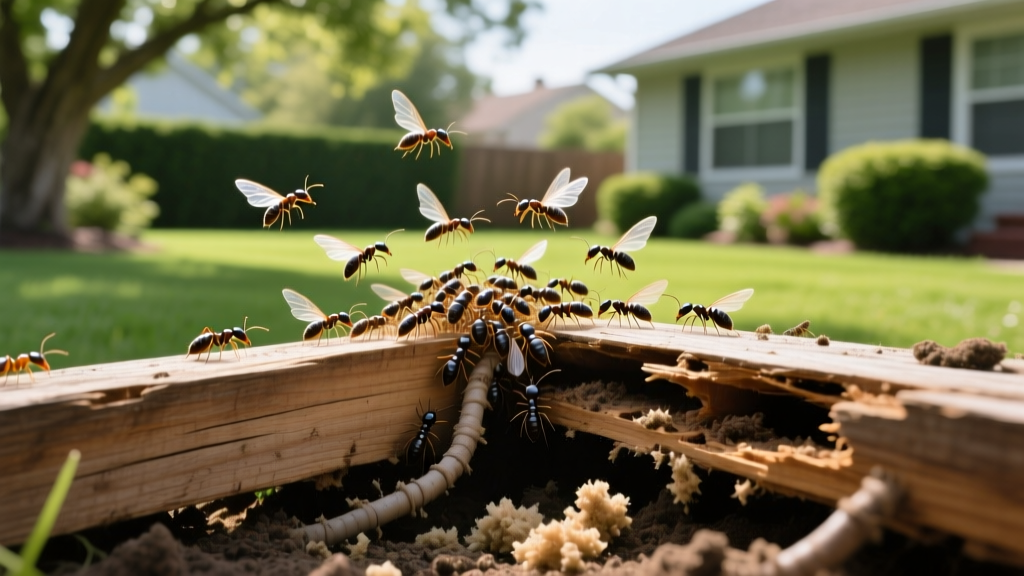
How to Identify and Stop an Adult Termite Swarm in Your Yard
The Anatomy of an Adult Termite Swarm
When homeowners spot an 'adult termite' in their yard, they are almost always looking at a reproductive alate, commonly known as a swarmer. While the subterranean termite colony consists of pale, wingless workers and large-headed soldiers that remain hidden underground or inside wood, the adult reproductives are the only caste that ventures into the open. Their sole biological imperative is to leave the parent colony, mate, and establish a new nest—often in the soil directly adjacent to your home's foundation.
⚠️ Critical Yard Defense Alert: Seeing a single adult termite swarmer is rarely an isolated event. A mature subterranean termite colony (typically 3 to 5 years old) can release thousands of alates in a single afternoon. If you see them in your yard, a mature colony is already foraging within a 100-foot radius of your property.
Understanding the behavior of the adult termite is the first step in effective yard defense. Swarmers are highly attracted to light and moisture. They typically emerge on warm, humid afternoons following a heavy spring rain. Once they land, they shed their wings and begin searching for a mate and a suitable damp soil cavity to start a new colony. Your yard's mulch beds, irrigated lawn edges, and woodpiles provide the perfect incubation environment.
Adult Termite vs. Flying Ant: The Backyard Identification Matrix
Misidentifying a swarmer as a flying carpenter ant leads to incorrect treatment protocols and wasted chemical applications. Carpenter ants and adult termites share similar size and coloration, but their morphological differences dictate entirely different pest management strategies. Use this matrix to confirm your target pest before deploying yard defenses.
| Feature | Adult Termite (Alate) | Flying Carpenter Ant |
|---|---|---|
| Wings | Four wings of equal length, milky/translucent, extending far past the abdomen. | Two pairs of unequal length (front wings longer), clear with visible dark veins. |
| Waist | Broad, uniform waist (thorax and abdomen are nearly the same width). | Pinched, narrow waist (distinct hourglass shape between thorax and abdomen). |
| Antennae | Straight, bead-like (moniliform) antennae. | Elbowed (geniculate) antennae with a distinct bend. |
| Shed Wings | Frequently found piled on patios, windowsills, and yard soil. | Rarely shed in piles; ants keep their wings until death. |
Why Your Yard is a Prime Target for Alates
According to the University of Kentucky Entomology Department, subterranean termites require constant contact with soil moisture to survive. Your yard inadvertently creates a microclimate that supports this. Over-irrigated lawn zones, dense wood mulch applied directly against the foundation, and stacked firewood create 'highways' that allow adult termites and their worker offspring to bypass the natural desiccation barrier of the surface soil.
Strategic Yard Defense: Stopping the Next Colony
Defending your yard against adult termites requires a multi-tiered approach that targets both the incoming swarmers and the subterranean foragers supporting them. Surface spraying is entirely ineffective against the hidden colony. Instead, deploy these proven, structural yard defense protocols.
Step 1: Perimeter Trenching and Soil Treatment
The gold standard for yard defense is creating a continuous, non-repellent chemical barrier in the soil. Non-repellent termiticides, such as those containing Fipronil (e.g., Termidor SC), do not kill on immediate contact. Instead, foraging workers pick up the active ingredient and transfer it to the rest of the colony through trophallaxis (grooming and food sharing).
- Trench Dimensions: Dig a trench 6 inches wide and 6 inches deep directly against the foundation footer.
- Mixing Ratio: Mix 0.8 fluid ounces of Termidor SC per gallon of water.
- Application Rate: Apply 4 gallons of the finished solution per 10 linear feet of trench.
- Backfilling: Push the treated soil back into the trench to seal the barrier.
Step 2: Strategic Bait Station Deployment
For yards with extensive hardscaping, patios, or environmental concerns regarding liquid soil treatments, in-ground bait stations offer a highly effective alternative. Systems like the Trelona Advance Termite Bait System (ATBS) utilize Novaluron, an insect growth regulator (IGR) that prevents termites from molting.
- Spacing: Install stations every 10 to 20 feet around the perimeter of the yard and home.
- Placement: Position stations in areas with high soil moisture and cellulose presence (near mulch beds, downspout outputs, and retaining walls).
- Monitoring: Inspect the wooden monitoring bases every 60 days. Once foraging activity is confirmed, replace the wood with the Novaluron bait cartridge.
Step 3: Moisture and Cellulose Management
Chemical barriers fail if physical bridges allow termites to bypass them. Alter your yard's physical profile to make it hostile to adult termite colonization.
- The 12-Inch Rule: Maintain a strict 12-inch gap between the foundation and any wood mulch, soil, or dense vegetation.
- Grade Correction: Ensure the soil grades away from the foundation at a minimum drop of 6 inches over the first 10 feet to prevent pooling.
- Stump Removal: Grind out dead tree stumps and remove the root ball. A decaying stump is a primary incubation site for new colonies started by adult swarmers.
Cost Breakdown: DIY Yard Defense vs. Professional Intervention
Deciding between DIY application and hiring a licensed pest control operator depends on your yard's complexity, the linear footage of your foundation, and your comfort handling restricted-use chemicals. Note that some high-grade termiticides (like professional-strength Fipronil) require a commercial applicator license in many states.
| Defense Strategy | Estimated Cost (Avg. 200ft Perimeter) | Time Investment | Efficacy & Longevity |
|---|---|---|---|
| DIY Liquid Trenching | $350 - $550 (Materials & Tools) | 12 - 18 Hours | High (if trench is continuous); lasts 5-10 years. |
| DIY Bait Stations | $400 - $700 (Initial Kit + Baits) | 4 Hours Setup + 1 Hr/Bimonthly | Moderate-High; requires strict adherence to monitoring schedule. |
| Professional Treatment | $1,200 - $2,500 | 1 Day (Technician Managed) | Highest; includes warranty, specialized drilling for hardscapes. |
Expert Insights: The 'Spray the Swarm' Fallacy
Common Homeowner Mistake
The most frequent error in yard termite defense is grabbing a can of over-the-counter pyrethroid aerosol (like Raid or Ortho Home Defense) and spraying the adult swarmers as they emerge from the soil. This is a critical mistake. While you will kill the visible adult termites, you are doing absolutely zero damage to the subterranean colony that produced them. Furthermore, the repellent nature of pyrethroids can cause the hidden workers to shift their foraging tunnels closer to your home's foundation to avoid the treated surface soil, inadvertently increasing the risk of structural infestation. The Environmental Protection Agency (EPA) strongly advises against surface spraying for subterranean termite control, recommending targeted soil and bait interventions instead.
Frequently Asked Questions
Do adult termite swarmers eat wood?
No. The adult reproductive alates do not have the gut protozoa required to digest cellulose. Their only function is to mate and establish a new colony. The damage to your yard structures and home is caused entirely by the blind, wingless worker caste.
How long do adult termite swarmers live after they fly?
In the open yard, most swarmers die within a few hours due to desiccation (drying out) or predation by birds and insects. However, if a pair successfully finds a damp soil cavity or a wood-to-soil contact point, they can live for decades, becoming the king and queen of a massive new colony.
Can I use nematodes in my yard to control termites?
While beneficial nematodes (like Steinernema carpocapsae) are excellent for controlling grub and flea populations in the lawn, they are highly ineffective against subterranean termites. Termites possess robust immune responses and grooming behaviors that neutralize nematode attacks, making this biological control method a waste of resources for termite defense.

