
Pest Control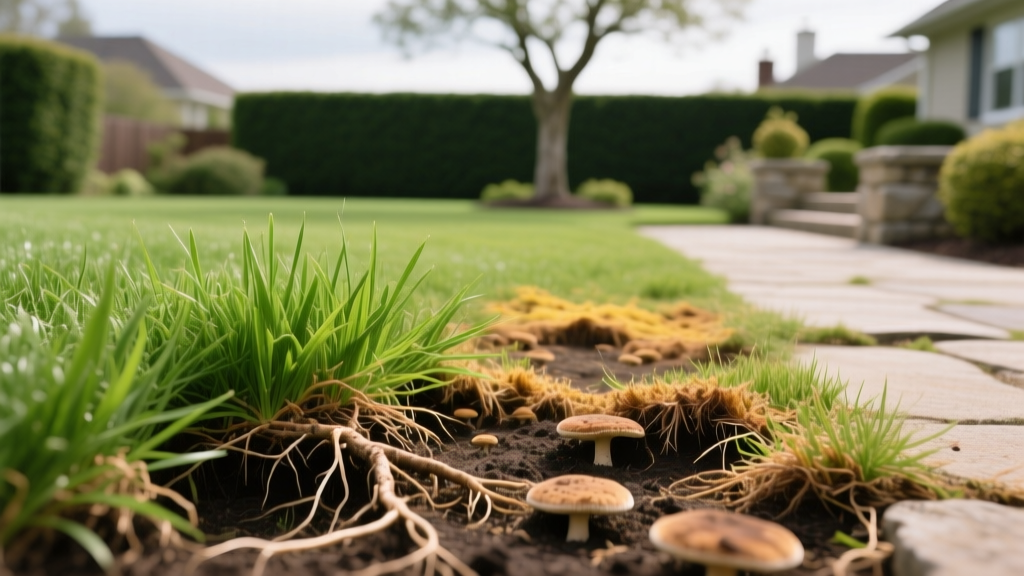
Take All Root Rot Fungicide Guide: Diagnosis and Solutions
Identifying Take-All Root Rot (TARR) vs. Other Lawn Diseases
Take-All Root Rot (TARR) is a devastating soil-borne disease caused by the ectotrophic root-infecting fungus Gaeumannomyces graminis var. graminis (Ggg). Primarily targeting St. Augustine and Centipede grasses in the Southern United States, TARR is frequently misdiagnosed as Brown Patch, chinch bug damage, or nematode infestation. Applying the wrong treatment wastes money and allows the pathogen to destroy the root system further.
Diagnostic Decision Tree
- TARR: Roots are distinctly black, short, and rotted. Stolons pull up from the soil with zero resistance. Yellowing (chlorosis) of the leaf blades precedes browning, and the turf thins out in irregular patches.
- Brown Patch (Rhizoctonia solani): Roots remain white, firm, and healthy. The damage is confined to the leaf blades, which display distinct tan lesions with dark brown borders. The turf typically forms circular rings.
- Nematode Damage: Roots appear swollen, galled, or severely stunted, but they lack the distinct black, mushy decay characteristic of TARR.
- Chinch Bugs: Damage occurs primarily in hot, dry, sunny areas near concrete edges. Insects are visible in the thatch layer, and roots remain completely healthy.
Pathogen Profile: Ggg survives in the soil as sclerotia and mycelium on infected root debris. It attacks the roots and stolons, blocking the plant's vascular system and preventing water and nutrient uptake. According to the University of Florida IFAS Extension, the fungus is most active when soil temperatures range between 70°F and 85°F, making fall and spring the highest-risk seasons.
The Science of TARR: Why Fungicides Alone Fail
Many homeowners apply a broad-spectrum fungicide and expect a full recovery, only to see the disease return the following season. TARR is heavily influenced by soil chemistry and cultural practices. The pathogen thrives in alkaline soils (pH above 7.0) and thick thatch layers. If your soil pH is high, the fungus produces ectotrophic hyphae that aggressively penetrate the root cortex. A successful take all root rot fungicide strategy must be paired with soil acidification and thatch management to suppress the Ggg pathogen long-term.
Top Take All Root Rot Fungicide Active Ingredients
Not all fungicides are effective against Ggg. Contact fungicides like chlorothalonil are useless against root-infecting pathogens. You must use systemic fungicides that are absorbed by the plant or penetrate the root zone. To prevent fungicide resistance, rotate between different Fungicide Resistance Action Committee (FRAC) groups.
| Active Ingredient | FRAC Group | Mode of Action | Product Examples | Est. Cost (per 5k sq ft) | Best Use Case |
|---|---|---|---|---|---|
| Azoxystrobin | Group 11 (QoI) | Inhibits cellular respiration | Syngenta Heritage G, Scotts DiseaseEX | $14 - $28 | Preventative & Early Curative |
| Propiconazole | Group 3 (DMI) | Inhibits sterol biosynthesis | Bonide Infuse, Bayer BioAdvanced | $12 - $18 | Curative & Rotation |
| Thiophanate-methyl | Group 1 (MBC) | Disrupts cell division | Cleary's 3336 | $15 - $22 | Systemic Rotation |
Note: Heritage G (0.31% Azoxystrobin) is the industry gold standard for TARR prevention. For residential users, Scotts DiseaseEX contains the exact same active ingredient at the same concentration but is packaged in smaller, consumer-friendly bags.
Step-by-Step Treatment Protocol (The "Peat & Prevent" Method)
The Texas A&M AgriLife Extension recommends a multi-pronged approach to suppress TARR. Follow this exact protocol for optimal results.
Step 1: Soil pH Correction and Peat Moss Topdressing
Lowering the soil pH to 5.5–6.0 creates an environment where Ggg struggles to produce infectious hyphae. Apply a 1/4-inch layer of sphagnum peat moss over the affected areas. One standard 3.8 cubic foot bale covers approximately 1,000 square feet at this depth. Water the peat moss immediately after application to settle it into the thatch and stolon zone.
Step 2: Targeted Fungicide Application
Apply Azoxystrobin (Heritage G or Scotts DiseaseEX) at the preventative rate (typically 2 to 4 lbs per 1,000 sq ft, check label) when soil temperatures drop to 80°F in the early fall, and again when they rise to 70°F in the spring. If the disease is already severe, apply at the curative rate (4 lbs per 1,000 sq ft) and switch to Propiconazole for the next application 28 days later to rotate FRAC groups.
Step 3: Nitrogen and Irrigation Audit
Excessive nitrogen promotes lush, weak top growth that cannot be supported by a compromised root system. Switch to a slow-release, low-nitrogen fertilizer (e.g., 8-2-12 or 15-0-15) with high potassium to boost plant stress tolerance. Adjust irrigation to deliver 0.5 to 0.75 inches of water per zone, deeply but infrequently, allowing the topsoil to dry between cycles.
Step 4: Equipment Sanitation
Ggg spreads easily via sclerotia clinging to mower blades and wheels. After mowing an infected lawn, spray the mower deck and blades with a 10% bleach solution or a quaternary ammonium disinfectant before moving to a healthy zone.
Warning: Never apply agricultural lime to a lawn suffering from Take-All Root Rot. Liming raises soil pH, which directly stimulates the Ggg pathogen and will accelerate turf decline. Only apply lime if a certified soil test explicitly indicates a calcium deficiency and a pH below 5.0.
Frequently Asked Questions
Can Take-All Root Rot be completely cured?
TARR cannot be entirely eradicated from the soil once established. The goal of a take all root rot fungicide program is suppression, not eradication. By maintaining acidic soil conditions, managing thatch, and applying preventative fungicides during peak infection windows, you can keep the pathogen dormant and maintain a healthy-looking lawn.
How long does it take for St. Augustine grass to recover?
Because TARR destroys the root system, recovery relies on the growth of new, healthy roots and stolons. With proper peat moss topdressing and fungicide applications, you will typically see new green stolon growth within 4 to 6 weeks during the active growing season (late spring to early summer). Severely damaged areas may require resodding.
Is Scotts DiseaseEX as effective as professional Heritage G?
Yes. Both products contain exactly 0.31% Azoxystrobin. The only difference is the carrier granule size and the bag size. Scotts DiseaseEX uses a smaller, lighter granule optimized for consumer drop spreaders, while Heritage G uses a heavier, professional-grade granule. For residential lawns under 10,000 square feet, DiseaseEX provides identical chemical efficacy at a more accessible price point.

