
Pest Control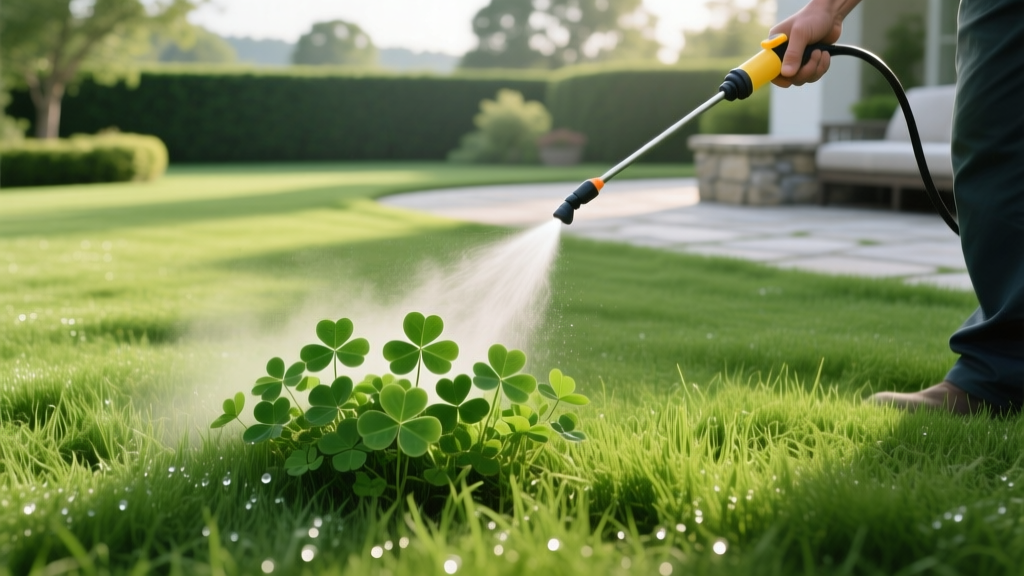
Best Clover Herbicide Options for Targeted Spot Treatment
White clover (Trifolium repens) is a persistent perennial broadleaf weed that thrives in nutrient-poor, compacted soils. While broadcast spraying an entire lawn is a common approach, targeted spot treatment using a specialized clover herbicide is vastly superior for preserving soil biology, reducing chemical runoff, and saving money. By isolating the treatment to active clover patches, you protect beneficial insects and maintain the health of your surrounding turfgrass.
Understanding Clover Biology and Stolon Growth
To effectively eradicate clover, you must understand its reproductive strategy. Clover spreads primarily through stolons—horizontal above-ground stems that root at the nodes every few inches. When you attempt to pull clover by hand, the stolons snap, leaving the deep taproot and secondary nodes intact to regenerate within weeks. A systemic clover herbicide bypasses this issue by translocating active ingredients down through the stolon network and into the taproot, ensuring complete necrosis of the plant.
The Creeping Threat: A single mature white clover plant can spread its stolons up to 12 inches in a single growing season. Spot treatment must target not just the visible center of the patch, but the outer 3-inch perimeter where microscopic stolon tips are actively rooting into the soil.
Top Active Ingredients for Clover Herbicide Spot Treatment
Not all broadleaf weed killers are formulated equally for clover. Clover's trifoliate leaves feature a waxy cuticle that repels water-based solutions, making the selection of the right active ingredient and adjuvant critical. As of 2026, multi-active ingredient formulations yield the highest kill rates because they attack the plant's cellular structure through multiple metabolic pathways.
| Active Ingredient Blend | Top Commercial Product | Grass Safety Profile | Avg. Cost (per oz) |
|---|---|---|---|
| 2,4-D + Dicamba + MCPP-p | Trimec Classic | Cool & Warm Season | $0.35 |
| Carfentrazone + 2,4-D + MCPP + Dicamba | SpeedZone Southern | Warm Season (Bermuda/Zoysia) | $0.85 |
| Triclopyr + 2,4-D | Cool Trimec | Cool Season (Fescue/Bluegrass) | $0.45 |
For homeowners with cool-season lawns (Kentucky Bluegrass, Tall Fescue), Cool Trimec offers an excellent balance of efficacy and safety. The addition of Triclopyr specifically targets tough, waxy broadleaves like clover and ground ivy. For warm-season lawns, SpeedZone Southern provides a rapid 'burn-down' effect via Carfentrazone, showing visible wilting in as little as 4 hours.
The Hard Water Problem: Why Your Herbicide Might Fail
A frequently overlooked failure mode in spot treatment is water chemistry. If you live in an area with hard water (high calcium and magnesium levels), these positively charged ions will bind to the negatively charged 2,4-D and Dicamba molecules in your clover herbicide. This process, known as 'tie-up,' neutralizes the herbicide before it ever reaches the leaf tissue.
Pro-Tip: The AMS Fix
Always add Ammonium Sulfate (AMS) to your spray tank before adding the herbicide. Use a rate of 2 tablespoons of AMS per gallon of water. The ammonium ions will bind to the hard water minerals, leaving your herbicide molecules free to penetrate the clover leaves.
Always add Ammonium Sulfate (AMS) to your spray tank before adding the herbicide. Use a rate of 2 tablespoons of AMS per gallon of water. The ammonium ions will bind to the hard water minerals, leaving your herbicide molecules free to penetrate the clover leaves.
Step-by-Step Spot Application Protocol
Precision is paramount. Over-applying clover herbicide will not kill the weed faster; it will only increase the risk of phytotoxicity (chemical burn) to your surrounding turfgrass.
- Calibrate Your Sprayer: Use a dedicated 1-gallon or 2-gallon pump sprayer. Never use a sprayer that has previously held glyphosate or soil sterilants.
- Mix in the Correct Order: Fill the tank halfway with water. Add 2 tablespoons of AMS per gallon. Agitate. Add 1.5 fluid ounces of your chosen clover herbicide concentrate. Finally, add 0.5 teaspoons of a Non-Ionic Surfactant (NIS) like Dyne-Amic to break the clover's waxy cuticle.
- Check the Weather: Apply only when ambient temperatures are between 65°F and 85°F. Applications above 85°F risk vapor drift, which can severely damage nearby ornamental shrubs and garden beds.
- Targeted Application: Adjust your sprayer nozzle to a fine pin-stream or low-pressure fan. Spray the clover patch until the leaves are uniformly wet, but stop before the liquid begins to drip onto the soil. Soil contact is wasted chemical.
- Perimeter Sweep: Extend your spray pattern 3 inches beyond the visible edge of the clover patch to catch hidden stolon runners.
Troubleshooting Common Clover Herbicide Failures
Even with the right products, environmental variables can disrupt the translocation process. Use this diagnostic guide if your spot treatment yields subpar results.
Symptom: Leaves curl and yellow, but the plant recovers in 3 weeks.
Cause: The herbicide successfully burned the foliage but failed to reach the taproot. This usually happens when clover is sprayed during a summer drought. When clover is drought-stressed, it shuts down its vascular system to conserve water, halting the downward translocation of the herbicide.
Fix: Wait for a significant rainfall or irrigate the lawn deeply for three consecutive days to stimulate active growth, then reapply the spot treatment.
Symptom: Clover dies completely, but a ring of brown grass surrounds the patch.
Cause: Herbicide overlap or excessive application rate. Cool-season grasses like Fescue are sensitive to high doses of 2,4-D and Dicamba, especially when temperatures exceed 80°F.
Fix: Reduce your application rate by 20% on the next pass and ensure you are not spraying past the point of leaf runoff.
Symptom: No visible reaction after 7 days.
Cause: Hard water tie-up or missing the surfactant. Without a non-ionic surfactant, the water-based spray will bead up and roll off the hydrophobic clover leaves.
Fix: Re-mix your solution ensuring the inclusion of both AMS and a high-quality NIS.
Post-Treatment Lawn Recovery and Overseeding
Once the clover herbicide has done its job, you are left with bare patches in your turf. Clover often indicates underlying soil deficiencies, specifically low nitrogen. Because clover is a legume, it fixes its own nitrogen from the atmosphere, allowing it to outcompete nitrogen-starved grass.
Wait at least 14 days after your clover herbicide application before mowing the lawn, and wait a full 21 to 28 days before attempting to overseed the bare patches. Most systemic broadleaf herbicides possess a slight soil residual that can inhibit the germination of new grass seed. Once the waiting period has passed, core aerate the compacted bare spots, apply a high-quality starter fertilizer, and overseed with a turfgrass blend suited to your climate. Addressing the low-nitrogen environment is the ultimate long-term defense against clover re-establishment.
Frequently Asked Questions
Is vinegar an effective clover herbicide for spot treatment?
Horticultural vinegar (20% to 30% acetic acid) acts as a contact desiccant. It will burn the tops off clover leaves within hours, but it lacks systemic properties. The taproot and stolons will remain entirely unaffected, and the clover will regrow within 10 days. Furthermore, high-concentration vinegar is highly corrosive, dangerous to handle, and will drastically lower your soil pH, potentially harming surrounding turfgrass.
How long after applying clover herbicide can I let my pets on the lawn?
According to EPA guidelines on herbicide safety, you should keep pets and children off the treated area until the liquid spray has completely dried into the leaf tissue. Under typical conditions (70°F and low humidity), this takes 2 to 4 hours. Once dry, the chemical is locked inside the plant vascular system and poses minimal transfer risk.
Can I mix clover herbicide with liquid lawn fertilizer?
It is generally not recommended to mix systemic clover herbicides with high-nitrogen liquid fertilizers in the same tank. The rapid growth stimulated by the nitrogen can cause the grass to outpace the herbicide's translocation rate, and the salt content in many liquid fertilizers can interfere with the herbicide's chemical stability. Apply your clover herbicide first, wait 7 days, and then apply your liquid fertilizer.
For more localized advice on turfgrass management and weed identification, consult resources from institutions like the University of Minnesota Extension or the NC State Turfgrass Program.

