
Pest Control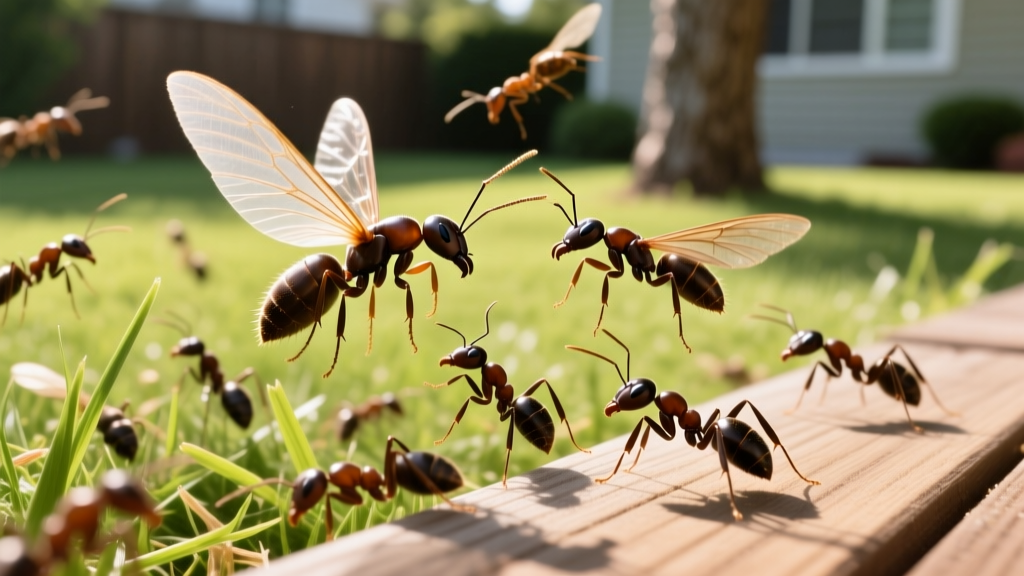
Termite Flies vs Flying Ants: Identify and Stop Yard Swarms
The "Termite Fly" Misconception: What You Are Actually Seeing
If you have spotted swarms of winged insects emerging from your lawn or mulch beds, you are likely searching for information on "termite flies." Entomologically speaking, there is no such insect as a termite fly. What you are witnessing are termite alates, commonly known as swarmers or reproductive termites. These are the mature, winged members of a subterranean or drywood termite colony whose sole biological purpose is to leave the nest, mate during a nuptial flight, and establish new colonies.
When homeowners see these insects, the immediate panic is understandable. A swarm indicates that a mature, hidden colony—likely containing hundreds of thousands of wood-destroying workers—is already established in or near your yard. According to the Environmental Protection Agency (EPA), termites cause billions of dollars in structural damage annually, making early identification and yard defense critical before they migrate from your soil to your home's sill plate.
Termite Swarmers vs. Flying Ants: The Identification Matrix
The most common mistake in yard pest defense is confusing termite swarmers with flying carpenter ants. Both swarm in the spring, both are attracted to light, and both shed their wings. However, their biology and the threat they pose to your property are vastly different. Carpenter ants excavate damp wood to build nests but do not consume it, whereas subterranean termites consume the cellulose in your structural lumber.
| Anatomical Feature | Termite Swarmer (Alate) | Flying Carpenter Ant |
|---|---|---|
| Waist | Broad, uniform thickness (no distinct waist) | Pinched, narrow hourglass waist |
| Antennae | Straight, beaded, or slightly curved | Distinctly elbowed (bent at a 90-degree angle) |
| Wings | Four wings of equal length, milky/translucent | Front wings longer than hind wings, dark/tinted |
| Shed Wings | Found in massive, uniform piles near light sources | Scattered individually, often mixed with frass |
Why Your Yard is Triggering a Nuptial Flight
Termite swarms are highly synchronized environmental events. Subterranean termites typically swarm on warm, humid mornings immediately following a significant rainfall. The moisture softens the soil, allowing the nymphs to push through the earth, while the humidity prevents the alates from desiccating during their flight.
If the swarm is originating directly from your mulch beds, lawn edges, or near a wooden fence post, you have an active exterior satellite colony. The National Pest Management Association (NPMA) notes that exterior swarms are a massive red flag; the workers foraging in your yard are likely also exploring the foundation of your home for micro-cracks to exploit.
⚠️ Critical Yard Inspection Tip: Do not simply spray the swarmers with over-the-counter aerosol bug spray. Killing the visible swarmers does nothing to the 300,000+ workers hidden underground. Worse, repellant sprays can cause the hidden colony to "bud" and split into multiple sub-colonies, multiplying your infestation. Your goal is to eliminate the colony, not just the fliers.
Step-by-Step Yard Defense: Trenching and Chemical Barriers
To defend your yard and home perimeter against subterranean termites, you must create a continuous, non-repellent chemical barrier in the soil. Non-repellent termiticides, like Fipronil, are undetectable to termites. They tunnel through the treated soil, pick up the active ingredient, and transfer it to the rest of the colony via trophallaxis (food sharing), eventually collapsing the entire population.
1. Product Selection and Dilution
The industry standard for DIY and professional soil treatment is Termidor SC (9.1% Fipronil) or Dominion 2L (21.4% Imidacloprid). As of 2026, a 20 oz bottle of Termidor SC costs approximately $85 to $95 and treats roughly 60 linear feet of trenching.
- Dilution Rate: Mix 0.8 fluid ounces of Termidor SC per 1 gallon of water.
- Application Volume: You must apply 4 gallons of the finished solution for every 10 linear feet of trench.
2. Trenching the Perimeter
- Dig the Trench: Using a trenching shovel, dig a continuous trench 6 inches wide and 6 inches deep directly against the foundation wall of your home, as well as around any wooden fence posts or detached structures in the yard.
- Clear Debris: Remove all loose soil, mulch, and rocks from the trench bottom to ensure the chemical binds directly to the native earth.
- Apply the Solution: Using a 1-gallon or 2-gallon pump sprayer, evenly drench the trench walls and bottom. (Remember: 4 gallons per 10 linear feet).
- Backfill: Shovel the excavated soil back into the trench, mixing it lightly with any remaining surface solution to ensure the backfill is also treated.
🛑 Environmental Safety Warning: Fipronil is highly toxic to bees and aquatic life. Never apply Termidor SC to blooming weeds, directly into water features, or on impervious surfaces like driveways where runoff can occur. Apply only to bare soil and allow it to dry completely before allowing pets or children back into the yard.
Alternative Route: In-Ground Bait Station Deployment
If your yard has extensive hardscaping, drainage systems, or a high water table that makes trenching impossible, an in-ground bait system is the superior alternative. Systems like the Advance Termite Bait System utilize a cellulose matrix laced with Diflubenzuron, an insect growth regulator that prevents termites from molting.
Deployment Strategy:
- Install bait stations every 10 feet around the perimeter of the structure and near known yard activity zones (e.g., woodpiles, stumps).
- Use a specialized auger (usually 2.75 inches in diameter) to drill a 10-inch deep hole.
- Insert the station housing, ensuring the cap is flush with the soil surface to prevent tripping hazards and lawnmower damage.
- Inspect the wooden monitoring bases every 90 days. Once termite feeding is confirmed, replace the monitoring base with the active bait cartridge ($15-$20 per cartridge).
While bait systems cost more upfront (approximately $250 to $350 for a 15-station DIY kit), they require less physical labor and provide an early warning system for future yard invasions.
DIY vs. Professional Intervention: Cost and Efficacy Breakdown
Deciding whether to handle a termite swarmer outbreak yourself or hire a licensed pest control operator depends on the scale of the infestation and your property's layout.
| Factor | DIY Chemical Trenching | Professional Termite Treatment |
|---|---|---|
| Initial Cost (Avg. 2,000 sq ft home) | $150 - $250 (Materials only) | $1,800 - $3,500 (Labor + Materials) |
| Warranty | None (Self-monitored) | 1 to 5-year renewable retreat/damage warranty |
| Equipment Required | Trenching shovel, 2-gallon pump sprayer, PPE | High-pressure rodding equipment, power augers |
| Best For | Isolated yard swarms, detached sheds, fence lines | Swarms originating near the main foundation, active structural damage |
If you confirm the "termite flies" are indeed subterranean alates and they are emerging within 5 feet of your home's foundation, professional intervention is highly recommended. Professionals can drill through concrete slabs, rod beneath patios, and treat hollow block foundations—tasks that are virtually impossible for a homeowner to execute safely and effectively. However, for defending the outer perimeter of your yard, protecting detached garages, and treating wooden fence lines, a DIY Fipronil trench provides exceptional, long-lasting defense.

