
Pest Control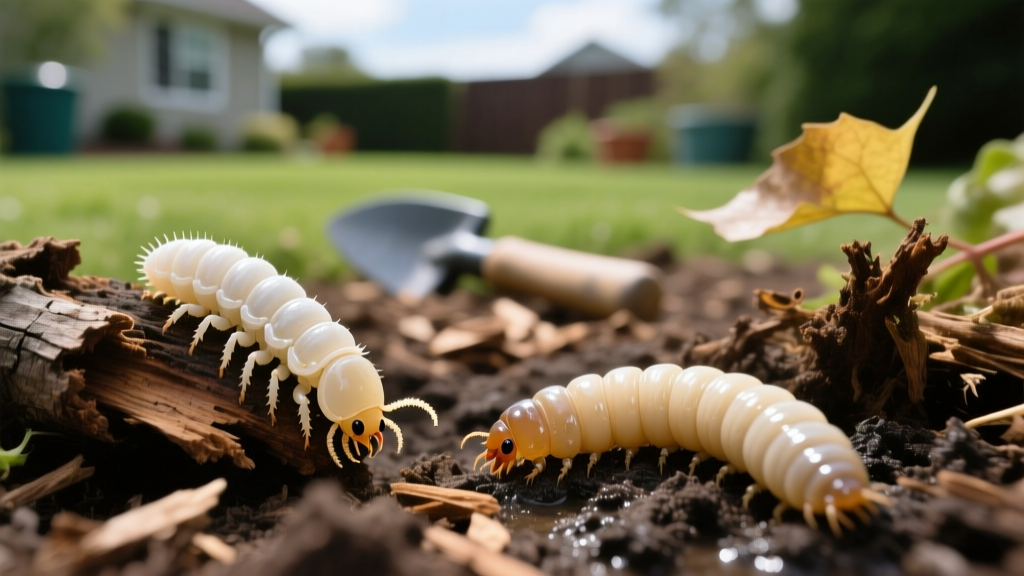
Termite Larvae vs Maggots: Yard Identification and Defense Guide
The Backyard Identification Crisis
Homeowners turning over mulch, compost, or topsoil often unearth small, white, squirming larvae. The immediate panic usually narrows down to two distinct fears: structural destruction (termites) or unsanitary rot (maggots). However, misidentifying these pests leads to wasted money on ineffective chemical treatments and unnecessary yard destruction. Furthermore, the most common white grub found in lawns is actually neither—it is a scarab beetle larva.
This guide breaks down the exact morphological differences between termite larvae, maggots, and scarab grubs. We provide targeted, professional-grade yard defense protocols, exact chemical dilution rates, and biological control timings to secure your property's perimeter and garden beds.
Visual Matrix: Termite Larvae vs Maggots vs Scarab Grubs
Before purchasing any pest control products, use this morphological matrix to identify the specimen. Use a magnifying glass or your smartphone's macro lens to inspect the head and thorax.
| Feature | Termite Larvae / Workers | Maggots (Fly Larvae) | Scarab Grubs (The Impostor) |
|---|---|---|---|
| Size | 1mm to 5mm (very small) | 3mm to 12mm (varies by species) | 10mm to 40mm (large, plump) |
| Legs | 6 tiny, jointed legs near head | None (legless) | 6 jointed legs on upper thorax |
| Head Capsule | Distinct, often dark or amber | None visible (hidden mouth hooks) | Distinct, hard, brown/orange |
| Body Shape | Straight, uniform, bead-like | Cylindrical, tapers sharply at head | C-shaped when disturbed, thick |
| Typical Yard Location | Inside wood, deep mud tubes | Compost, rotting fruit, decaying roots | Soil root zone (2-4 inches deep) |
Termite Larvae: The Structural Threat at Your Perimeter
True termite larvae are rarely found crawling freely in open garden soil. Subterranean termites (Reticulitermes spp.) are highly sensitive to desiccation and UV light. If you find termite larvae or workers in your yard, you have likely breached a subterranean gallery, a mud tube, or an infested piece of landscape timber. According to Penn State Extension, finding foraging workers near your foundation indicates an active colony is exploiting a moisture bridge to your home.
Yard Defense Protocol (Termites)
If termites are confirmed near your foundation, perimeter defense is mandatory. Bait stations are effective for monitoring, but liquid termiticides provide an immediate, continuous chemical barrier.
- Product: Termidor SC (Fipronil 9.1%). Cost: $75–$90 per 20oz bottle.
- Dilution: Mix 0.8 fluid ounces of Termidor SC per gallon of water.
- Application (Trenching): Dig a trench 6 inches wide and 6 inches deep directly against the foundation footer.
- Volume: Apply 4 gallons of the finished solution per 10 linear feet of trench.
- Mulch Rule: Never apply termiticide directly to wood chip mulch. Pull mulch back 12 to 18 inches from the foundation to expose the soil and eliminate a hidden moisture bridge.
⚠️ Warning: Soil Disturbance
Do not rototill or aggressively aerate soil within 2 feet of your foundation after applying a liquid termiticide. This will break the continuous chemical barrier and allow subterranean termites to bypass the treatment zone undetected.
Maggots: The Sanitary and Root Nuisance
Maggots are the larval stage of flies. In a yard setting, you are typically dealing with one of three categories: Black Soldier Fly larvae (beneficial composters), House/Bottle fly maggots (sanitary nuisances), or Root Maggots (destructive crop pests). Root maggots (Delia spp.) are the primary concern for gardeners, as they tunnel into the roots of brassicas (cabbage, broccoli) and alliums (onions, garlic), causing wilting and plant death.
Garden Defense Protocol (Maggots)
Chemical pesticides are largely ineffective against root maggots once they are inside the plant tissue. Defense relies on biological disruption and physical barriers.
- Biological Control (BTI): Apply Bacillus thuringiensis israelensis (sold as Mosquito Bits or Dunks) to the soil surface. While primarily for fungus gnats and mosquitoes, BTI disrupts the digestive systems of various fly larvae in wet soil environments. Cost: ~$15 for a 30oz shaker.
- Beneficial Nematodes: Apply Heterorhabditis bacteriophora (Hb nematodes) via a hose-end sprayer. These microscopic worms actively hunt and infect fly pupae and larvae in the top 2 inches of soil. Cost: $35–$50 for 10 million count (treats ~2,000 sq ft).
- Timing: Apply nematodes when soil temperatures are strictly between 60°F and 85°F. Irrigate the area with 1/4 inch of water immediately after application to wash the nematodes out of the UV zone and into the root layer.
- Physical Barriers: Use floating row covers over brassicas immediately after transplanting to prevent adult flies from laying eggs at the soil line.
For comprehensive management of specific crop-destroying maggots, the University of California IPM program recommends strict crop rotation and the removal of all decaying crop residue post-harvest to eliminate overwintering pupae sites.
The "False Alarm": Scarab Beetle Grubs
If the white grub you found in your lawn is plump, over half an inch long, and immediately curls into a "C" shape when picked up, you are looking at a scarab beetle grub (Japanese beetle, June bug, or European chafer). These are not termites, nor are they maggots. They are root-feeding turf destroyers.
Turf Defense Protocol (Scarab Grubs)
Grub control requires precise timing, as curative treatments fail if the grubs have already matured and stopped feeding.
- Preventative (Chlorantraniliprole): Apply products like Scotts GrubEX1 in late spring (May/June). This active ingredient takes 60-90 days to fully translocate in the soil and targets early-instar grubs.
- Curative (Trichlorfon): If you find active, large grubs eating roots in late summer (August/September), use a Trichlorfon-based product (e.g., Bayer Advanced 24 Hour Grub Killer). Water it in with 1/2 inch of irrigation immediately, as Trichlorfon degrades rapidly in alkaline soils.
According to University of Maryland Extension, a healthy lawn can tolerate 5 to 8 grubs per square foot. Only initiate chemical treatment if you count more than 10 grubs per square foot across multiple test areas.
The Diagnostic Decision Tree
Use this rapid field guide the next time you dig in the yard:
- Does it have legs?
- No: It is a maggot (fly larva). Check for rotting organic matter or damaged taproots.
- Yes: Proceed to step 2.
- Is it larger than 1/2 inch and C-shaped?
- Yes: It is a scarab beetle grub. Assess turf damage.
- No: Proceed to step 3.
- Is it tiny (under 1/4 inch), straight, and found inside a mud tunnel or wood?
- Yes: It is a termite. Inspect the home foundation immediately.
- No: It may be an ant larva or a beneficial beetle larva. Leave it alone.
Expert Sources & Further Reading
- Penn State Extension: Subterranean Termites - Biology, identification, and structural defense protocols.
- UC IPM: Onion and Cabbage Maggots - Agricultural guidelines for managing root-destroying fly larvae.
- University of Maryland Extension: White Grubs - Thresholds and timing for turfgrass scarab beetle management.

