
Pest Control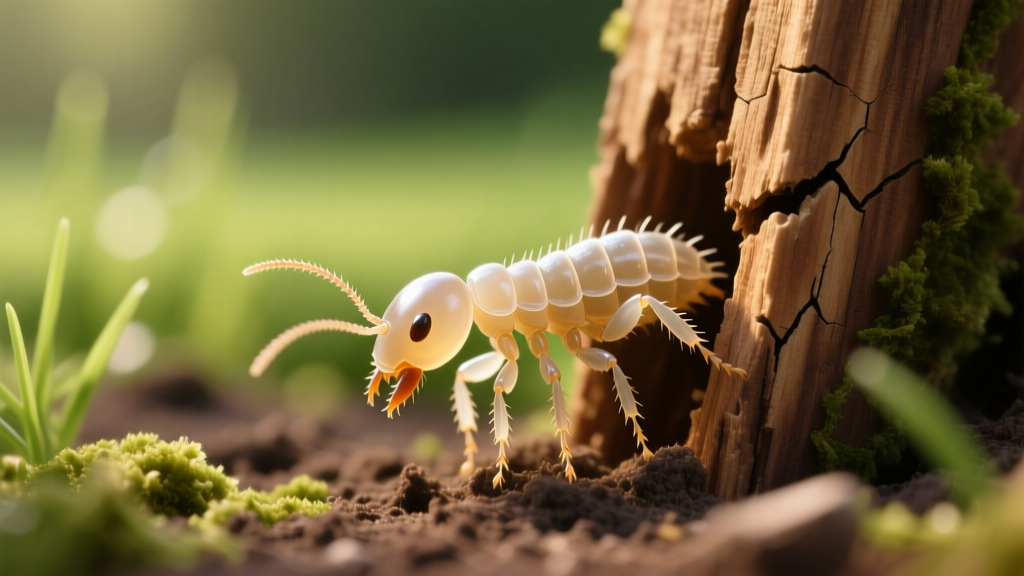
Termite Nymph Identification: Spotting and Stopping Yard Swarms
The Hidden Threat in Your Mulch: Understanding Termite Nymphs
When homeowners discover pale, soft-bodied insects in their yard, they often dismiss them as harmless grubs or ant pupae. However, if these insects possess distinct wing pads, you are looking at a termite nymph. In the context of subterranean termite biology, a nymph is not merely a "baby" worker; it is the specific developmental stage destined to become an alate (a reproductive swarmer).
Finding nymphs in your soil or mulch beds is a critical biological indicator. According to entomologists at the University of Florida IFAS, the presence of nymphs confirms that the local termite colony is at least 3 to 5 years old, highly mature, and actively preparing to launch a reproductive swarm. Ignoring nymphs in your landscaping means ignoring a colony that has likely already established satellite nests near your home's foundation.
⚠️ Critical Warning: Surface-level insecticide sprays (like standard bifenthrin yard sprays) will not eliminate a nymph-heavy colony. Nymph galleries are typically located 18 to 36 inches below the soil surface, well beyond the reach of broadcast surface treatments.
Visual Identification Matrix: Nymphs vs. Lookalikes
Accurate identification dictates your treatment strategy. Termite nymphs are frequently confused with worker larvae or carpenter ant pupae. Use the matrix below to confirm your findings before purchasing treatment chemicals.
| Feature | Termite Nymph | Termite Worker Larva | Carpenter Ant Pupa |
|---|---|---|---|
| Body Shape | Uniformly thick, straight abdomen | C-shaped, grub-like | Segmented, distinct pinched waist |
| Wing Pads | Visible, darkened pads on thorax | Absent | Encased in silken cocoon |
| Color | Creamy white, slightly translucent | Pure white, opaque | Tan to dark brown |
| Location | Deep mud tubes, central gallery | Foraging tunnels, wood voids | Inside damp, rotting wood galleries |
Yard Hotspots: Where Nymphs Develop
Subterranean termites require precise moisture levels to rear nymphs successfully. Nymphs are highly susceptible to desiccation, meaning the colony will only position them in the most humidity-controlled zones of the yard. Inspect these specific micro-environments:
- Deep Mulch Zones (>3 Inches): Mulch piled deeper than 3 inches against a foundation creates an insulated, high-humidity terrarium. Nymphs will cluster in the bottom inch of the mulch layer where it meets the soil.
- AC Condensate Lines: The constant drip from HVAC condensation lines creates a permanent moisture column. Digging 6 inches around the PVC pipe termination point often reveals dense mud tubes packed with nymphs.
- Buried Construction Debris: Untreated pine stakes, buried form boards, or stumps left behind by builders act as "nursery wood." The NC State Extension notes that buried cellulose is the primary catalyst for localized colony expansion.
- Irrigation Leaks: A dripping valve box maintains soil moisture at 25-30%, the exact threshold required for alate (swarmer) development.
Targeted Treatment Protocols for Nymph-Heavy Zones
Eliminating a colony that has reached the nymph-producing stage requires systemic eradication. You must use non-repellent termiticides or chitin synthesis inhibitors to ensure the toxicant reaches the deep central gallery where the nymphs reside.
Protocol A: Liquid Trenching with Fipronil (Fastest Knockdown)
Fipronil (the active ingredient in Termidor SC) utilizes a "transfer effect." Foraging workers pick up the chemical and pass it to the nymphs and queen through grooming and trophallaxis (food sharing).
- Mix Rate: Combine 0.8 fluid ounces of Termidor SC (9.1% Fipronil) per gallon of water. A standard 20 oz bottle costs roughly $90 to $110 in 2026 and yields 25 gallons of finished solution.
- Trench Dimensions: Dig a trench 6 inches deep and 6 inches wide directly against the foundation or around the infested landscape timber.
- Application Volume: Apply 4 gallons of the mixed solution per 10 linear feet of trench.
- Backfill: Treat the excavated soil with a 1:10 dilution of the mixture before shoveling it back into the trench to create a continuous chemical barrier.
Protocol B: In-Ground Bait Stations (Lowest Environmental Impact)
If trenching is impossible due to hardscaping or drainage concerns, use bait stations containing Noviflumuron (Sentricon) or Novaluron (Trelona). These are chitin synthesis inhibitors that prevent nymphs from molting into adult swarmers, effectively collapsing the colony's reproductive cycle.
- Spacing: Install stations every 10 to 15 feet around the perimeter of the yard and home.
- Cost: Expect to pay $12 to $18 per station for the hardware and initial bait matrix.
- Timeline: Baiting is slower than liquid treatments. The EPA notes that colony elimination via baiting typically takes 90 to 180 days, as the toxicant must be slowly integrated into the colony's food web.
Pro Tip for Edge Cases: If the colony is under extreme environmental stress (such as a drought or partial poisoning from a repellent spray), nymphs can undergo a process called "neoteny." They will skip the swarmer stage entirely, develop functional reproductive organs while remaining in the worker-like form, and begin laying eggs underground. This is why using non-repellent chemicals like Fipronil is critical; it prevents the stress response that triggers neotenic reproductives.
Frequently Asked Questions
Do termite nymphs eat wood?
Yes, but at a significantly lower rate than mature workers. Nymphs rely heavily on workers to feed them regurgitated cellulose. Because they eat less, they are harder to kill with stomach-poison baits, making the transfer effect of liquid termiticides or the grooming-transfer of bait matrices highly necessary.
If I destroy the nymphs in my yard, is my house safe?
No. The nymphs you find in a yard mulch bed represent only a fraction of the colony's reproductive output. The primary queen, located deep underground (often beneath the concrete slab of your home), will simply reallocate resources to produce a new batch of nymphs if the current ones are destroyed without eliminating the queen.
When do termite nymphs typically swarm?
Once nymphs complete their final molt into alates (swarmers), they wait for a specific trigger: a warm day (above 75°F) immediately following a significant rainfall event. In most of the United States, this occurs between late March and early June, depending on the species and local climate.

