
Pest Control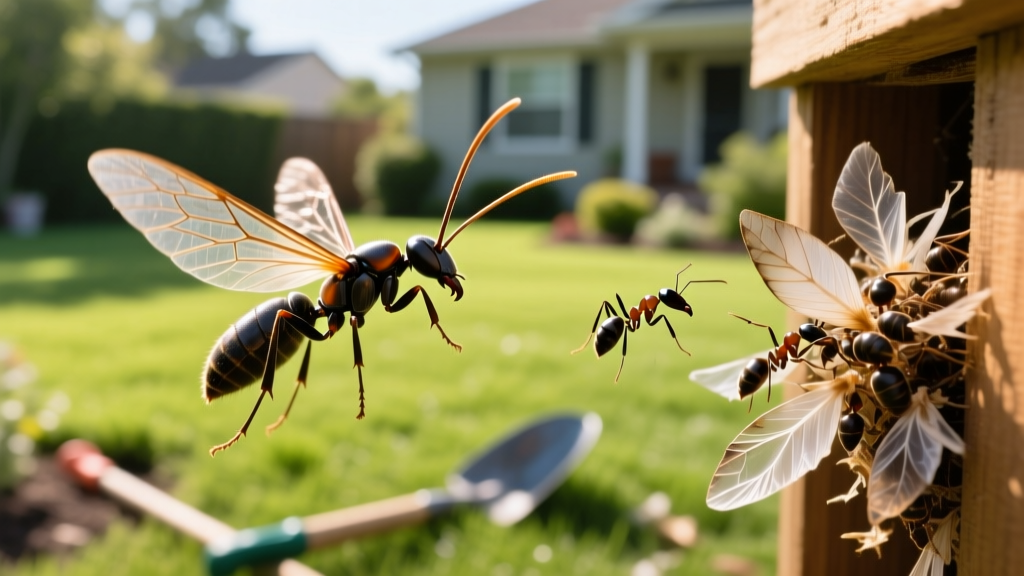
Termite Pictures With Wings: Identify Swarmers vs. Flying Ants
The Urgency of Spotting Winged Termites in Your Yard
Spotting winged insects near your foundation, garden beds, or wooden fences triggers immediate concern for any homeowner. While many flying insects are harmless pollinators or nuisance pests, winged termites—scientifically known as alates or swarmers—represent a critical biological warning sign. When you examine termite pictures with wings, you are looking at the reproductive caste of a mature, established subterranean or drywood termite colony. Their sole biological imperative is to leave the nest, mate, and establish new satellite colonies, often directly within the structural lumber of your home or the wooden retaining walls in your landscape.
Ignoring a swarm event because the insects eventually drop their wings and die off is a costly mistake. The visible swarmers are merely the emissaries of a hidden workforce of hundreds of thousands of worker termites that are actively consuming cellulose out of sight. According to the National Pest Management Association, termites cause over $5 billion in property damage annually in the United States, and standard homeowner insurance policies rarely cover this destruction. Accurate visual identification is the first mandatory step in deploying an effective yard defense and eradication protocol.
Visual Identification: Termite Pictures With Wings vs. Flying Ants
Homeowners frequently confuse winged termites with flying carpenter ants, especially during spring nuptial flights. Both pests emerge in large numbers when humidity and temperature conditions align, but their anatomical differences dictate entirely different treatment strategies. Use the comparison matrix below to cross-reference your yard sightings with verified entomological traits.
| Anatomical Feature | Winged Termite (Swarmer) | Flying Carpenter Ant |
|---|---|---|
| Waist / Body Segments | Thick, uniform width (two broad segments) | Pinched, narrow waist (three distinct segments) |
| Antennae | Straight, beaded, or slightly curved | Elbowed (distinct 90-degree bend) |
| Wing Structure | Four wings of equal length, extending far past the abdomen | Two long front wings, two shorter hind wings |
| Wing Texture | Translucent, milky, or smoky with visible veins | Clear with distinct dark veins, often iridescent |
| Coloration | Dark brown to black (subterranean); pale to reddish (drywood) | Typically black, red, or multi-colored |
The Discarded Wing Phenomenon
You are actually more likely to find discarded wings than the insects themselves. After a brief mating flight, swarmers land, snap off their wings at a natural fracture line near the base, and seek a crevice to start a new colony. Finding piles of translucent, identically sized wings on windowsills, patio concrete, or spider webs in your shrubbery is definitive proof of a localized swarming event.
Decoding the Swarming Behavior in Landscapes
Subterranean termites typically swarm during daylight hours in the spring, often immediately following a heavy rainstorm that softens the soil. Drywood termites, prevalent in coastal and southern regions, tend to swarm in late summer or early fall, often at dusk. The presence of swarmers in your yard indicates that a mature colony (usually 3 to 5 years old) is located within 100 to 300 feet of the sighting location.
⚠️ CRITICAL YARD DEFENSE WARNING: Do not spray visible swarmers with over-the-counter aerosol contact killers (like Raid or Ortho Home Defense). While this kills the visible reproductive cast, it does absolutely nothing to the subterranean workers destroying your property. Worse, localized chemical repellents can cause the main colony to 'bud' or splinter into multiple satellite colonies, multiplying your infestation and complicating professional eradication.
Proven Yard Defense & Eradication Protocols
Once you have confirmed the presence of winged termites via visual identification, you must transition from observation to active eradication. Modern termite science relies on non-repellent transfer technologies and chitin synthesis inhibitors rather than archaic chemical barriers.
1. Liquid Trenching (The Fipronil Transfer Method)
The industry standard for subterranean termite eradication involves trenching and rodding a non-repellent termiticide around the perimeter of your home and adjacent yard structures (like wooden sheds or retaining walls). Products containing 9.1% Fipronil (such as Taurus SC or Termidor HE) are the gold standard in 2026.
- The Mechanism: Fipronil is undetectable to termites. Workers tunnel through the treated soil, picking up the active ingredient on their cuticle.
- The Transfer Effect: Through a process called trophallaxis (mutual grooming and food sharing), the lethal dose is passed throughout the colony, resulting in total colony collapse within 60 to 90 days.
- Application Specs: Dig a trench 6 inches wide and 6 inches deep directly against the foundation. Apply 4 gallons of finished solution per 10 linear feet. For a standard 200-linear-foot home perimeter, this requires roughly 80 gallons of mixed solution.
- Cost Analysis: A 20oz bottle of Taurus SC costs approximately $85 and treats 60 linear feet. Professional application of Termidor HE typically ranges from $1,200 to $2,500 depending on soil type and linear footage.
2. Bait Station Deployment (Chitin Synthesis Inhibition)
For properties with extensive hardscaping, wells, or sensitive garden beds where liquid trenching is impossible, in-ground bait systems like the Advance Termite Bait System provide a highly effective alternative.
- Installation: Stations are installed in the soil every 10 feet around the structure and near active yard mud tubes.
- Monitoring Phase: Stations initially contain untreated cellulose monitoring blocks to confirm foraging activity.
- Baiting Phase: Once termites are detected, the monitoring block is replaced with a bait matrix containing Noviflumuron.
- The Mechanism: Noviflumuron is a chitin synthesis inhibitor. Termites require chitin to molt and grow. When workers ingest the bait and share it with the colony, the nymphs and workers fail to molt, leading to a systematic collapse of the colony's population dynamics.
For comprehensive guidelines on safe application and environmental protection during yard treatments, always consult the Environmental Protection Agency's termite control protocols.
Frequently Asked Questions About Swarmers
Do winged termites bite humans or pets?
No. Termite swarmers possess mandibles designed for chewing wood and soil, not for biting animals or humans. They do not carry venom or known pathogens. Their presence is a threat to your property's structural integrity, not your physical health.
If I see swarmers in my yard, is my house definitely infested?
Not definitively, but the risk is exceptionally high. Swarmers are poor flyers and usually travel less than 300 feet from their origin nest. If you see them in your yard, the parent colony is likely under your patio, near a wooden fence line, or directly beneath your foundation slab. A professional inspection utilizing moisture meters and acoustic emission detectors is required to confirm structural infestation.
How long does a swarming event last?
A single swarm event is remarkably brief, typically lasting only 30 to 40 minutes. The alates emerge en masse, take flight, and quickly drop to the ground. If you miss the flight, the only remaining evidence will be the discarded wings on the ground or stuck in spider webs near exterior lighting fixtures.

