
Pest Control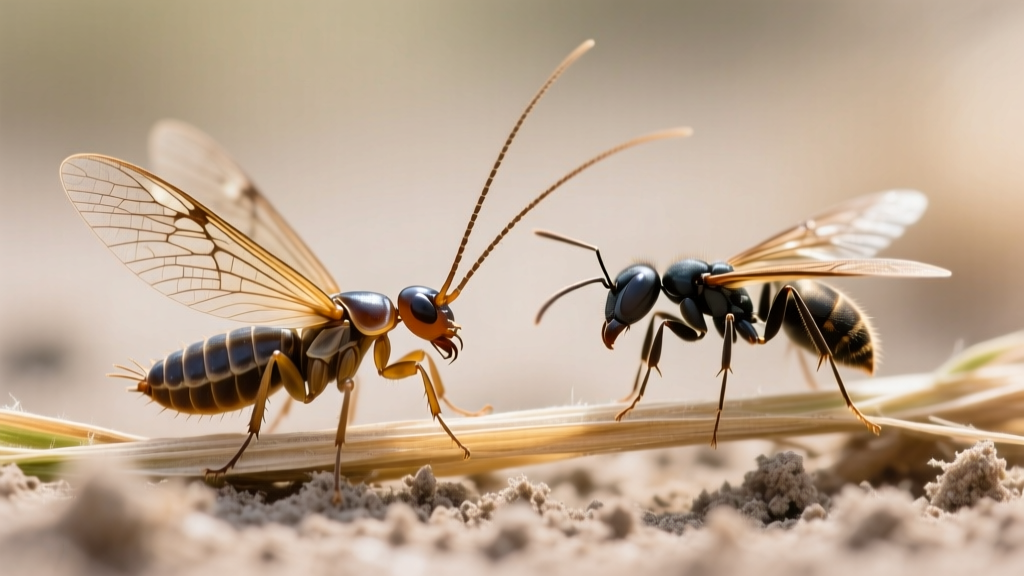
Termite With Wings Images: How to Identify Swarmers vs. Flying Ants
If you have found yourself searching for termite with wings images after spotting a swarm of insects near your foundation or patio, you are likely dealing with termite alates—commonly known as swarmers. Seeing these winged reproductive termites in your yard is a critical warning sign. Unlike worker termites that remain hidden underground, swarmers emerge in broad daylight to establish new colonies, and their presence often indicates a mature, established nest is already feeding on your property.
Misidentifying a winged termite as a harmless flying ant can cost homeowners thousands of dollars in delayed structural repairs. This guide provides the exact morphological markers to confirm your sighting, explains the environmental triggers behind the swarm, and outlines a precise, actionable yard defense protocol using current industry-standard treatments.
The Visual Test: Winged Termites vs. Flying Ants
Both winged termites and carpenter ants produce reproductive swarmers that look remarkably similar to the untrained eye. However, under close inspection, their anatomical differences are absolute. When examining a specimen or comparing your sighting to termite with wings images, focus on three distinct physical traits: the waist, the antennae, and the wing structure.
| Feature | Winged Termite (Alate) | Flying Ant (Carpenter Ant) |
|---|---|---|
| Body Shape | Thick, uniform, and blocky. No distinct waist between the thorax and abdomen. | Distinctly pinched, narrow waist (petiole) separating the thorax and abdomen. |
| Antennae | Straight and slightly beaded, resembling a string of tiny pearls extending forward. | Elbowed (bent at a 90-degree angle) with a distinct joint near the base. |
| Wings | Two pairs of equal-length wings that are roughly twice as long as the body, milky or translucent. | Two pairs of unequal-length wings; front wings are noticeably longer than hind wings, tinted brownish. |
Pro Tip: Termite wings are incredibly fragile. If you find piles of discarded, identical wings on your windowsills, patio concrete, or caught in spider webs around your yard, this is definitive proof of a termite swarm, even if you do not see the insects themselves.
Why Alates Swarm: Triggers and Seasonality
Termites do not swarm randomly. The emergence of alates is a highly synchronized biological event triggered by specific microclimatic conditions. Understanding these triggers helps you anticipate and monitor your yard during high-risk windows.
Swarming Profiles by Species
- Eastern Subterranean (Reticulitermes flavipes): Swarms in the spring (March to May) during daylight hours, typically on warm, humid mornings immediately following a heavy rainfall. Soil temperatures must reach 65°F to 70°F.
- Formosan Subterranean (Coptotermes formosanus): Swarms from May through July, primarily at dusk or early evening. They are highly attracted to exterior porch lights and streetlamps.
- Drywood Termites (Incisitermes minor): Swarms occur in late summer to early fall (August to November), often in the late afternoon. Unlike subterranean species, they do not require soil contact and emerge directly from infested wood or eaves.
According to the National Pest Management Association, a mature subterranean termite colony can produce hundreds of thousands of swarmers in a single season. However, only a tiny fraction survive to start a new colony. The primary danger is not the swarmers themselves—they do not eat wood—but the massive worker population they represent beneath your soil.
The 48-Hour Yard Defense Action Plan
If you have confirmed the presence of winged termites, do not panic, but do not delay. Avoid the common mistake of spraying over-the-counter aerosol insecticides (like Raid) on the swarmers. This only kills the visible reproductives, leaves the subterranean colony entirely unaffected, and can contaminate the soil, making professional termiticide applications less effective later.
- Contain and Collect: Sweep up the swarmers or discarded wings into a ziplock bag. This provides your pest control professional with a physical specimen for exact species identification.
- Perimeter Inspection for Mud Tubes: Grab a flashlight and inspect your foundation. Subterranean termites build shelter tubes made of soil and saliva to travel above ground. Look for pencil-width (1/4 to 1 inch) brown, vein-like structures running up concrete piers, foundation walls, or behind shrubbery. Break one open; if it is active, you will see tiny, pale worker termites inside.
- Eliminate Wood-to-Soil Contact: Immediately pull mulch back at least 6 inches from your foundation. Remove any firewood stacks, wooden trellises, or dead tree stumps touching the soil within 20 feet of your home.
- Deploy Targeted Termiticides: If you are executing a DIY defense, apply a non-repellent liquid termiticide. Termidor SC (active ingredient: Fipronil 9.1%) is the industry standard. Because it is non-repellent, termites cannot detect it, allowing them to tunnel through the treated soil and transfer the chemical to the rest of the colony via the 'transfer effect'.
Exact Application Specifications for Liquid Barriers
To create a continuous chemical barrier around your home's perimeter, you must trench the soil. Dig a trench 6 inches wide and 6 inches deep directly against the foundation. Mix Termidor SC at a rate of 0.8 fluid ounces per gallon of water to achieve a 0.06% active ingredient concentration. Apply 4 gallons of the finished solution per 10 linear feet of trench. Backfill the trench with the treated soil. For homes with concrete patios or driveways abutting the foundation, you must drill 1/2-inch holes through the concrete every 12 inches and inject the solution into the sub-slab soil.
Bait Station Alternatives and 2026 Pricing
If trenching and drilling are not viable for your landscape design, termite bait systems offer a highly effective, less invasive alternative. Modern bait stations utilize chitin synthesis inhibitors, which prevent termites from molting, ultimately collapsing the colony.
The Environmental Protection Agency notes that bait systems require consistent monitoring but drastically reduce the volume of chemical pesticides introduced into the yard environment. The Trelona ATBS (Advance Termite Bait System) uses Novaluron as its active ingredient. Stations must be installed flush with the soil every 10 to 20 feet around the perimeter of the structure.
Estimated Treatment Costs (2026 Averages)
- Liquid Termiticide Barrier (Professional): $1,500 – $3,500 depending on linear footage and slab drilling requirements.
- Bait Station Installation (Professional): $1,200 – $2,500 for initial setup, plus $300 – $500 annually for monitoring and bait replenishment.
- DIY Liquid Trenching (Materials Only): $350 – $600 for a standard 200-linear-foot perimeter using professional-grade Fipronil concentrates.
Frequently Asked Questions
Do winged termites bite humans or pets?
No. Termite alates possess mandibles designed for chewing wood, but they are entirely harmless to humans and pets. They do not sting, bite, or transmit diseases. Their sole purpose is reproduction.
How long do termite swarms last?
A localized swarm event is typically brief, lasting only 30 to 45 minutes. The alates emerge, take flight, mate, and quickly shed their wings to burrow into the soil. However, a mature colony may release multiple smaller swarms over a period of several weeks during the peak season.
Can I just kill the swarmers and ignore the rest?
Killing the visible swarmers does absolutely nothing to stop the structural damage occurring underground. The workers and soldiers remain active 24/7, consuming cellulose. Eradicating the swarmers is merely a cosmetic fix; you must treat the soil or deploy baits to eliminate the source colony.

