
Pest Control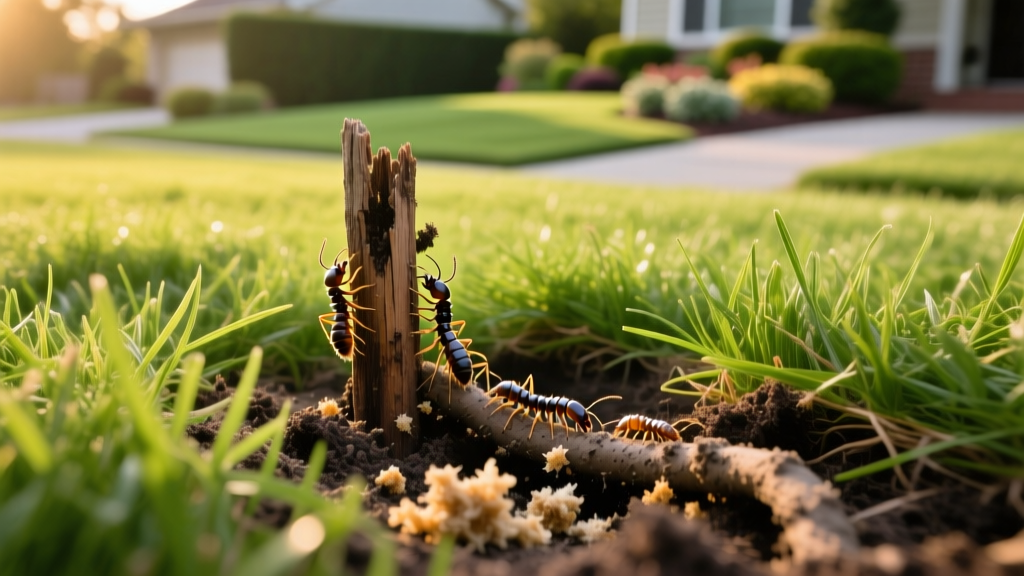
Termites in Grass: Identification, Risks, and Yard Defense Tactics
The Truth About Termites in Your Lawn
Finding mud tubes, discarded wings, or active swarmers in your yard often triggers immediate panic. Homeowners frequently assume that termites in grass mean their lawn is being consumed from the roots up. However, this is a fundamental misunderstanding of termite biology. Termites are cellulose digesters; they do not feed on living grass blades or healthy root systems. Instead, they feed on dead organic matter, decaying wood, and the thatch layer of your lawn.
When you see termite activity in your grass, it indicates one of two things: either you are dealing with agricultural (desert) termites that are harmlessly recycling dead thatch, or you have subterranean termites using your lawn soil as a foraging highway toward a much more lucrative target—your home's wooden structural framing. According to the University of California Integrated Pest Management program, subterranean termites require constant contact with soil moisture, making irrigated lawns an ideal transit corridor to reach foundation cracks.
⚠️ Critical Warning: Do not apply standard lawn grub killers (like Imidacloprid or Dylox) to control termites. These products are formulated for shallow-root-feeding beetles and will not penetrate deep enough or possess the non-repellent transfer properties required to collapse a subterranean termite colony.
Agricultural vs. Subterranean: Which Termite is in Your Grass?
Accurate identification dictates your defense strategy. Treating harmless agricultural termites with expensive foundation termiticides is a waste of resources, while ignoring subterranean foragers can lead to catastrophic structural damage. Use this comparison matrix to identify the culprit in your yard.
| Feature | Agricultural (Desert) Termites | Subterranean Termites |
|---|---|---|
| Primary Diet | Dead grass, thatch, surface debris | Sound timber, structural wood, dead roots |
| Mud Tube Structure | Flat, broad, web-like sheets over grass | Distinct, raised, pencil-sized tunnels |
| Threat to Home | None (Do not attack structural wood) | Severe (Primary cause of structural damage) |
| Required Action | Dethatch lawn, adjust irrigation | Immediate perimeter trenching and baiting |
Step-by-Step Yard Defense: Treating Subterranean Foragers
If you have confirmed the presence of subterranean termites foraging through your grass toward your foundation, you must establish a continuous chemical or bait barrier. As of 2026, the industry gold standard relies on non-repellent active ingredients that exploit the termites' social grooming habits to spread the toxin throughout the colony.
Step 1: Perimeter Trenching with Fipronil
Liquid termiticides containing Fipronil (e.g., Termidor SC) remain the most effective DIY and professional barrier treatment. Fipronil is non-repellent, meaning termites cannot detect it. They tunnel through the treated soil, ingest the chemical, and transfer it to nestmates via trophallaxis (food sharing).
- Dig the Trench: Using a trenching shovel, dig a continuous trench 6 inches wide and 6 inches deep directly against the foundation wall, cutting through the grass edge.
- Mix the Solution: Mix 0.8 fluid ounces of Termidor SC per gallon of water. For a standard home requiring 60 linear feet of treatment, you will need approximately 24 gallons of finished solution.
- Apply: Pour 4 gallons of the mixed solution into the trench for every 10 linear feet of foundation.
- Backfill: Once the liquid is absorbed, push the excavated soil back into the trench to cap the treatment and prevent UV degradation of the chemical.
Step 2: Strategic Bait Station Deployment
For properties with high water tables, well systems, or concrete slab foundations where trenching is impossible, bait stations utilizing Novaluron (e.g., Trelona ATBS) are the superior alternative. Novaluron is a chitin synthesis inhibitor; it prevents termites from molting, leading to colony collapse within 60 to 90 days.
- Placement: Install stations in the soil 2 to 4 feet away from the foundation, spaced 10 to 20 feet apart around the entire perimeter.
- Drilling Slabs: If termites are emerging through grass adjacent to a concrete driveway or patio, you must drill 1/2-inch holes through the concrete every 12 inches and inject the Fipronil solution directly into the sub-slab soil using a soil rodding tool.
💡 Pro Tip for Clay Soils: If your lawn sits on heavy, compacted clay, liquid termiticides will pool and run off rather than absorb. Use a soil surfactant or physically aerate the trench bottom with a pickaxe before applying the Fipronil solution to ensure deep penetration.
Cost Breakdown: DIY vs. Professional Termite Yard Treatment
Budgeting for termite defense requires understanding the long-term investment. While DIY methods save on labor, professional treatments often come with structural damage warranties that DIY applications lack. Below is the 2026 average pricing landscape for residential perimeter defense.
| Treatment Method | Estimated DIY Cost | Professional Cost | Warranty Included? |
|---|---|---|---|
| Liquid Fipronil Barrier | $75 - $120 | $9 - $14 / linear ft. | Pro Only (Usually 1-5 years) |
| Novaluron Bait Stations | $350 - $500 (15 stations) | $1,200 - $2,500 | Pro Only (Annual renewal required) |
Expert FAQ: Swarms, Mud Tubes, and Foundation Risks
Why do I see termite swarmers in my grass after it rains?
Subterranean termite alates (swarmers) require high soil moisture and specific barometric pressure drops to emerge from their subterranean galleries. Heavy rainfall softens the soil crust, allowing them to push through the grass. If you see hundreds of discarded, translucent wings on your lawn, it means a mature colony is actively reproducing nearby. The NC State Extension notes that a single colony can contain over a million workers, making immediate perimeter treatment critical.
Are the mud tubes on my oak tree a threat to the tree?
No. Termites do not eat living tree tissue. They are using the bark as a physical bridge to travel between the soil and a dead branch, or they are simply foraging on the surface. However, a heavily infested tree in your yard acts as a satellite feeding station. If the tree is within 20 feet of your home, consider injecting the base of the tree with a Fipronil solution to eliminate the localized foraging hub.
Will mulching my garden beds attract termites from the grass?
Mulch itself does not generate termites, but it provides the exact environment they seek: moisture retention and a hidden transit route. The Environmental Protection Agency (EPA) advises keeping organic mulch at least 6 inches away from your home's siding and foundation. If you have active termites in your grass, switch to inorganic ground covers like gravel or rubber mulch near the foundation until the colony is eliminated.

