
Pest Control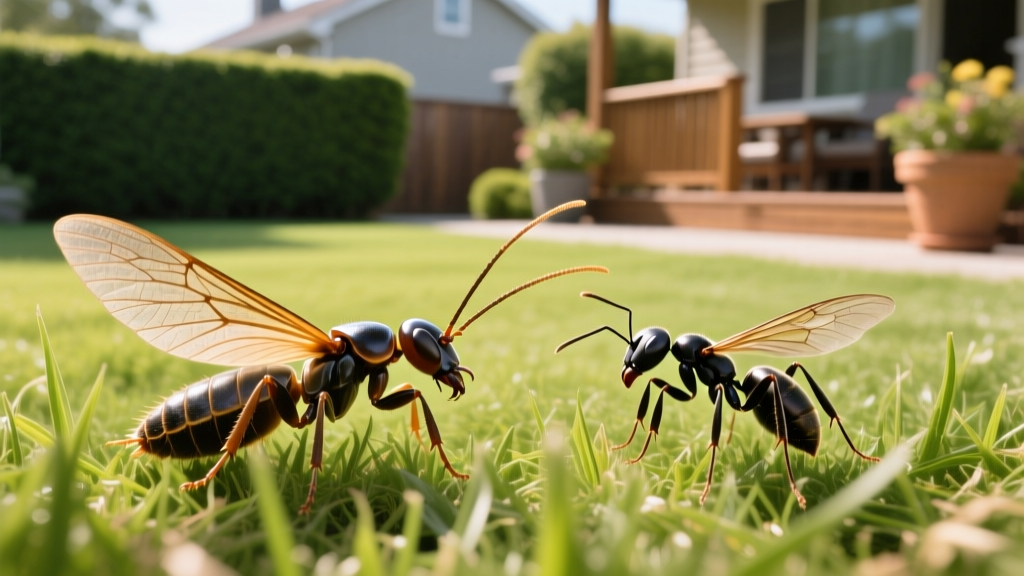
Termites With Wings vs. Flying Ants: Identification and Yard Defense Guide
The Biology of Alates: Why Termites Grow Wings
Spotting termites with wings in your yard is a critical warning sign that a mature, subterranean termite colony is actively expanding. These winged reproductive termites, scientifically known as alates or swarmers, emerge from underground nests primarily between March and June when soil temperatures reach 65°F to 70°F. Their sole biological purpose is to mate and establish new colonies. Once they find a suitable mate and a damp, wood-rich landing zone, they shed their wings—leaving behind the translucent, silvery wing piles that homeowners often find on patios, window sills, and mulch beds.
According to the University of Kentucky Department of Entomology, a single mature Eastern Subterranean termite colony can produce tens of thousands of these swarmers annually. However, the survival rate of alates is less than 1%. Despite this low survival rate, the presence of termites with wings in your yard indicates that a massive, wood-destroying colony is already established within 100 to 300 feet of your property line. Ignoring this outdoor warning sign inevitably leads to structural infestations as the new queens seek out the cellulose in your home's foundation sill plates and support piers.
Termites With Wings vs. Flying Ants: The Identification Matrix
Homeowners frequently confuse winged termites with flying carpenter ants. Misidentification leads to wasted money on the wrong pesticides. Carpenter ants excavate wood to build nests but do not consume it, whereas termites digest cellulose, causing catastrophic structural failure. Use the comparison matrix below to accurately identify the pest in your yard.
| Anatomical Feature | Termites With Wings (Alates) | Flying Carpenter Ants |
|---|---|---|
| Wings | Two pairs of equal-length wings; milky/translucent; extend far past the abdomen. | Two pairs of unequal-length wings; clear/tinted; front wings significantly longer than hind wings. |
| Antennae | Straight, bead-like (moniliform); no distinct bend. | Elbowed (geniculate); distinct 90-degree bend near the base. |
| Waist (Thorax) | Broad, uniform thickness; no distinct separation between thorax and abdomen. | Pinched, narrow waist (petiole) connecting thorax and abdomen. |
| Body Color | Dark brown to black body; pale, cream-colored legs. | Uniformly dark black, red, or multi-colored depending on species. |
| Behavior in Yard | Poor flyers; flutter erratically near ground level; shed wings quickly. | Strong flyers; often seen foraging on tree trunks or flying toward outdoor lighting. |
Yard Vulnerability Zones: Where Swarming Termites Strike
When alates shed their wings, the newly mated kings and queens immediately seek out soil-to-wood contact zones with high moisture content. To defend your yard, you must eliminate the microhabitats that attract them. The U.S. Environmental Protection Agency (EPA) emphasizes moisture control and wood removal as the primary non-chemical defense strategies.
- Mulch Beds: Mulch retains moisture and provides a hidden highway for termites. Keep mulch at least 6 inches away from your home's foundation and limit the depth to 2 inches. Consider replacing organic wood mulch near the foundation with inorganic alternatives like crushed stone or rubber mulch.
- Fence Posts and Deck Piers: Wooden fence posts set directly into soil are prime targets. If you have wooden fencing, ensure the posts are treated with micronized copper azole (MCA) or alkaline copper quaternary (ACQ), and install metal post bases to elevate the wood 2 inches above the soil grade.
- Tree Stumps and Root Systems: Decaying stumps act as termite incubators. Grind stumps at least 12 inches below grade and treat the remaining root zone with a borate-based wood preservative like Bora-Care to prevent colonization.
- Firewood Storage: Never store firewood directly on the lawn or against the house. Elevate woodpiles on metal racks at least 18 inches off the ground and maintain a 20-foot clearance from your home's exterior.
Step-by-Step Perimeter Defense Protocol
If you have confirmed the presence of termites with wings, habitat modification alone is insufficient. You must establish a chemical barrier in your yard's soil to intercept foraging workers and protect your foundation.
Phase 1: Trenching and Rodding
The industry standard for subterranean termite control is a continuous liquid soil treatment using a non-repellent active ingredient like Fipronil (9.1%). Non-repellents are undetectable to termites, allowing them to pass through the treated soil, pick up a lethal dose, and transfer it to the rest of the colony via trophallaxis (food sharing).
- Dig the Trench: Using a flat spade, dig a continuous trench around the entire exterior perimeter of your foundation. The trench must be exactly 6 inches wide and 6 inches deep.
- Calculate Volume: The standard application rate for Fipronil-based termiticides (such as Termidor SC or Taurus SC) is 4 gallons of finished solution per 10 linear feet of trench.
- Mix the Solution: Mix 0.8 fluid ounces of Fipronil concentrate per 1 gallon of water. For a standard 200-linear-foot home perimeter, you will need 80 gallons of finished solution and 64 ounces of concentrate.
- Apply and Backfill: Pour the solution evenly into the trench. For enhanced penetration in heavy clay soils, use a soil injection rod to deliver the chemical every 12 inches along the trench bottom before backfilling with the excavated soil.
Warning: Utility Line Clearance
Before digging any trench deeper than 4 inches, you must call 811 to have underground utility lines marked. Hitting a gas or fiber-optic line during perimeter trenching can result in severe injury and massive financial liability.
Before digging any trench deeper than 4 inches, you must call 811 to have underground utility lines marked. Hitting a gas or fiber-optic line during perimeter trenching can result in severe injury and massive financial liability.
Phase 2: Concrete Slab Drilling
Where patios, driveways, or sidewalks abut the foundation, trenching is impossible. You must drill through the concrete to treat the soil beneath. Use a hammer drill with a 1/2-inch masonry bit to drill holes every 12 inches, approximately 2 inches away from the foundation wall. Inject 2 gallons of the Fipronil solution into every 10 linear feet of drilled holes, then plug the holes with concrete patch or silicone caulk.
Termite Bait Stations: A Targeted Alternative
For homeowners who prefer not to apply liquid chemicals or have complex landscaping (like koi ponds or extensive root systems) that makes trenching impractical, in-ground bait stations offer a highly effective yard defense. Systems like the Sentricon System with Always Active technology or the Advance Termite Bait System utilize cellulose matrices laced with chitin synthesis inhibitors (CSI) such as Hexaflumuron or Diflubenzuron.
These stations are installed in the soil every 10 feet around the property perimeter. When termites feed on the bait, the CSI prevents them from molting, ultimately collapsing the colony. While bait systems do not provide the immediate protective barrier of a liquid trench, they are superior for colony elimination and require only 5 to 10 gallons of water for installation, making them ideal for environmentally sensitive yards.
Professional Treatment Costs and ROI
While DIY trenching with generic Fipronil can cost between $350 and $500 in materials for an average home, professional application ensures proper calibration, slab drilling, and warranty coverage. In 2026, professional liquid termiticide treatments typically cost between $5 and $12 per linear foot, translating to $1,000 to $2,500 for a standard 2,000-square-foot home. Professional bait station installations range from $1,200 to $2,000 for the first year, with annual renewal and monitoring fees of $300 to $400. Given that the average cost to repair structural termite damage exceeds $8,000, investing in a comprehensive yard defense protocol yields a massive return on investment.
Frequently Asked Questions
Do termites with wings bite humans or pets?
No. Termite alates possess mandibles designed exclusively for chewing wood and cellulose. They do not bite humans, pets, or other insects. Their presence is a structural threat, not a biological or medical one.
How far can termite swarmers fly from the original colony?
Subterranean termite swarmers are notoriously weak flyers. They typically rely on wind currents to travel and rarely fly more than 100 to 300 yards from their parent colony. If you see them in your yard, the source colony is almost certainly on your property or an immediate neighbor's property.
Will outdoor bug zappers kill termite swarmers?
While UV light traps and bug zappers will kill some alates, they are entirely ineffective as a control strategy. A mature colony releases thousands of swarmers simultaneously; a zapper will only eliminate a tiny fraction and will not stop the surviving mated pairs from establishing new nests in your yard's soil.

