
Pest Control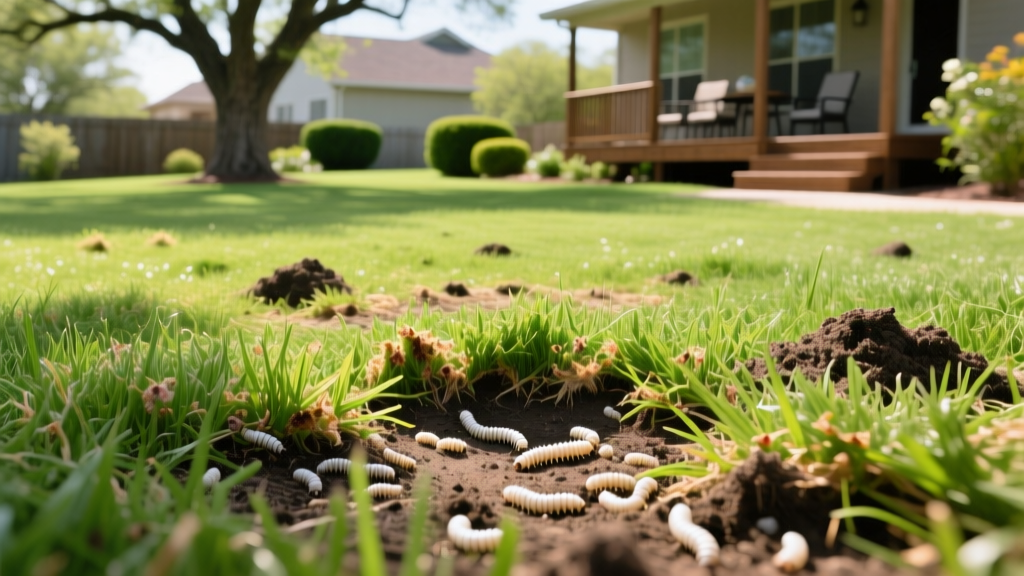
Grubs in Texas: Regional Timing Calendar for Lawn Treatment
The Unique Challenge of Grubs in Texas Climates
Managing white grubs in Texas requires a fundamentally different approach than in northern states. The extended heat, varied soil compositions—from the heavy black clay of the Dallas-Fort Worth metroplex to the alkaline caliche of Central Texas—and the presence of multiple grub species create a complex pest management environment. Texas lawns, predominantly St. Augustine, Bermuda, and Zoysia, face severe root destruction if treatments are applied based on generic national calendars rather than localized soil temperature triggers.
The primary culprits damaging Texas turf are the larvae of June bugs (Phyllophaga spp.) and May beetles (Cyclocephala spp.). Unlike northern grubs that follow a strict annual lifecycle, many Texas grub species exhibit asynchronous emergence, meaning you can often find first, second, and third-instar larvae feeding simultaneously in late summer. According to Texas A&M AgriLife Extension, misidentifying the species or applying chemicals outside the optimal biological window is the leading cause of treatment failure in the state.
The Biological Trigger: Soil Temperature Over Calendar Dates
Homeowners often make the mistake of applying preventative grub control on a fixed calendar date (e.g., 'always apply on May 1st'). This is a critical error. Grub egg-laying is dictated by soil temperature, not the calendar. Female beetles begin laying eggs in the thatch and upper soil profile when the soil temperature at a 2-inch depth consistently reaches between 80°F and 85°F.
The 85°F Soil Rule: Purchase a standard digital soil probe thermometer. Insert it 2 inches into the soil in a sunny area of your lawn. When the reading hits 85°F for three consecutive days, the egg-laying window has officially opened. Preventative treatments must be in the ground before this threshold is crossed to ensure the chemical barrier is active when eggs hatch 14 to 21 days later.
Regional Treatment Calendar for Texas Lawns
Because Texas spans multiple USDA Hardiness Zones and experiences drastic latitudinal temperature shifts, your application window shifts depending on your region. Below is the strategic calendar for 2026 turf management.
| Region | Preventative Window | Curative Window | Dominant Soil Type |
|---|---|---|---|
| North Texas (Dallas, Denton, Sherman) | June 1 – June 20 | August 15 – Sept 10 | Heavy Black Clay (Expansive) |
| Central Texas (Austin, San Antonio, Waco) | May 15 – June 5 | August 1 – August 25 | Alkaline Caliche / Clay Loam |
| South Texas (Houston, Corpus Christi, Valley) | May 1 – May 20 | July 20 – August 15 | Sandy Loam / Gulf Coast Clay |
Preventative vs. Curative Chemistry: Selecting the Right Active Ingredient
The Environmental Protection Agency (EPA) regulates various active ingredients for grub control, but they function entirely differently. Choosing the wrong chemistry for your specific timing will result in wasted money and dead turf.
Preventative Chemistry (Apply Before Eggs Hatch)
- Chlorantraniliprole (e.g., Scotts GrubEx1): An anthranilic diamide that is highly effective and safe for pollinators. It is slow-acting and requires 60 to 90 days to fully translocate into the root zone. Best applied in early April to May. Cost: ~$24 per 5,000 sq. ft.
- Imidacloprid (e.g., Bayer Advanced Season Long Grub Control): A neonicotinoid that provides a faster residual barrier. It must be applied closer to the egg-laying window (late May to June) and breaks down faster in high-UV Texas environments. Cost: ~$18 per 5,000 sq. ft.
Curative Chemistry (Apply When Grubs are Actively Feeding)
- Trichlorfon (e.g., Bayer Advanced 24-Hour Grub Killer / Dylox): An organophosphate that acts as a contact and stomach poison. It kills actively feeding 2nd and 3rd instar grubs within 24 hours but has a very short residual life (only 7-10 days). Must be applied in late summer when damage first appears. Cost: ~$15 per 5,000 sq. ft.
- Carbaryl (e.g., Sevin): Less effective on mature grubs than Trichlorfon and highly toxic to earthworms. Generally not recommended for Texas turf unless Trichlorfon is unavailable.
Warning: Neonicotinoid Pollinator Risk
If applying Imidacloprid, ensure your lawn is completely free of flowering weeds (like clover or Texas dandelion). Mow the lawn immediately before application to remove any blooms and protect native Texas bee populations.
If applying Imidacloprid, ensure your lawn is completely free of flowering weeds (like clover or Texas dandelion). Mow the lawn immediately before application to remove any blooms and protect native Texas bee populations.
The 0.5-Inch Watering Rule: Activating Granules in Texas Soils
Granular grub control products are useless if they remain trapped in the thatch layer. They must be watered into the top 2 inches of soil where the grubs feed. However, Texas soils present unique irrigation challenges.
Managing Heavy Black Clay (North Texas)
Black clay has a notoriously slow infiltration rate, often absorbing less than 0.2 inches of water per hour. If you apply 0.5 inches of water all at once, the product will wash into the street via surface runoff. The Fix: Use the 'cycle and soak' method on your sprinkler controller. Apply 0.15 inches of water, wait 45 minutes for absorption, and repeat until a total of 0.5 inches is delivered.
Managing Sandy Loam (South Texas & Coastal Regions)
Sandy soils drain rapidly. While infiltration isn't an issue, leaching is. Applying too much water will push the chemical barrier past the 2-inch root zone, rendering it ineffective. The Fix: Apply exactly 0.3 to 0.4 inches of water immediately after spreading the granules to move them into the thatch without pushing them into the groundwater.
Troubleshooting: Why Your Grub Treatment Failed
If you applied a product and still see brown, peeling patches of St. Augustine or Bermuda grass, consider these common failure modes:
- Thatch Interception: If your thatch layer exceeds 0.5 inches, granular products will bind to the dead organic matter and never reach the soil. You must core aerate or use a dethatching rake before application.
- Late-Season Curative Failure: By late October, soil temperatures drop below 65°F, and grubs migrate deeper into the soil profile to overwinter. They stop feeding. Applying Trichlorfon in November will not work because the grubs are not eating the treated roots.
- Misdiagnosis (Take-All Root Rot): In Texas, Take-All Root Rot (TARR) causes brown, easily peeled turf that mimics grub damage perfectly. Perform the 'tug test': grab a handful of brown grass and pull. If it lifts easily and you see no white, C-shaped grubs in the top 2 inches of soil, you are likely dealing with TARR, a fungal disease, not an insect pest.
Frequently Asked Questions
Do nematodes work for grub control in Texas heat?
Beneficial nematodes (Heterorhabditis bacteriophora) can be effective as an organic curative treatment, but Texas summer soil temperatures frequently exceed 95°F, which kills the nematodes before they can infect the grubs. If using nematodes, apply them at dusk in late September when soil temperatures drop below 85°F, and irrigate heavily to keep the soil moist.
Will treating for grubs also kill the adult June bugs flying around my porch?
No. Soil-applied granular treatments target the subterranean larval stage. Adult June bugs are airborne and feed on tree foliage (like oak and pecan leaves). To reduce adult populations, you must target the larvae in the soil before they mature and emerge the following spring.
How much does professional grub control cost in Texas?
Professional lawn care services in Texas typically charge between $85 and $140 per application for a standard 5,000 to 8,000 square foot urban lawn. This usually includes a premium commercial-grade preventative like Acelepryn (chlorantraniliprole), which offers longer residual control than consumer-grade products.

