
Pest Control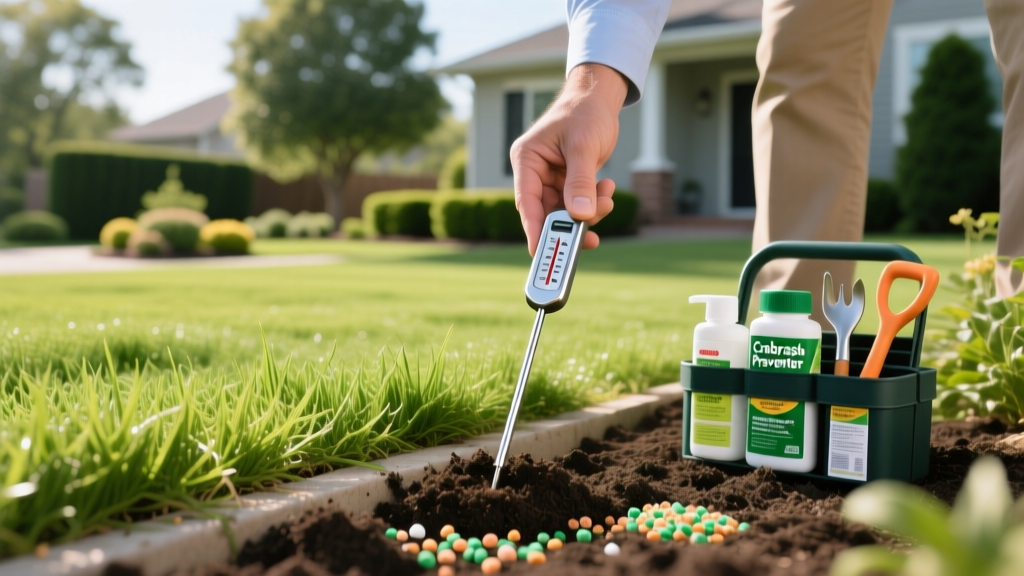
Timing Pre Emergents for Lawns: The Ultimate Soil Temp Guide
The Science of Germination: Why Calendar Dates Fail
Applying pre emergents for lawns based on a fixed calendar date—such as 'always apply on April 1st'—is the most common reason homeowners experience summer weed breakthroughs. Weed seeds do not possess calendars; they respond strictly to environmental triggers. For annual grassy weeds like crabgrass (Digitaria sanguinalis) and goosegrass (Eleusine indica), the primary trigger is soil temperature.
Crabgrass germination initiates when the soil temperature at a 2-inch depth reaches 50°F to 55°F for three to five consecutive days. In transitional climate zones, this window can shift by up to four weeks from year to year depending on spring cloud cover, soil moisture, and snowmelt. Relying on phenological indicators, such as forsythia bushes blooming, is a secondary heuristic that often falls short because microclimates cause forsythias to bloom at varying soil temperatures.
The 55°F Rule: To guarantee efficacy, deploy a digital probe soil thermometer. Measure at a 2-inch depth in a shaded, representative area of your turf at 9:00 AM. Once readings consistently hit 53°F–55°F, your application window is open. Applying too early risks UV degradation and microbial breakdown of the chemical barrier before peak germination; applying too late allows the radicle to breach the soil surface, rendering the pre-emergent useless.
Active Ingredients Decoded: Prodiamine vs. Dithiopyr
The efficacy of pre emergents for lawns is dictated by the active ingredient's chemical half-life and its binding affinity to soil organic matter. The professional turf industry relies primarily on two distinct chemistries for spring applications.
| Active Ingredient | Common Brand | Application Rate (per 1,000 sq ft) | Residual & Traits |
|---|---|---|---|
| Prodiamine | Barricade 65 WDG | 0.5 to 1.15 oz (based on target residual) | Up to 6 months. Strictly pre-emergent. Highly stable, low water solubility. |
| Dithiopyr | Dimension 2EW | 0.5 to 0.75 oz | 3 to 4 months. Offers early post-emergent control (up to 1-tiller crabgrass). |
| Pendimethalin | Pendulum AquaCap | 1.0 to 1.5 oz | 2 to 3 months. Highly susceptible to UV photodegradation if not watered in. |
According to North Carolina State University Extension, prodiamine provides the longest residual barrier due to its strong binding to soil organic matter and high resistance to microbial degradation. However, dithiopyr is the superior choice for homeowners who miss the early spring window, as its unique chemistry allows it to kill crabgrass that has already germinated but has not yet developed tillers (the 1-leaf to 1-tiller stage).
The Split-Application Strategy: Maximizing the Chemical Barrier
A single, heavy spring application of pre-emergent is an outdated practice that often leads to late-summer weed breakthroughs. The modern agronomic standard is the split-application method. By dividing your total annual chemical rate into two separate applications spaced 6 to 8 weeks apart, you refresh the chemical barrier just as the initial residual begins to thin, maintaining a lethal concentration in the top inch of the soil profile.
Calculating Exact Application Rates
Let us calculate a split-application program using Prodiamine 65 WDG for a 5,000 square foot lawn targeting a 4-month residual barrier.
- Total Annual Rate: To achieve a 4-month barrier, the label requires approximately 0.83 oz per 1,000 sq ft annually.
- Total Product Needed: 5,000 sq ft / 1,000 = 5.0 x 0.83 oz = 4.15 oz of Prodiamine for the year.
- Application 1 (Early Spring at 53°F): Apply 2.07 oz mixed in 1 to 2 gallons of water per 1,000 sq ft.
- Application 2 (Late Spring / Early Summer): Apply the remaining 2.08 oz 60 days later to extend the barrier through the peak August heat stress.
Watering Requirement: Pre-emergents must be incorporated into the top 0.5 inches of soil via irrigation or rainfall (approx. 0.25 inches of water) within 48 hours of application. Failure to water in the product leaves it on the surface where UV rays will photodegrade the active ingredient, completely neutralizing the treatment.
Integrating Pre-Emergents with Soil Nutrition Plans
Treating pest control and soil nutrition as isolated practices leads to chemical antagonism and poor turf health. Pre emergents for lawns interact directly with the soil's Cation Exchange Capacity (CEC) and thatch layers, which dictates how you should schedule your spring fertilizers.
The Thatch Binding Effect
Pre-emergent herbicides are highly lipophilic, meaning they bind aggressively to organic matter. If your lawn has a thatch layer exceeding 0.5 inches, the pre-emergent will bind to the dead organic tissue rather than reaching the mineral soil surface where weed seeds germinate. If core aeration or dethatching is required, it must be performed before the pre-emergent application. Aerating after application will physically fracture the chemical barrier, creating localized zones where crabgrass can easily penetrate.
Avoiding the 'Weed and Feed' Trap
Big-box store 'Weed and Feed' products combine pre-emergents with high-nitrogen, fast-release fertilizers (often 20-0-0 or similar ratios). Applying heavy nitrogen when soil temperatures are in the 50s forces cool-season grasses (Fescue, Kentucky Bluegrass) to push rapid vertical top-growth at the direct expense of root development. As noted by Michigan State University Extension, weak root systems developed during spring nitrogen surges make the turf highly susceptible to summer drought stress and fungal pathogens like Brown Patch. Keep your pre-emergent application strictly isolated from your spring nitrogen fertilizer; delay heavy nitrogen feeding until the turf has fully greened up and soil temperatures exceed 65°F.
Troubleshooting Pre-Emergent Failures
If you applied a pre-emergent and still see crabgrass or spurge by July, the failure is rarely the chemical itself. It is almost always an environmental or mechanical breakdown of the barrier.
Common Failure Modes
- Insufficient Carrier Volume: Spraying less than 1.5 gallons of water per 1,000 sq ft results in uneven coverage. The chemical barrier requires overlapping droplet distribution to form a continuous 'sheet' across the soil.
- Scalping the Turf: Mowing cool-season grasses below 2.5 inches allows sunlight to penetrate the canopy and hit the soil surface. Pre-emergents break down faster under direct UV exposure, and weed seeds require light triggers to germinate. Maintain a 3.5-inch cut height to shade the soil and preserve the chemical barrier.
- Heavy Spring Rains: While water is required to activate the product, extreme, prolonged saturation can cause the chemical to leach below the germination zone (the top 1 inch of soil), particularly in sandy soils with low organic matter and low CEC.
Frequently Asked Questions
Can I apply pre-emergent and grass seed at the same time?
No. Standard pre-emergents like prodiamine and dithiopyr do not distinguish between crabgrass seeds and desirable turfgrass seeds; they will inhibit the cell division of your new grass seed. If you must seed in the spring, use a specialized active ingredient called Siduron (Tupersan), which is the only pre-emergent that selectively targets crabgrass while allowing cool-season grass seedlings to establish.
Do liquid pre-emergents work better than granular?
Chemically, the active ingredient performs identically once watered into the soil. However, liquid applications (using a backpack sprayer) provide superior coverage and allow for precise split-application dosing compared to granular products, which rely on the accuracy of your broadcast spreader calibration. Liquids also eliminate the issue of granules getting trapped in tall grass blades and failing to reach the soil surface.
How do I control Poa annua (Annual Bluegrass)?
Poa annua is a winter annual that germinates in late summer when soil temperatures drop below 70°F. To control it, you must apply a separate pre-emergent application in late August or early September, timing it to coincide with the late-summer soil temperature drop, rather than the spring crabgrass window.

