
Pest Control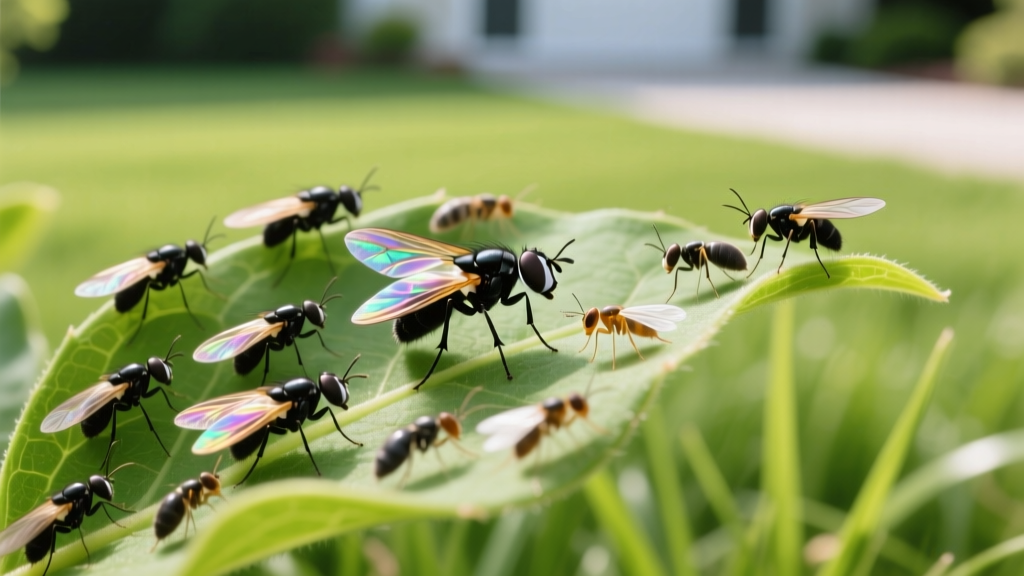
Tiny Bugs With Wings in the Yard: Identification & Control Guide
The Usual Suspects: Identifying Tiny Bugs With Wings
When you disturb your lawn or garden beds and see a cloud of minuscule flying insects scatter, you are likely dealing with one of three primary turf and ornamental pests. These tiny bugs with wings are rarely just a nuisance; they are often indicators of underlying soil imbalances or active vectors for plant pathogens. Accurate identification is the prerequisite for effective eradication, as broad-spectrum sprays frequently fail against their specific life cycles.
| Pest Species | Size & Appearance | Primary Damage Sign | Preferred Habitat |
|---|---|---|---|
| Fungus Gnats (Bradysia spp.) | 1/8 inch, dark gray/black, long legs, weak fliers | Seedling collapse, yellowing lower leaves, root hair shearing | Moist, organic-rich topsoil, overwatered turf, compost piles |
| Whiteflies (Aleyrodidae) | 1/16 inch, powdery white wings, triangular resting posture | Sticky honeydew residue, black sooty mold, stippled foliage | Undersides of broadleaf ornamentals, vegetable garden perimeters |
| Thrips (Thysanoptera) | 1/20 inch, slender, pale yellow to dark brown, fringed wings | Silvering or scarring on leaf surfaces, deformed flower buds | Deep within flower petals, tight leaf whorls, dry turf thatch |
| Leafhoppers (Cicadellidae) | 1/4 inch, wedge-shaped, pale green, rapid jumpers | Hopperburn (browning leaf margins), stippling, vectoring aster yellows | Turfgrass canopies, clover patches, weedy yard borders |
Environmental Triggers: Why They Invade Your Yard
Tiny bugs with wings do not invade randomly; they exploit specific microclimates. The most common catalyst for fungus gnat and leafhopper population explosions is improper irrigation scheduling. When soil moisture exceeds the field capacity for extended periods, it creates an anaerobic environment that promotes the growth of Pythium and Fusarium fungi—the primary food source for gnat larvae.
⚠️ Warning: The Overwatering Trap
Homeowners often respond to wilting plants by increasing irrigation. However, wilting can be caused by root damage from gnat larvae, not just dry soil. Watering damaged roots exacerbates the fungal growth that feeds the next generation of pests. Always verify soil moisture with a tensiometer before adjusting your sprinkler schedule.
Whiteflies and thrips, conversely, thrive in hot, dusty conditions with low humidity. Yards adjacent to unpaved driveways or construction sites often see higher thrip pressure because dust settles on leaves, disrupting the natural predatory mites that keep thrip populations in check. Furthermore, excessive use of broad-spectrum pyrethroid insecticides (like bifenthrin) decimates beneficial parasitic wasps (Encarsia formosa), leading to rapid whitefly resistance and population rebound.
The 3-Step Yard Defense Protocol
Eliminating these pests requires a phased approach that targets both the flying adults and the soil-dwelling or leaf-hiding immature stages. Relying solely on adult knockdown sprays guarantees a re-infestation within 14 days.
Step 1: Moisture and Habitat Calibration
Before applying any biological or chemical controls, you must correct the environmental baseline. For turfgrass like Kentucky Bluegrass or Bermuda, maintain soil tension readings between 20 and 40 kPa. If your tensiometer reads above 60 kPa, your soil is waterlogged. Reduce irrigation frequency and aerate the turf using a core aerator to pull 3-inch plugs, improving drainage and disrupting the gnat larval habitat in the top 2 inches of soil. For ornamental beds, apply a 1-inch layer of coarse arborist wood chips; this creates a physical barrier that prevents adult gnats from reaching the soil to oviposit (lay eggs).
Step 2: Biological Warfare (Nematodes & Bti)
For soil-dwelling larvae (fungus gnats), chemical drenches are often ineffective due to thatch binding. Instead, deploy Steinernema feltiae beneficial nematodes. These microscopic worms actively hunt gnat larvae in the soil pore space. Apply at a rate of 25,000 nematodes per square foot using a hose-end sprayer with the filter screen removed to prevent clogging. Cost is approximately $35 for 50 million nematodes, treating roughly 2,000 square feet. Keep the soil surface moist for 7 days post-application to ensure nematode survival.
For standing water or highly saturated bog gardens where gnats and mosquitoes breed, utilize Bacillus thuringiensis israelensis (Bti). Products like Summit Mosquito Bits ($15 for 30 oz) contain this naturally occurring bacterium, which produces proteins that crystallize in the alkaline midgut of gnat and mosquito larvae, causing fatal septicemia. Bti is entirely non-toxic to mammals, birds, and beneficial pollinators, as confirmed by the Environmental Protection Agency (EPA).
Step 3: Targeted Chemical Knockdown
If whitefly or thrip populations on ornamentals exceed the economic threshold (more than 5 adults per leaf), intervene with Spinosad. Derived from the soil actinomycete Saccharopolyspora spinosa, Spinosad (e.g., Monterey Garden Insect Spray, $22 for 16 oz) disrupts the insect's nicotinic acetylcholine receptors. Apply at a rate of 2 fluid ounces per gallon of water, focusing strictly on the undersides of leaves where whiteflies congregate. To prevent resistance, rotate Spinosad with Azadirachtin (neem extract, 4.5% concentration) every 14 days. According to the University of Minnesota Extension, rotating modes of action is critical to preventing the rapid genetic resistance seen in whitefly populations.
Treatment Cost & Efficacy Matrix
Budgeting for pest control requires understanding the cost-per-application and the expected timeline for population collapse. Below is a comparative matrix for managing a standard 5,000 sq. ft. yard with mixed turf and ornamental beds.
| Treatment Modality | Target Pest | Estimated Cost (5k sq ft) | Time to Population Collapse | Re-application Interval |
|---|---|---|---|---|
| Steinernema feltiae Nematodes | Fungus Gnat Larvae | $85 - $110 | 10 - 14 days | Every 3 weeks during peak spring/fall |
| Bti (Mosquito Bits/Dunks) | Gnat/Mosquito Larvae | $25 - $40 | 24 - 48 hours (larval death) | Every 30 days |
| Spinosad (Liquid Concentrate) | Whiteflies, Thrips | $30 - $45 | 3 - 5 days | Every 7 - 14 days (max 6x per season) |
| Insecticidal Soap (Potassium Salts) | Whitefly Nymphs, Leafhoppers | $20 - $30 | Immediate (contact kill) | Every 5 - 7 days |
Frequently Asked Questions
Are tiny bugs with wings harmful to humans or pets?
The species commonly found in yards—fungus gnats, whiteflies, thrips, and leafhoppers—do not bite humans or pets. They lack the mouthparts required to pierce mammalian skin. However, severe whitefly infestations produce copious amounts of honeydew, which can stain patio furniture and promote the growth of sooty mold on hardscapes. Thrips may occasionally land on humans and attempt to probe the skin with their rasping mouthparts, causing a mild, temporary itch, but they do not feed on blood or transmit diseases to mammals.
Why do I see more tiny flying bugs right after I mow the lawn?
Mowing creates mechanical vibration and physical disturbance that forces resting insects to take flight. Leafhoppers and adult fungus gnats often shelter deep within the turf canopy to avoid direct sunlight and desiccation. When the mower passes over, the sudden change in air pressure and physical agitation triggers their escape response. If you consistently see massive clouds of tiny bugs after mowing, it indicates a high population density sheltering in overly tall or thatch-heavy turf. Lowering your mowing height slightly and performing a deep dethatching will reduce their harborage zones.
Can I use yellow sticky traps outdoors to control these pests?
Yellow sticky traps are highly effective for monitoring and reducing adult fungus gnat and whitefly populations indoors or in enclosed greenhouses. Outdoors, however, their efficacy drops significantly due to wind, dust accumulation, and the sheer volume of incoming pests from neighboring properties. If you use them outdoors, place them strictly as monitoring tools near high-value ornamentals to gauge population peaks, replacing them every 7 days or immediately after a rainstorm. Do not rely on them as a standalone eradication method in an open yard environment.

