
Pest Control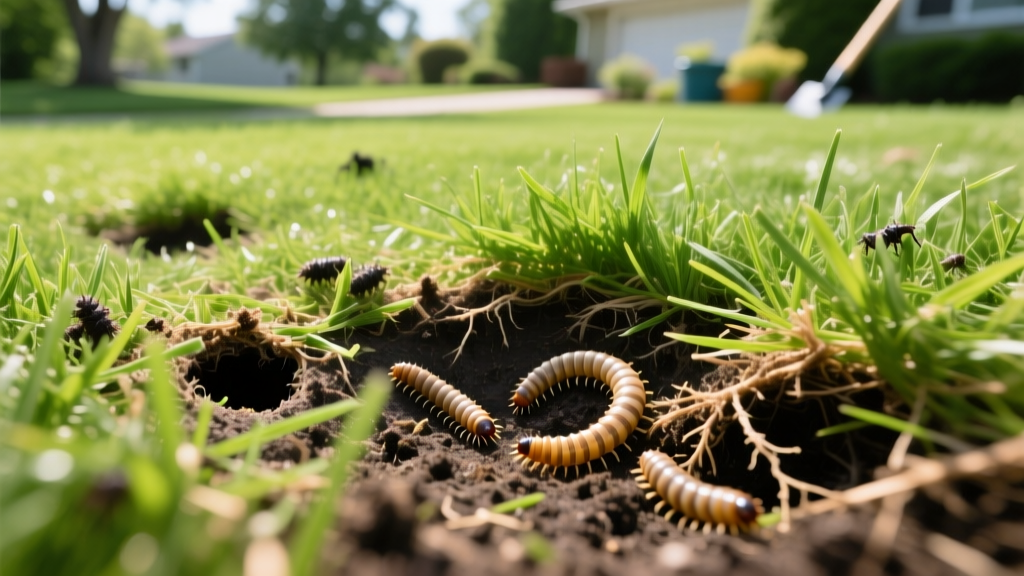
Ground Grubs: Identification, Treatment, and Lawn Recovery
The Hidden Threat: Understanding Ground Grubs and Turf Damage
Ground grubs are the subterranean larval stage of scarab beetles, primarily Japanese beetles (Popillia japonica), June bugs (Cotinis nitida), and European chafers (Rhizotrogus majalis). These C-shaped, cream-colored insects feed aggressively on turfgrass root systems, severing the plant's ability to uptake water and nutrients. While the initial damage manifests as irregular brown patches that mimic drought stress, the true cost of a ground grub infestation often lies in the secondary destruction caused by foraging wildlife.
Warning: Secondary Pest Damage
Skunks, raccoons, and crows will actively tear up your lawn to feed on ground grubs. A single skunk can flip over 10 to 15 square feet of sod in a single night. If you notice rolled-back turf or deep, conical digging holes, treat the secondary wildlife damage by addressing the primary grub food source immediately.
The 'Tug Test' and Threshold Calculations
Before purchasing any treatment, you must confirm the presence of ground grubs and calculate the population density. Turfgrass can tolerate a certain number of grubs without showing visible damage, depending on the root depth and vigor of the grass species. Treatments should only be applied when populations exceed the economic and aesthetic thresholds.
To sample your lawn, use a flat-edged spade to cut a 1-foot by 1-foot square of turf, roughly 3 inches deep, and peel it back like a carpet. Count the grubs in the exposed soil and on the underside of the sod. Replace the turf and water it immediately. Repeat this in three different areas of the lawn, focusing on the boundaries between healthy and dead grass.
| Turfgrass Species | Action Threshold (Grubs per sq. ft.) | Root System Vigor |
|---|---|---|
| Kentucky Bluegrass | 5 - 7 | Moderate (Rhizome dependent) |
| Perennial Ryegrass | 6 - 8 | Low (Bunch-type growth) |
| Tall Fescue | 8 - 10 | High (Deep taproots) |
| Zoysiagrass / Bermuda | 10 - 12 | Very High (Dense stolons) |
According to research from the University of Minnesota Extension, applying insecticides when grub counts are below these thresholds is an unnecessary expense that disrupts beneficial soil biology and accelerates pesticide resistance.
Biological Warfare: Beneficial Nematodes for Ground Grubs
For homeowners seeking organic or pet-safe lawn care, entomopathogenic nematodes offer a highly effective biological control method. Specifically, the Heterorhabditis bacteriophora (Hb) strain is the most lethal to ground grubs. These microscopic roundworms actively seek out grubs in the soil, penetrate their body cavities, and release symbiotic bacteria (Photorhabdus luminescens) that kill the host within 48 hours.
Application Specifications and Constraints
- Timing: Apply in late summer (mid-August to late September) when grubs are small, actively feeding near the surface, and most susceptible to infection.
- Soil Temperature: Soil must be consistently above 60°F (15°C) at a 2-inch depth. Nematodes become dormant and ineffective in cold soil.
- Moisture Requirements: Nematodes require a film of water to move through soil pores. Apply 0.2 inches of irrigation immediately before application, and another 0.25 inches immediately after to wash them off the grass blades and into the thatch layer.
- UV Protection: Apply strictly during early morning or dusk. UV radiation will kill exposed nematodes on the grass surface within minutes.
- Cost Analysis: Expect to pay between $45 and $85 per 10,000 square feet for high-quality, fresh Hb nematodes. Always purchase from suppliers that ship with cold packs and guarantee viability.
Chemical Interventions: Preventatives vs. Curatives
When biological controls are insufficient or populations have already exceeded severe thresholds, synthetic insecticides become necessary. The Rutgers University Cooperative Extension categorizes grub control chemicals into two distinct operational windows: preventatives and curatives.
Preventative Chemistry (April - July)
Preventatives target first-instar larvae as they hatch in late summer. They must be applied weeks before the eggs hatch, as they require time to bind to soil organic matter and move into the root zone.
- Chlorantraniliprole (Acelepryn): The gold standard for preventative control. It is highly selective, posing virtually zero risk to pollinators and earthworms. Constraint: It takes 60 to 90 days to fully translocate into the root zone. Apply in April or May for August grub control.
- Imidacloprid (Merit): A neonicotinoid that provides excellent control of young grubs. It is faster-acting than Acelepryn but carries higher toxicity risks for non-target invertebrates. Apply in June or early July.
Curative Chemistry (August - October)
If you missed the preventative window and discover active ground grubs destroying your lawn in the fall, you must use a fast-acting curative insecticide.
- Trichlorfon (Dylox): The primary curative option. It kills large, third-instar grubs within 24 to 72 hours. Critical Edge Case: Trichlorfon degrades rapidly in alkaline soils. If your soil pH is above 7.5, the active ingredient will break down before it reaches the grubs. You must water it in heavily (0.5 inches) immediately after application to move it past the thatch layer before hydrolysis occurs.
Step-by-Step Lawn Recovery Post-Infestation
Eradicating ground grubs is only half the battle; repairing the severed root systems and damaged soil architecture is critical for long-term turf survival.
- Debris Removal and Tamping: Rake away dead, loose thatch from the damaged areas. Use a lawn roller or your feet to press the peeled-back sod firmly against the soil to re-establish root-to-soil contact.
- Core Aeration: Grub feeding and subsequent wildlife digging severely compact the soil. Perform deep core aeration (pulling 3-inch plugs) across the affected zones to restore oxygen flow to surviving roots.
- Overseed with Endophyte-Enhanced Turf: When reseeding bare patches, select tall fescue or perennial ryegrass varieties enhanced with Epichloë endophytes. These naturally occurring fungi live symbiotically within the grass blade and produce alkaloids that deter adult scarab beetles from laying eggs in the turf, providing a biological defense against future ground grub generations.
- Starter Fertilizer Application: Apply a high-phosphorus starter fertilizer (e.g., 10-18-10) to stimulate rapid root regeneration in the recovering turf.
Frequently Asked Questions
Do milky spore products work for all ground grubs?
No. Milky spore (Paenibacillus popilliae) is highly specific and only effective against Japanese beetle grubs. It will not control European chafers, June bugs, or Asiatic garden beetles, and it can take 2 to 4 years to build up sufficient spore counts in the soil to provide meaningful control.
Can I apply nematodes and chemical insecticides at the same time?
No. Broad-spectrum insecticides, particularly carbamates and organophosphates, will kill beneficial nematodes. If you must use a chemical curative like Trichlorfon, wait at least 14 days before introducing nematodes to the soil ecosystem.

