
Pest Control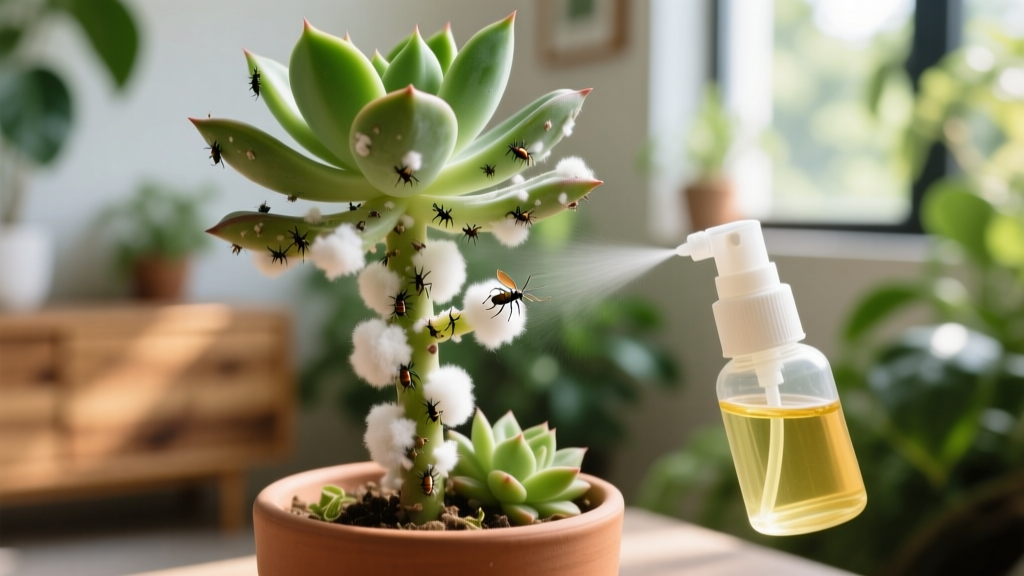
How to Eliminate Mealybugs on Houseplants: A Complete Treatment Guide
The Anatomy of an Infestation: Why Mealybugs Keep Coming Back
Mealybugs on houseplants are not merely a cosmetic nuisance; they are aggressive sap-sucking insects belonging to the Pseudococcidae family. Unlike spider mites or aphids, mealybugs secrete a dense, hydrophobic waxy cuticle that protects them from contact pesticides and environmental stressors. This white, cotton-like armor is precisely why standard watering or casual misting fails to dislodge them.
When treating mealybugs on houseplants, most homeowners fail because they target only the visible adults. A single female can lay up to 600 eggs in a protected ovisac. These eggs hatch into microscopic 'crawlers' within 7 to 10 days, migrating to new leaf axils before maturing. To achieve total eradication, your treatment protocol must break this 21-to-30-day life cycle at multiple stages.
Expert Insight: The presence of black sooty mold on your plant's leaves is a secondary indicator. Mealybugs excrete a sugary waste product called honeydew, which serves as a breeding ground for sooty mold fungi. If you see black powder on lower leaves, look up—the mealybug colony is likely hiding in the stem joints directly above.
The 3-Phase Mealybug Eradication Protocol
This protocol relies on mechanical dissolution, residual growth regulation, and root-zone defense. Follow these phases sequentially for the highest success rate.
Phase 1: Isolation and Contact Dissolution (Days 1-3)
Immediately move the infested plant to a quarantine zone away from your other houseplants. Mealybugs cannot fly, but crawlers can hitch rides on clothing, pets, or watering cans.
- The Solvent: Use 70% isopropyl alcohol. Do not use 91% or 99% concentrations; higher proof alcohol evaporates too quickly to penetrate the mealybug's waxy shell. The 30% water content in 70% alcohol keeps the solution wet long enough to dissolve the cuticle and dehydrate the insect.
- The Application: Dip a cotton swab (Q-tip) directly into the 70% alcohol and dab every visible white mass. Pay special attention to the undersides of leaves, the crotches of petioles, and beneath loose bark.
- Cost & Materials: A 16 oz bottle of 70% isopropyl alcohol costs approximately $3.00. Cotton swabs cost $2.00 per box.
Phase 2: Residual Foliar Treatment (Days 4-14)
Alcohol kills on contact but leaves no residual protection. Once the visible adults are dissolved, you must target the newly hatched crawlers. According to Clemson University HGIC, horticultural oils and insecticidal soaps are highly effective when applied consistently.
- The Product: Use a clarified hydrophobic extract of neem oil (Azadirachtin). Azadirachtin acts as an Insect Growth Regulator (IGR), disrupting the molting process of the crawlers. Products like AzaMax or Bonide Neem Oil RTU are industry standards.
- The Dilution: If using a concentrate like AzaMax, mix 1.5 ounces per gallon of lukewarm water. Add 1/2 teaspoon of mild liquid dish soap (like Dawn) as an emulsifier to prevent the oil from separating.
- The Schedule: Spray the entire plant—top and bottom of leaves, stems, and the top layer of soil—until dripping. Apply at dusk or under dim grow lights to prevent phototoxicity (leaf burn). Repeat every 5 to 7 days for three consecutive weeks.
Phase 3: Root Zone Defense (Days 15-21)
Some species, specifically root mealybugs (Rhizoecus), live entirely below the soil line, feeding on root systems and causing unexplained plant wilting. Furthermore, foliar crawlers frequently drop into the topsoil to hide between feedings.
Instead of using chemical systemic granules (like Imidacloprid), which pose prolonged toxicity risks to indoor pets and are largely banned for indoor ornamental use in several regions, utilize a biological soil drench. Apply Steinernema feltiae beneficial nematodes to the damp soil. These microscopic worms actively hunt and infect soil-dwelling mealybug nymphs without harming the plant's roots. A single application of nematodes (approx. $15-$20 for a million-count pack) provides long-term biological control in the potting medium.
WARNING: What NOT To Do
Never apply isopropyl alcohol or heavy neem oil sprays to plants with fuzzy or highly textured leaves, such as African Violets (Saintpaulia), Peperomia, or Calathea. The liquid will pool in the leaf hairs, causing severe cellular collapse and rot. For these sensitive species, rely exclusively on insecticidal soap sprays and systemic biological controls.
Treatment Decision Matrix: Matching the Cure to the Severity
Not every infestation requires the full nuclear protocol. Use this decision matrix to determine the most efficient, cost-effective treatment based on your current situation.
| Infestation Level | Primary Tactic | Secondary Tactic | Estimated Cost | Time to Eradication |
|---|---|---|---|---|
| Light (1-3 visible clusters on a single stem) | 70% Isopropyl Alcohol spot treatment | Daily visual inspection for 14 days | < $5.00 | 1-2 Weeks |
| Moderate (Multiple stems, honeydew present, crawlers visible) | Alcohol spot + Azadirachtin foliar spray | 3-week spray rotation (every 5 days) | $15.00 - $25.00 | 3-4 Weeks |
| Severe / Root (Plant wilting, soil surface white, heavy leaf drop) | Insecticidal soap drench + Nemotode application | Repotting with sterile soil + pruning dead matter | $30.00 - $45.00 | 4-6 Weeks |
Preventative Quarantine and Maintenance
Eradication is only half the battle. The University of Florida IFAS Extension emphasizes that mealybugs are almost exclusively introduced into a home via newly purchased plants or contaminated potting media. Implement these non-negotiable quarantine rules:
- The 14-Day Rule: Isolate all new plant acquisitions in a separate room for a minimum of 14 days. Inspect the leaf axils and soil surface with a 10x jeweler's loupe before introducing them to your main collection.
- Ant Control: Mealybugs and ants share a symbiotic relationship. Ants will 'farm' mealybugs for their honeydew and actively protect them from predators. If you see ants on your houseplants, you must treat the ant trail with a borax-based bait (like Terro Liquid Ant Bait) to stop them from relocating mealybug crawlers to new plants.
- Nitrogen Management: Avoid high-nitrogen synthetic fertilizers. Excess nitrogen promotes soft, succulent new growth, which is highly attractive to piercing-sucking insects. Switch to a balanced, slow-release organic fertilizer to toughen the plant's cell walls.
Frequently Asked Questions
Can mealybugs survive in dry potting soil?
Yes. While they prefer moist environments, root mealybugs and dormant eggs in the ovisac can survive in dry soil for several weeks. If you are reusing a pot from an infested plant, you must sterilize it with a 10% bleach solution and discard the old soil entirely.
Will a shower wash mealybugs off my plant?
A strong stream of water can dislodge adult mealybugs from sturdy plants like Ficus or Schefflera, but it will not dissolve their waxy coating, nor will it reach crawlers hidden deep inside tight leaf sheaths. Water pressure alone is insufficient for eradication and risks spreading the crawlers to nearby plants via splash-back.
Are mealybugs harmful to humans or pets?
No. Mealybugs do not bite, sting, or transmit diseases to humans, dogs, or cats. They are strictly phytophagous (plant-eating). However, the honeydew they produce can attract nuisance insects like fungus gnats and fruit flies into your home.

