
Pest Control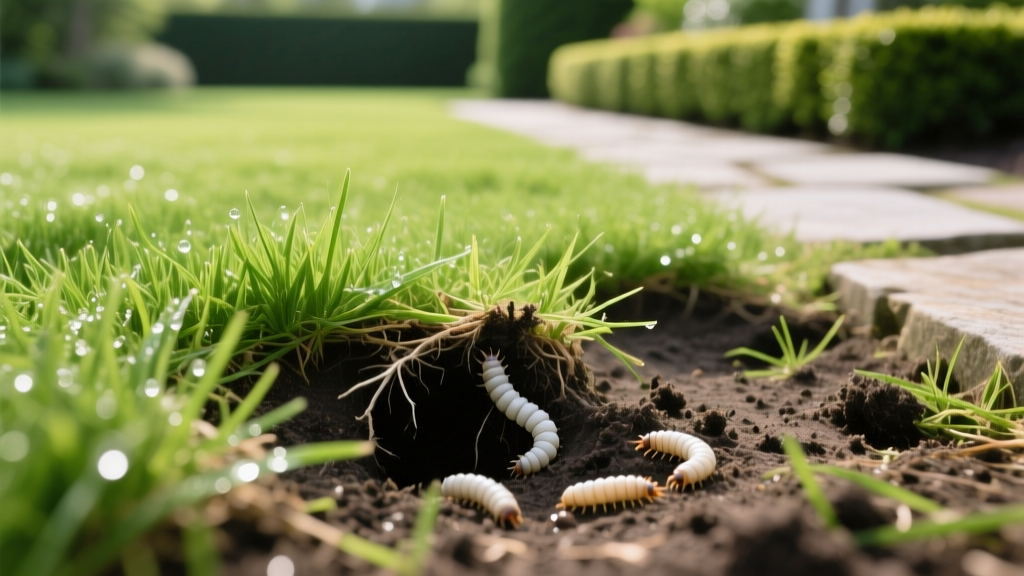
How to Identify, Treat, and Save Grass With Grubs Fast
The Hidden Threat: Why Grubs Destroy Turf Roots
When your lawn develops irregular brown patches and the turf feels spongy underfoot, you are likely dealing with a subsurface infestation. White grubs—the larval stage of scarab beetles like the Japanese beetle (Popillia japonica), European chafer (Rhizotrogus majalis), and June beetle (Phyllophaga)—feed aggressively on the root systems of cool-season and warm-season grasses. Severed roots cannot uptake water or nutrients, leading to rapid turf desiccation. Furthermore, saving grass with grubs requires immediate intervention, as secondary pests like skunks, raccoons, and crows will tear up the remaining sod to feed on the protein-rich larvae.
Warning: Do not rely on a soap flush test to diagnose grubs. Soap flushes only surface insects that hide in the thatch layer (like chinch bugs or sod webworms). Grubs live 2 to 6 inches deep in the soil profile and require physical soil sampling for accurate identification.
Diagnostic Framework: Confirming a Grub Infestation
Before applying any treatment, you must verify the grub population density. Treating grass with grubs unnecessarily wastes money and disrupts soil biology. Use a sharp spade to cut three sides of a 12-inch by 12-inch square of sod, about 3 inches deep. Peel the sod back like a carpet and manually count the C-shaped, creamy-white larvae in the exposed soil and on the root mat.
Grub Threshold Matrix
| Turf Health Status | Japanese Beetle | European Chafer | Action Required |
|---|---|---|---|
| Healthy, well-watered | 10+ per sq ft | 5-10 per sq ft | Monitor; treat if exceeded |
| Stressed, drought-prone | 5-8 per sq ft | 3-5 per sq ft | Immediate curative treatment |
| Visible animal digging | Any presence | Any presence | Treat and repair immediately |
According to the University of Kentucky Entomology Department, European chafers are significantly more destructive than Japanese beetles because their larvae feed later into the fall and begin earlier in the spring, requiring lower threshold interventions.
Biological vs. Chemical Controls: Choosing Your Weapon
The strategy to rescue grass with grubs depends entirely on the current month and the grub's lifecycle stage. Grubs are most vulnerable when they are small and actively feeding near the surface (late summer to early fall). By late fall, they migrate deep into the soil to overwinter, rendering most treatments ineffective.
Active Ingredient Comparison
| Active Ingredient | Common Brand | Type | Best Application Window | Cost per 1,000 sq ft |
|---|---|---|---|---|
| Chlorantraniliprole | Scotts GrubEx1 | Preventative | May to mid-July | $4.50 - $5.50 |
| Trichlorfon | Bayer Advanced 24-Hr | Curative | August to October | $6.00 - $8.00 |
| Heterorhabditis bacteriophora | BioLogic Ecomask | Biological Curative | Late August to September | $12.00 - $15.00 |
| Paenibacillus popilliae | Milky Spore | Biological Preventative | Spring or Fall | $8.00 - $10.00 |
Step-by-Step Eradication and Lawn Recovery Protocol
If you are dealing with an active, curative scenario in late summer or early fall, follow this exact protocol to save grass with grubs and restore the root zone.
Step 1: Apply a Fast-Acting Curative Insecticide
For immediate knockdown of actively feeding grubs, apply a granular product containing Trichlorfon (e.g., Dylox or Bayer 24-Hour Grub Killer). Unlike neonicotinoids which take weeks to translocate through the plant, Trichlorfon degrades rapidly but kills grubs on contact within 24 to 48 hours. Water the lawn with exactly 0.25 inches of irrigation immediately after application to move the chemical into the top 2 inches of the soil profile where the grubs are feeding.
Step 2: Address Secondary Animal Damage
Even after the grubs are dead, skunks and raccoons may continue digging out of habit. To deter mammalian foraging while the turf recovers, lay down biodegradable jute netting or secure bird netting over the damaged areas using landscape staples. Alternatively, apply a castor oil-based repellent (like Chase Mole & Gopher Repellent) which alters the soil scent profile, signaling to foraging mammals that the food source is gone.
Step 3: Slit-Seed and Topdress the Bare Patches
Grub-damaged grass rarely recovers its root mass once completely severed. You must re-establish the turf. Use a slit-seeder to cut shallow furrows (1/4 inch deep) directly into the dead patches. Drop a high-phosphorus starter fertilizer (such as a 10-18-10 NPK ratio) to stimulate rapid root development, followed by premium Kentucky Bluegrass or Tall Fescue seed. Topdress with 1/4 inch of screened compost to retain moisture and protect the seed from birds.
Expert Insight: The University of Minnesota Extension notes that maintaining a mowing height of 3.0 to 3.5 inches promotes deeper, more robust root systems. Turf with deeper roots can sustain higher grub populations before showing visible surface stress, effectively raising your damage threshold.
Preventative Timing Calendar for Long-Term Defense
The most cost-effective way to manage grubs is to prevent the next generation from establishing. If you prefer a chemical-free approach, beneficial nematodes (Heterorhabditis bacteriophora) are highly effective curative agents, but they require strict environmental conditions. Soil temperatures must be above 60°F, and the application must be watered in immediately to prevent UV degradation of the nematodes. For long-term preventative defense, transition to Chlorantraniliprole (Scotts GrubEx1). This anthranilic diamide class insecticide is highly targeted, posing minimal risk to earthworms and pollinators compared to older imidacloprid formulations. Apply it between May 15 and July 15. The active ingredient binds to the thatch and soil, remaining stable until the beetle eggs hatch in August, providing a lethal barrier exactly when the young grubs begin their initial root feeding.

