
Pest Control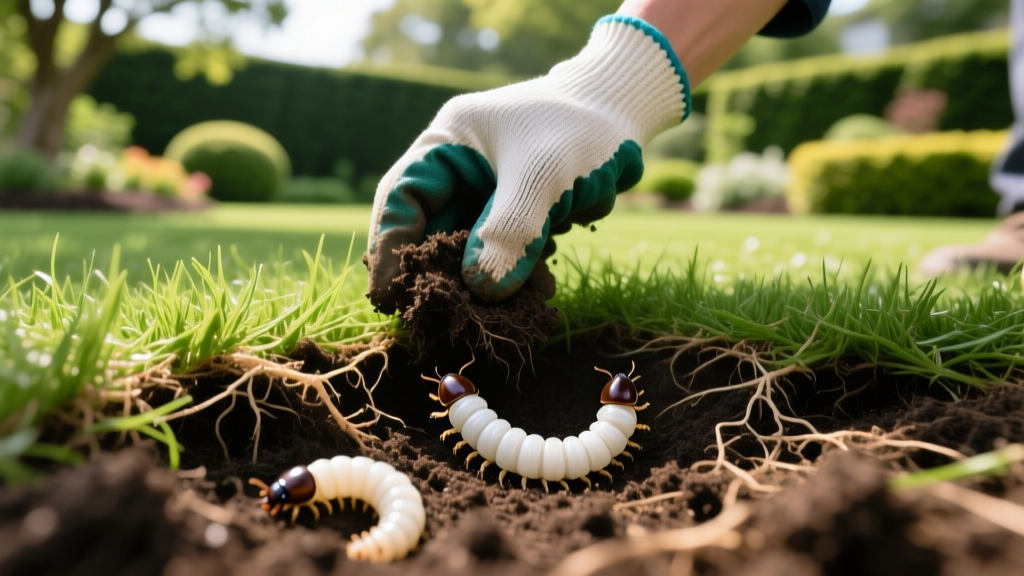
How to Eradicate White Grubs in Soil: The Complete Defense Guide
The Hidden Threat: Understanding White Grubs in Soil
When your lawn develops irregular brown patches that feel spongy underfoot, the damage is rarely just surface-level drought stress. Finding white grubs in soil is the hallmark of a severe subsurface infestation. These C-shaped larvae—primarily the offspring of Japanese beetles, European chafers, and June bugs—feed aggressively on turfgrass roots, severing the plant's ability to uptake water and nutrients. Left unchecked, a moderate infestation can destroy a 5,000-square-foot lawn in under three weeks during peak late-summer feeding cycles.
Effective yard defense requires moving beyond generic 'grub killer' marketing claims. You must correctly identify the grub species, calculate the exact population threshold, and deploy targeted chemical or biological controls at precise phenological windows. According to Ohio State University Extension, treating the wrong life stage is the number one reason homeowners experience treatment failure and subsequent lawn death.
Quick Diagnostic Checklist: The 1-Square-Foot Test
- The Tug Test: Grab a handful of brown turf. If it rolls back like loose carpet with zero root resistance, grubs have severed the root zone.
- The Soil Plug: Use a flat spade to cut a 12x12-inch square of turf, 3 inches deep, and peel it back.
- The Threshold: Count the grubs. Healthy turf can tolerate 5-7 grubs per square foot. Stressed or newly seeded lawns require treatment at 3-5 grubs per square foot. If you count 10 or more, immediate curative action is mandatory.
Grub Species Identification Matrix
Not all white grubs in soil are identical, and their species dictates your biological control options. Examine the 'raster' (the pattern of bristles and bare spots on the underside of the grub's tail end) and the head capsule color to confirm your adversary.
| Species | Raster Pattern | Head Capsule | Peak Damage Window |
|---|---|---|---|
| Japanese Beetle | V-shaped zipper | Chestnut brown | August - October |
| European Chafer | Y-shaped zipper | Light yellow-brown | September - November |
| Oriental Beetle | Transverse, straight line | Dark brown | August - September |
| June Bug (Phyllophaga) | Irregular, no distinct zipper | Reddish-brown | Spring & Fall |
Strategic Treatment Timelines: Preventative vs. Curative
Eradicating white grubs in soil requires matching the active ingredient to the grub's life cycle. Applying a fast-acting curative in June will fail because the eggs haven't hatched; applying a slow-acting preventative in September will fail because the grubs are too large and the chemical will degrade before ingestion.
Preventative Chemical Controls (The Shield)
Preventatives are long-residual chemicals applied before or just as eggs hatch. They do not kill large, third-instar grubs.
- Chlorantraniliprole (e.g., Syngenta Acelepryn G): The gold standard for environmental safety and long residual. Apply between April and early June. It moves slowly through the thatch and soil profile, providing up to 6 months of control. Current Cost: ~$230 for a 115-lb bag covering 43,000 sq. ft. ($5.35 per 1,000 sq. ft.).
- Imidacloprid (e.g., Bayer Merit 0.5G): A neonicotinoid that requires precise timing. Apply mid-June to mid-July. It breaks down faster than Acelepryn, so applying it in April is a wasted investment. Current Cost: ~$65 for a 30-lb bag covering 15,000 sq. ft.
Curative Chemical Controls (The Scalpel)
Curatives are short-residual, fast-acting nerve agents used when you discover active, feeding grubs in late summer or early fall.
- Trichlorfon (e.g., Dylox 6.2 G): The industry standard for emergency knockdown. Apply from August through October. It degrades rapidly in alkaline soils (pH > 7.5), meaning you must water it in immediately and heavily. Current Cost: ~$70 for a 30-lb bag covering 10,000 sq. ft. ($7.00 per 1,000 sq. ft.).
⚠️ Critical Application Warning
Never apply Trichlorfon (Dylox) in the spring. Third-instar grubs waking from winter dormancy are massive, highly resistant to contact poisons, and stop feeding shortly after to pupate into adult beetles. Spring curative applications are a 100% failure rate scenario. Use spring applications only to target early-hatching species or rely on Acelepryn.
Biological Warfare: Nematodes and Milky Spore
For homeowners managing organic yards, pet-safe zones, or properties near sensitive waterways, biological controls offer highly effective alternatives to synthetic neurotoxins.
Heterorhabditis bacteriophora (Hb) Nematodes
Not all nematodes kill grubs. You must specifically source Heterorhabditis bacteriophora (Hb) or Steinernema scarabaei. These microscopic worms hunt grubs, enter their bodies, and release symbiotic bacteria that kill the host within 48 hours.
- Application Rate: 1 billion nematodes per 2,500 square feet.
- Timing: Late August to mid-September when soil temperatures are between 60°F and 85°F.
- Execution Rules: Apply at dusk or on a heavily overcast day. UV light kills nematodes on contact. Pre-water the lawn to moisten the top 2 inches of soil, apply via a hose-end sprayer with the filter removed, and irrigate with 0.25 inches of water immediately after to wash them into the root zone.
- Cost: ~$45 to $60 per 10-million pack (requires refrigerated shipping and storage).
Milky Spore (Paenibacillus popilliae)
Milky spore is a highly specific bacterium that only targets Japanese beetle grubs. It is useless against European chafers or June bugs. While it can establish in the soil for 10-15 years of passive control, it takes 2 to 4 years to build up enough spore density to significantly reduce populations. It is a legacy investment, not an emergency rescue tool.
Step-by-Step Soil Drench and Recovery Protocol
Once you have selected your treatment, follow this exact sequence to ensure the active ingredient reaches the white grubs in soil and the turf recovers.
- Mow and Dethatch: Mow the lawn to 2 inches. If your thatch layer exceeds 0.5 inches, use a power rake to remove it. Thatch acts as a sponge, trapping chemicals and nematodes before they reach the soil.
- Apply the Treatment: Use a calibrated rotary spreader for granular products (set according to the manufacturer's dial for the specific product weight). For liquid nematodes, use a hose-end sprayer.
- The 0.5-Inch Watering Rule: Within 1 hour of application, apply exactly 0.25 to 0.5 inches of irrigation. Use a straight-sided tuna can placed on the lawn to measure the water depth. This washes the chemical off the grass blades and into the top 2-3 inches of soil where the grubs are feeding.
- Restrict Access: Keep children and pets off the treated lawn until the grass is completely dry (usually 4-6 hours for granular products).
- Overseed with Endophytes: Grubs avoid grasses infected with beneficial endophytic fungi. Once the grubs are eradicated, aerate the damaged patches and overseed with endophyte-enhanced tall fescue or perennial ryegrass to create a biological deterrent against future generations.
Defending Against Secondary Scavengers
Often, the most severe lawn damage isn't caused by the white grubs in soil, but by the predators hunting them. Raccoons, skunks, and flocks of crows will aggressively tear up turf, rolling it back in massive sheets to gorge on the protein-rich larvae. According to University of Kentucky Entomology, secondary animal damage frequently peaks in late autumn when grubs move deeper into the soil profile.
To defend your yard against these scavengers, you must eliminate the food source using a fast-acting curative like Trichlorfon. Physical deterrents like motion-activated sprinklers (e.g., the Orbit Yard Enforcer) can provide temporary nighttime protection, but they will not stop a hungry skunk if a massive grub population remains active just beneath the soil surface. Eradicate the grubs, and the mammals will naturally move on to more productive foraging grounds.

