
Pest Control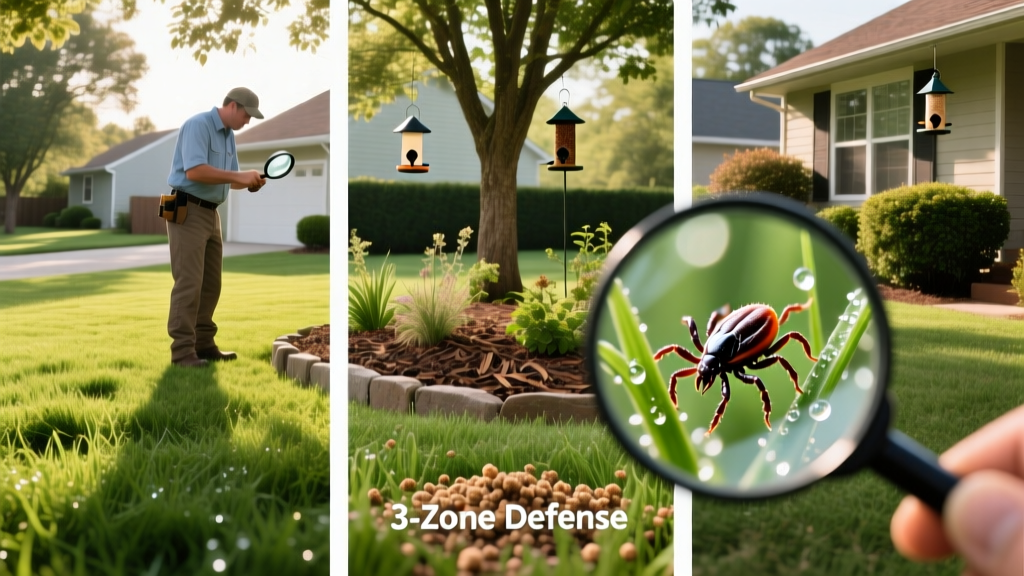
Treating Yard for Ticks: A Beginner’s 3-Zone Defense Guide
Ticks are more than just a nuisance; they are vectors for serious illnesses like Lyme disease, anaplasmosis, and alpha-gal syndrome. When treating yard for ticks, most beginners make the critical mistake of broadcasting pesticides across their entire manicured lawn. This wastes money and fails to target the actual problem. Ticks do not thrive in short, sun-baked grass. They require high humidity and shade, meaning they concentrate heavily in specific microclimates around your property.
To effectively eliminate tick populations, you must adopt a targeted, perimeter-based approach. This guide breaks down the exact biological hotspots, provides a cost-comparison of top-tier chemical and organic treatments, and delivers a precise, step-by-step application protocol for long-term yard defense.
The 3-Zone Tick Defense Strategy
According to research from the Centers for Disease Control and Prevention (CDC), up to 82% of tick encounters on residential properties occur in the transitional edges between lawns and wooded areas. We divide your yard into three distinct management zones to maximize treatment efficacy.
Zone 1: The High-Traffic Perimeter (0–10 feet from the house)
This is your primary living space. The goal here is environmental modification rather than heavy chemical reliance. Keep turfgrass mowed to a maximum height of 3 inches. Remove all leaf litter, tall weeds, and ground-covering vines like ivy, which trap the moisture ticks need to survive. Ensure playground equipment and patios are situated in full-sun areas, as UV radiation naturally desiccates tick populations.
Zone 2: The Transitional Edge (The 3-Foot Barrier)
This is the most critical zone for treating yard for ticks. You must create a physical and chemical barrier between your manicured lawn and any adjacent brush, woods, or stone walls. Install a 3-foot-wide border of dry wood chips or crushed gravel. Ticks are highly reluctant to cross dry, hot, abrasive surfaces. This physical barrier is then supplemented with your primary pesticide application, creating a 'kill zone' for ticks migrating from the woods.
Zone 3: The Deep Woods and Brush
Attempting to spray deep into dense, shaded woods is generally ineffective and ecologically disruptive. Instead, focus on clearing brush piles and pruning lower tree branches to allow sunlight to penetrate the forest floor, naturally reducing the ambient humidity that ticks require.
Chemical vs. Organic: Choosing Your Treatment Arsenal
Selecting the right active ingredient depends on your budget, the severity of the infestation, and the presence of pets or children. Below is a direct comparison of the three most effective solutions available to homeowners in 2026.
| Treatment Type | Active Ingredient / Product | Est. Cost per 5,000 sq ft | Residual Control | Pet & Kid Safety Wait Time |
|---|---|---|---|---|
| Synthetic Chemical | Bifenthrin 7.9% (e.g., Talstar P) | $9.00 | 30–45 days | 2–4 hours (until completely dry) |
| Organic Botanical | Cedarwood Oil (e.g., Wondercide) | $35.00 | 7–14 days | Safe immediately after drying |
| Biological Control | Beneficial Nematodes (S. carpocapsae) | $25.00 | Season-long (if established) | Safe immediately |
Expert Insight: Bifenthrin is the gold standard for rapid, heavy knockdown and long-term residual control. However, it is highly toxic to aquatic life and bees during application. If your property borders a pond or you maintain active pollinator gardens, pivot to Cedarwood oil or Nematodes to protect local ecosystems.
Step-by-Step Application Guide for Bifenthrin
If you have chosen a Bifenthrin-based concentrate like Talstar P, precise calibration is non-negotiable. Over-mixing damages your turf and wastes money; under-mixing fails to kill the ticks.
- Calculate Your Square Footage: Measure only Zone 1 and Zone 2. Do not measure the entire property. A typical suburban edge treatment requires treating roughly 2,000 to 4,000 square feet.
- Mix the Solution: The standard label rate for tick control is 1 fluid ounce of Bifenthrin concentrate per 1,000 square feet. For a 3,000 sq ft edge, mix 3 ounces of concentrate with 3 to 4 gallons of water in a pump sprayer, or use a hose-end sprayer calibrated to 1 oz per gallon.
- Pre-Wet the Area: If the soil is bone-dry, lightly water the edge zones the night before. Ticks will retreat deep into the soil during droughts, making them harder to reach.
- Apply with a Fan Nozzle: Use a coarse fan spray pattern. You want droplets to coat the grass blades, the base of the turf, and the top layer of leaf litter. Avoid a fine mist, which causes chemical drift into non-target areas.
- Target the Undersides: Ticks quest (wait for hosts) on the tips and undersides of tall grass and shrub leaves. Angle your sprayer nozzle upward to coat the lower foliage of any shrubs bordering the woods.
- Enforce the Drying Period: Keep all children and pets off the treated zones for a minimum of 2 to 4 hours, or until the grass is completely dry to the touch.
Common Beginner Mistakes That Ruin Tick Treatments
Warning: The Rainfall Error
Applying Bifenthrin less than 24 hours before a heavy rain event will wash the active ingredient into the soil before it binds to the plant cuticle. Always check the local forecast and ensure a 48-hour dry window post-application for maximum residual bonding.
Applying Bifenthrin less than 24 hours before a heavy rain event will wash the active ingredient into the soil before it binds to the plant cuticle. Always check the local forecast and ensure a 48-hour dry window post-application for maximum residual bonding.
Warning: The Stone Wall Blindspot
Mortared and unmortared stone walls are prime real estate for American Dog Ticks and Blacklegged Ticks due to the high humidity and rodent traffic in the crevices. Beginners often spray the grass near the wall but forget to soak the cracks and crevices of the stone itself. Use a pin-stream nozzle to inject the pesticide deep into wall gaps.
Mortared and unmortared stone walls are prime real estate for American Dog Ticks and Blacklegged Ticks due to the high humidity and rodent traffic in the crevices. Beginners often spray the grass near the wall but forget to soak the cracks and crevices of the stone itself. Use a pin-stream nozzle to inject the pesticide deep into wall gaps.
Seasonal Timing: When to Spray for Maximum Impact
Timing your application to the biological life cycle of the tick is just as important as the chemical you use. According to data from Penn State Extension, tick activity is strictly temperature-dependent.
- Early Spring (The First Application): Deploy your first treatment when daytime temperatures consistently hit 45°F to 50°F. This targets overwintering adult ticks and early-emerging nymphs before they have a chance to mate and lay eggs.
- Early Summer (The Nymph Peak): Nymphs (the size of a poppy seed) are responsible for the majority of human Lyme disease transmissions because they are nearly invisible. Schedule a second application in late May or early June to intercept this highly dangerous life stage.
- Early Fall (The Winter Prep): A final application in September or early October targets adult ticks seeking their final blood meal before winter dormancy, drastically reducing the overwintering population that will emerge the following spring.
By combining the 3-zone environmental strategy with precise, seasonally timed chemical or organic applications, you can reduce tick populations on your property by up to 90%. Consistency and targeting the transitional edges—not the middle of the lawn—are the true secrets to a tick-free yard.

