
Pest Control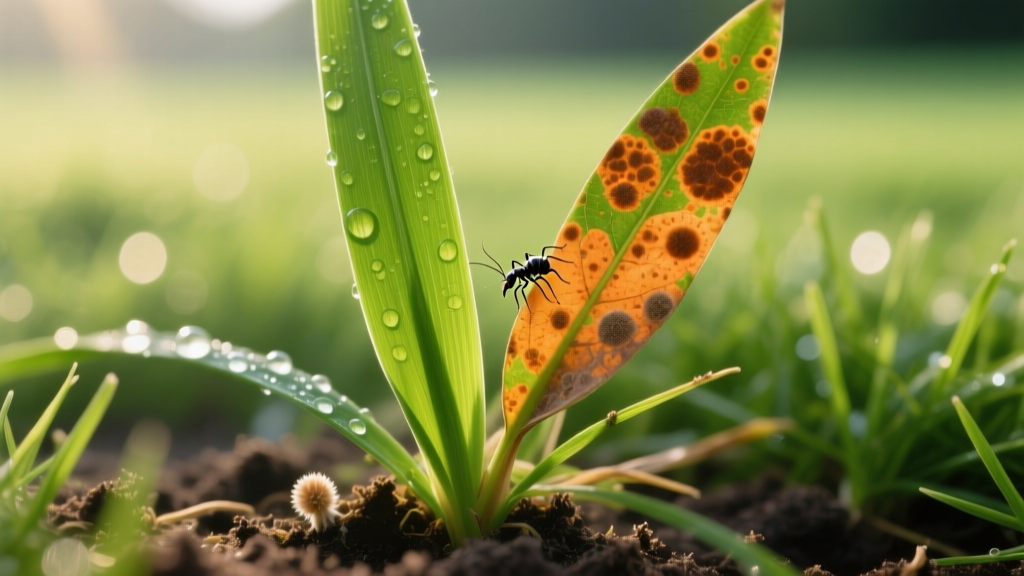
Turfgrass Leaf Rust: Diagnosis, Treatment, and Prevention Guide
The Pathogen Profile: Understanding Puccinia in Turfgrass
Leaf rust in turfgrass is primarily caused by fungal pathogens in the Puccinia genus, most notably Puccinia coronata (crown rust) and Puccinia graminis (stem rust). Unlike necrotrophic fungi that kill tissue to feed, rust fungi are obligate parasites. They require living plant cells to survive and reproduce, extracting nutrients directly from the turfgrass foliage. This biological distinction is critical for diagnosis and treatment: because the fungus relies on living tissue, it rarely kills the entire turf canopy outright unless the infection is severe and compounded by environmental stress.
According to Penn State Extension, rust spores require 6 to 8 hours of continuous leaf wetness to germinate and penetrate the stomata. Once inside, the mycelium grows intercellularly, eventually erupting through the leaf epidermis to form uredinia—the characteristic orange, powdery pustules that release millions of windborne spores. These infections typically peak in late summer and early fall when daytime temperatures hover between 65°F and 75°F, nights are cool, and heavy morning dew provides the necessary canopy moisture.
Quick Symptom Checklist:
- Orange, yellow, or brown powdery pustules on individual grass blades.
- Orange dust transferring to shoes, mower decks, and pet paws.
- Generalized yellowing or thinning of the turf canopy from a distance.
- Severe leaf tip dieback and shredding of the leaf margins.
Symptom Matrix: Differentiating Rust from Look-Alike Diseases
Misdiagnosis leads to wasted chemical applications. While the orange dust is a dead giveaway for advanced rust, early-stage infections manifest as small yellow flecks that mimic other foliar diseases. Use the matrix below to differentiate leaf rust from common look-alikes before selecting a treatment protocol.
| Disease | Primary Foliar Symptom | Temperature Range | Key Differentiator |
|---|---|---|---|
| Leaf Rust | Orange/yellow powdery pustules | 65°F - 75°F | Spores rub off on fingers/shoes |
| Red Thread | Pink/red sclerotia at leaf tips | 60°F - 75°F | Visible pink thread-like structures |
| Dollar Spot | Hourglass-shaped straw-colored lesions | 60°F - 85°F | White cobweb mycelium in morning dew |
| Brown Patch | Large circular brown patches | 75°F - 90°F | Distinct dark smoke-ring border |
Cultural Control Protocol: Starving the Fungus
Because rust fungi attack slow-growing, stressed turf, cultural manipulation is often enough to eradicate the disease without chemical intervention. The goal is to stimulate rapid vertical growth, forcing the plant to shed infected leaf tissue through regular mowing.
1. The Nitrogen Push Strategy
Rust thrives in nitrogen-deficient environments. Applying 0.5 to 1.0 lbs of actual nitrogen per 1,000 square feet using a fast-release source like Urea (46-0-0) will stimulate rapid foliage production. As the grass grows, the infected leaf tips are mowed off and removed, effectively eliminating the spore-producing structures. In 2026, a 50 lb bag of agricultural urea costs approximately $25-$35, making this the most cost-effective first line of defense.
2. Canopy Moisture Management
Rust spores cannot germinate without prolonged leaf wetness. Transition your irrigation schedule from frequent, light waterings to deep, infrequent cycles. Water only between 4:00 AM and 6:00 AM so the canopy dries rapidly once the sun rises. If morning dew is heavy, use a bamboo pole or a drag mat to physically remove moisture from the leaf surface before the sun bakes the spores into the stomata.
3. Thatch Reduction and Airflow
A thatch layer exceeding 0.5 inches traps humidity at the soil line, creating a microclimate ideal for Puccinia sporulation. Perform core aeration in early fall to break up compacted soil and improve drainage. Prune overhanging tree branches to increase sunlight penetration and wind velocity across the turf canopy, which accelerates foliar drying.
Chemical Intervention: Fungicide Selection and Application Rates
When cultural practices fail to halt the spread, or when high-value turf (such as golf course fairways or premium residential Kentucky bluegrass lawns) is severely threatened, targeted fungicide applications are required. University of Minnesota Extension recommends utilizing systemic fungicides that penetrate the leaf tissue and halt mycelial growth.
Fungicide Resistance Warning: Rust fungi have a high genetic mutation rate. Repeatedly applying the same Fungicide Resistance Action Committee (FRAC) class will result in resistant pathogen strains. Always rotate between FRAC Group 3 (DMI inhibitors) and FRAC Group 11 (QoI/Strobilurins) or tank-mix them to protect chemical efficacy.
Top Active Ingredients for Leaf Rust
- Propiconazole 14.3% (FRAC 3): Found in products like Banner MAXX II and generic equivalents. Apply at a rate of 1.0 to 2.0 fl oz per 1,000 sq ft. Propiconazole offers excellent curative action, halting existing infections within 48 hours. Expect to pay $90-$120 per pint for professional-grade formulations.
- Azoxystrobin 23% (FRAC 11): The active ingredient in Heritage SC and Scotts DiseaseEx. Apply at 0.4 to 0.8 fl oz per 1,000 sq ft for liquid applications, or follow granular label rates (typically 2-4 lbs per 1,000 sq ft). Azoxystrobin is highly effective as a preventative but has limited curative reach once pustules have erupted.
- Flutriafol 10% + Pyraclostrobin 15% (FRAC 3 + 11): Premix products like Headway provide dual modes of action, offering both immediate knockdown and extended residual protection (up to 28 days).
Application Timelines and Tank Mixing
For severe outbreaks, execute a curative tank mix: combine 1.5 fl oz of Propiconazole with 0.4 fl oz of Azoxystrobin per 1,000 sq ft. Apply in 1.5 to 2.0 gallons of water per 1,000 sq ft to ensure thorough coverage of the leaf blade. Do not irrigate for at least 24 hours post-application to allow the systemic chemicals to translocate through the xylem.
Preventative Maintenance Calendar
Long-term management of leaf rust requires aligning your agronomic practices with the pathogen's life cycle. Implement this seasonal framework to maintain turf resilience:
- Early Spring (April-May): Conduct soil testing. Address phosphorus or potassium deficiencies, which weaken cell walls and make stomatal penetration easier for rust spores.
- Early Summer (June): Raise mowing heights to 3.0 - 3.5 inches. Taller grass shades the soil, reducing evaporation and maintaining deeper root systems that resist environmental stress.
- Late Summer (August-September): Monitor for the first signs of yellow flecking. Apply a preventative strobilurin (FRAC 11) application if the lawn has a history of severe rust outbreaks and extended periods of overcast, humid weather are forecasted.
- Autumn (October-November): Execute the nitrogen push strategy. Apply a final dose of fast-release nitrogen to promote root carbohydrate storage and aggressively mow off any late-season rust infections before winter dormancy.
By combining precise nitrogen management, strategic moisture control, and scientifically rotated fungicide chemistries, you can effectively eradicate leaf rust and maintain a dense, resilient turfgrass canopy year-round.

