
Pest Control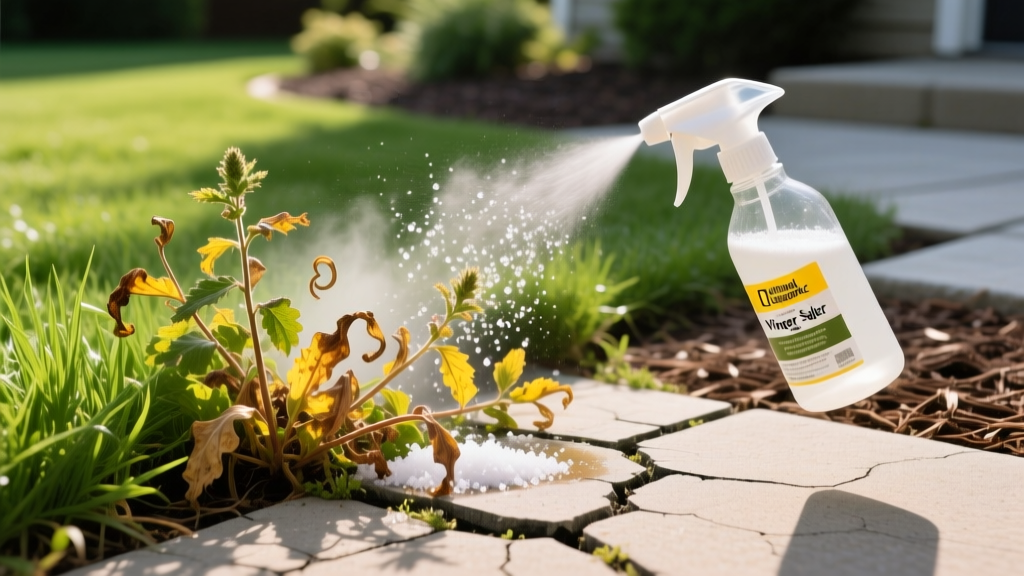
Vinegar and Salt Weed Killer: Safe Recipes & Soil Risks
The Chemistry of Desiccation: How It Works
The internet is flooded with DIY herbicide recipes, but the vast majority fail to explain the underlying plant physiology or the long-term edaphic (soil) consequences. A vinegar and salt weed killer relies on two distinct mechanisms to destroy plant tissue: rapid desiccation and osmotic stress. Understanding these mechanisms is the difference between a successful organic weed control strategy and permanently sterilizing your garden beds.
Acetic acid (the active component in vinegar) is a contact herbicide. When applied at concentrations of 20% to 30%, it rapidly dissolves the waxy cuticle on the leaf surface, causing the plant to lose its moisture barrier. The foliage desiccates and dies within hours. However, acetic acid does not translocate to the roots. This is where the salt component comes in, acting as a systemic stressor that disrupts the plant's internal water balance, though its efficacy on deep taproots remains limited.
⚠️ Critical Distinction: Kitchen vs. Horticultural Vinegar
Standard culinary vinegar is 5% acetic acid. This concentration will only burn the tips of young, tender weed seedlings and is entirely ineffective on mature broadleaf weeds or grasses. For a functional DIY herbicide, you must source horticultural vinegar (20% to 30% acetic acid). Note that at 20%+, acetic acid is classified as a severe eye irritant and requires proper PPE (goggles, gloves, long sleeves) during handling.
The Formulation: Two Distinct Recipes
The most dangerous mistake homeowners make is blindly following recipes that call for "table salt" (sodium chloride) without specifying the application zone. Sodium is highly toxic to soil structure. Therefore, we must split the formulation into two distinct recipes based on your target area.
| Ingredient | Driveway/Patio Formula (Sterilant) | Soil-Safe Garden Formula |
|---|---|---|
| Base | 1 Gallon 20% Horticultural Vinegar | 1 Gallon 20% Horticultural Vinegar |
| Salt Type | 1 Cup Table Salt (Sodium Chloride) | 1 Cup Epsom Salt (Magnesium Sulfate) |
| Surfactant | 1 tbsp Liquid Dish Soap | 1 tbsp Non-Ionic Surfactant or Dish Soap |
| Best Use Case | Gravel, driveway cracks, sidewalk seams | Near garden beds, lawns, tree root zones |
| Approx. Cost (2026) | $28.00 per gallon | $32.00 per gallon |
By substituting sodium chloride with magnesium sulfate (Epsom salt) in the soil-safe formula, you introduce a mild osmotic shock to the weeds while actually providing trace magnesium to the surrounding soil, completely avoiding the destructive effects of sodium.
The Sodium Trap: Why Table Salt Destroys Soil
To understand why the "Driveway Formula" must never be used in planting beds, we must look at soil chemistry—specifically, the Cation Exchange Capacity (CEC). Soil particles (clay and organic matter) carry a negative charge and hold onto positively charged ions (cations) like calcium (Ca2+), magnesium (Mg2+), and potassium (K+), which are essential for plant growth.
When you apply sodium chloride (NaCl) to soil, the sodium ions (Na+) aggressively displace calcium and magnesium on the soil exchange sites. According to research from the University of Minnesota Extension, high sodium levels cause clay particles to repel one another rather than clump together. This process, known as deflocculation, destroys soil structure, resulting in a hard, impermeable crust that prevents water infiltration and root respiration. Once a garden bed is heavily salted, it can take years of gypsum (calcium sulfate) applications and deep tilling to remediate the soil profile.
"While vinegar and salt mixtures will burn the foliage of weeds, the salt component persists in the soil indefinitely. It is a non-selective sterilant that will prevent future seed germination and damage the microbial food web long after the vinegar has broken down." — Adapted from NC State Cooperative Extension guidelines on organic weed management.
Step-by-Step Application Protocol
Even the perfect recipe will fail if applied under the wrong environmental conditions. Contact herbicides require specific weather parameters to maximize tissue burn before the solution evaporates or dilutes.
- Check the Forecast: Select a day with zero rain in the 24-hour forecast. Wind speeds must be under 5 mph to prevent drift onto desirable plants.
- Timing is Critical: Apply between 10:00 AM and 2:00 PM. The intense UV radiation and peak heat accelerate the desiccation process, causing the leaf cuticle to collapse faster than the plant can repair it.
- Mix in a Pump Sprayer: Do not mix in a hose-end sprayer. Use a dedicated 1-gallon or 2-gallon polyethylene pump sprayer. Add the salt first, swirl to dissolve in a small amount of warm water, then add the vinegar and surfactant last to prevent excessive foaming.
- Saturate the Foliage: Spray until the leaves are glistening but not dripping. Because acetic acid does not move systemically through the phloem, 100% leaf coverage is mandatory.
- Follow-Up Treatment: For perennial weeds with deep taproots (like bindweed or dandelions), the top growth will die in 24 hours, but the root will likely push new shoots in 10-14 days. Reapply the solution immediately when new shoots are 1-2 inches tall to exhaust the root's carbohydrate reserves.
Troubleshooting Common Failures
If your vinegar and salt weed killer is underperforming, diagnose the issue using these common failure modes:
- Failure Mode: Weeds turn brown but recover completely within a week.
Diagnosis: You used 5% household vinegar, or you sprayed on a cool, cloudy day (below 65°F). Fix: Upgrade to 20% horticultural vinegar and apply during peak afternoon heat. - Failure Mode: Desirable plants nearby show severe necrosis or dieback.
Diagnosis: Herbicide drift or soil splash. Fix: Switch to a stream-jet nozzle instead of a fine mist fan nozzle, and use a physical cardboard shield when spraying near bed edges. - Failure Mode: The sprayer nozzle clogs constantly.
Diagnosis: Undissolved salt crystals or impurities in cheap Epsom salt. Fix: Pre-dissolve the salt in 1 cup of hot water before adding it to the main vinegar tank, and install an inline mesh filter on your sprayer wand.
When to Abandon DIY for Commercial Organics
While formulating your own vinegar and salt weed killer is cost-effective for small driveways, mixing and handling 20% acetic acid carries significant respiratory and ocular risks. If you are managing large areas or prefer a stabilized, OMRI-listed (Organic Materials Review Institute) product, commercial d-limonene (citrus oil) and clove oil (eugenol) emulsions often provide superior cuticle penetration without the soil-salinity risks associated with DIY salt mixes. Products like Avenger Weed Killer or Green Gobbler (priced around $45–$60 per gallon in 2026) utilize advanced emulsifiers that keep the active organic acids suspended evenly, eliminating the need for manual surfactant mixing and ensuring consistent burn rates across varied weed species.

