
Pest Control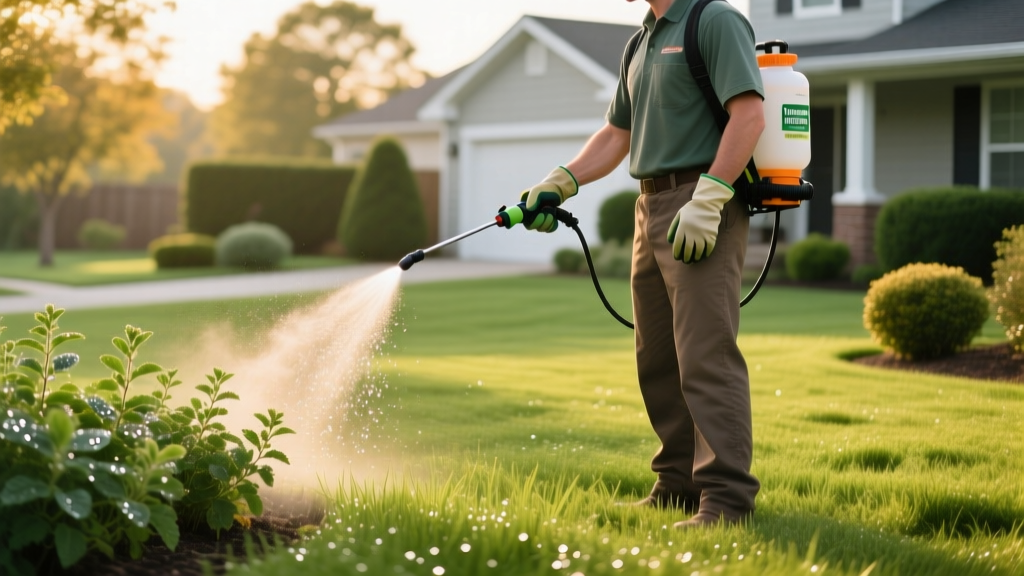
When to Apply Virginia Buttonweed Killer: Regional Timing Guide
The Biological Challenge of Virginia Buttonweed
Virginia buttonweed (Diodia virginiana) is widely considered the most difficult broadleaf weed to eradicate in warm-season southern lawns. Unlike standard broadleaf weeds like dandelions or clover, buttonweed possesses a complex survival architecture: a deep taproot, an extensive rhizome network, and the ability to propagate from both seeds and root fragments. Furthermore, its leaves are covered in microscopic, waxy trichomes (hairs) that actively repel water-based herbicide solutions, causing droplets to bead up and roll off onto the soil.
Because of this biological armor, the specific virginia buttonweed killer you choose is only half the battle. The other half—and arguably the more critical factor—is seasonal timing. Applying the wrong chemistry at the wrong phenological stage, or spraying when regional temperatures trigger turfgrass phytotoxicity, will result in expensive failures. According to NC State TurfFiles, mature buttonweed stands often require two to three sequential applications spaced 21 to 28 days apart to achieve complete control.
Regional Application Calendars: Deep South vs. Upper South
Seasonal timing for buttonweed control is strictly dictated by your specific USDA Hardiness Zone and regional soil temperatures. The Deep South (Zones 8b-10a) experiences earlier emergence and longer growing seasons than the Upper South/Transition Zone (Zones 7a-8a). Below is the definitive 2026 regional calendar for post-emergent herbicide applications.
| Month | Deep South (FL, South TX, South GA, Gulf Coast) | Upper South (NC, VA, North TX, TN, AR) |
|---|---|---|
| March | Weed is emerging. Apply pre-emergent (though largely ineffective on buttonweed). Focus on soil aeration to reduce compaction. | Turf and weed are dormant. Do not apply post-emergent herbicides. |
| April | CRITICAL WINDOW 1: Apply first post-emergent treatment while weeds are young (2-4 leaf stage) and actively translocating nutrients to roots. | Monitor for early emergence as soil temps cross 65°F. Prepare sprayer equipment. |
| May | CRITICAL WINDOW 2: Apply second sequential treatment 21-28 days after the first. Target late-emerging flushes. | CRITICAL WINDOW 1: Apply first post-emergent treatment as buttonweed enters rapid vegetative growth. |
| June | Monitor for survivors. Spot treat only. Avoid broadcast spraying if daytime highs exceed 85°F to prevent vapor drift and turf burn. | CRITICAL WINDOW 2: Apply second sequential treatment. Ensure adequate soil moisture prior to application. |
| July - August | Emergency spot-treatments only. The weed is likely setting seed; systemic herbicides translocate poorly during peak heat stress. | Spot-treat survivors. Avoid broadcast applications during summer heat dormancy. |
| September | FINAL WINDOW: Apply late-season treatment to kill mature plants before they drop seeds into the soil bank for next year. | FINAL WINDOW: Apply late-season treatment as temperatures drop below 85°F and weeds begin storing carbohydrates in roots for winter. |
Top Virginia Buttonweed Killer Formulations
Standard 2,4-D and Dicamba mixes found at big-box hardware stores will only burn the top foliage of buttonweed, leaving the rhizome network intact to resprout within three weeks. Professional-grade formulations are required. Here are the top-performing chemistries for 2026, including exact cost-per-application metrics.
1. Celsius WG (Bayer)
Active Ingredients: Thiencarbazone-methyl (15.2%), Iodosulfuron-methyl-sodium (1.9%), Dicamba (5.5%).
Mode of Action: ALS inhibitor + Synthetic Auxin.
Best For: St. Augustine, Centipede, Bermuda, and Zoysia. Highly effective on mature, drought-stressed buttonweed.
Cost Analysis: A 10 oz bottle retails for approximately $165. At the label rate of 0.057 oz per 1,000 sq ft, the cost is roughly $0.94 per 1,000 sq ft per application. This makes it the most cost-effective professional option despite the high upfront bottle price.
2. SpeedZone Southern (PBI Gordon)
Active Ingredients: 2,4-D, MCPP-p, Dicamba, Carfentrazone-ethyl.
Mode of Action: Synthetic Auxin + PPO Inhibitor.
Best For: Rapid visual burn-down. The Carfentrazone provides visible browning within 24 hours, which satisfies impatient homeowners, but systemic translocation is weaker than Celsius WG.
Cost Analysis: Retailing around $75 per gallon. At the label rate of 3.0 fl oz per 1,000 sq ft, the cost is approximately $1.75 per 1,000 sq ft.
3. Dismiss South (FMC)
Active Ingredients: Sulfentrazone, Imazethapyr.
Best For: Lawns heavily infested with both buttonweed and purple/yellow nutsedge. Safe on most warm-season grasses but requires careful calibration on St. Augustine.
⚠️ Surfactant Science: The Missing Link
Never apply a virginia buttonweed killer without a surfactant. The waxy trichomes on buttonweed leaves require a Methylated Seed Oil (MSO) or a high-quality Non-Ionic Surfactant (NIS) to break surface tension. MSO is strictly required for Celsius WG to penetrate the leaf cuticle. Apply at a rate of 1 to 2 pints per 100 gallons of spray solution (approx. 1/2 teaspoon per gallon for backpack sprayers). According to UF/IFAS Extension, omitting the surfactant reduces buttonweed control efficacy by up to 60%.
Step-by-Step Application Protocol
To maximize herbicide translocation and minimize turf stress, follow this precise application sequence:
- Pre-Water the Turf: Irrigate the lawn 24 hours before application. Buttonweed and turfgrass must be actively growing and not under drought stress for systemic herbicides to move through the plant's phloem.
- Calibrate the Sprayer: Use a backpack sprayer calibrated to deliver 1.5 to 2.0 gallons of finished solution per 1,000 sq ft. This ensures adequate coverage without excessive runoff.
- Select the Right Nozzle: Use an Air Induction Extended Range (AIXR) or Turbo TeeJet Induction (TTI) nozzle. These produce coarse, air-filled droplets that resist wind drift and shatter upon impact, penetrating the dense buttonweed canopy to reach the lower stems.
- Mix Order (WALES): Add ingredients in this order: Wettable powders (Celsius WG), Agitate, Liquid surfactants (MSO), Emulsifiable concentrates, Soluble liquids. Fill the tank halfway with water before adding chemicals.
- Post-Application Wait: Do not mow for 48 hours before or 48 hours after application. Do not irrigate for at least 24 hours to allow the herbicide to fully absorb through the foliar tissue.
Common Failure Modes and Edge Cases
Why did your previous application fail? Lawn care professionals frequently encounter these specific edge cases when treating buttonweed:
The 'Brown Top, Green Root' Illusion
If you used a product containing Carfentrazone (like SpeedZone) or applied a systemic herbicide during high heat (above 88°F), the top foliage will rapidly necrosis (turn brown). However, the heat stress shuts down the plant's internal transport system. The herbicide never reaches the rhizomes. Three weeks later, the weed resprouts from the roots. Solution: Always apply systemic herbicides when daytime temperatures are between 70°F and 85°F, ideally in the early morning.
Floratam St. Augustine Phytotoxicity
While Celsius WG is generally safe for St. Augustinegrass, the specific 'Floratam' cultivar is highly sensitive to certain herbicides during periods of rapid growth or temperature fluctuations. Applying 2,4-D heavy mixes to Floratam in late spring can cause severe stunting and yellowing. Solution: Stick to the lowest label rates of Celsius WG and avoid SpeedZone Southern on Floratam entirely.
Compacted Soil Synergy
Buttonweed is an indicator weed for heavy, wet, compacted soils. If you continuously apply herbicides without addressing the soil structure, the buttonweed will outcompete the weakened turfgrass every season. Solution: Pair your chemical control with core aeration in late spring and top-dressing with compost to improve drainage and give your Bermuda or Zoysia the biological advantage.
Frequently Asked Questions
Will pre-emergent herbicides stop Virginia buttonweed?
No. Pre-emergents like Prodiamine or Dithiopyr are largely ineffective against buttonweed because it primarily spreads through deep rhizomes and root fragments that bypass the chemical barrier in the top inch of soil. Post-emergent systemic herbicides are mandatory for control.
Can I use Glyphosate (Roundup) on buttonweed?
Only if your warm-season turf (like Bermuda or Zoysia) is completely dormant in late winter. Glyphosate is non-selective and will kill any green tissue it touches. Spot-treating with a sponge applicator during summer is possible but highly risky and impractical for large infestations.
How many applications does it take to fully eradicate a severe infestation?
For a severe, multi-year infestation, expect to execute a minimum of three applications per season (Spring, early Summer, early Fall) over the course of two consecutive years to deplete the soil seed bank and exhaust the deep rhizome networks.

