
Pest Control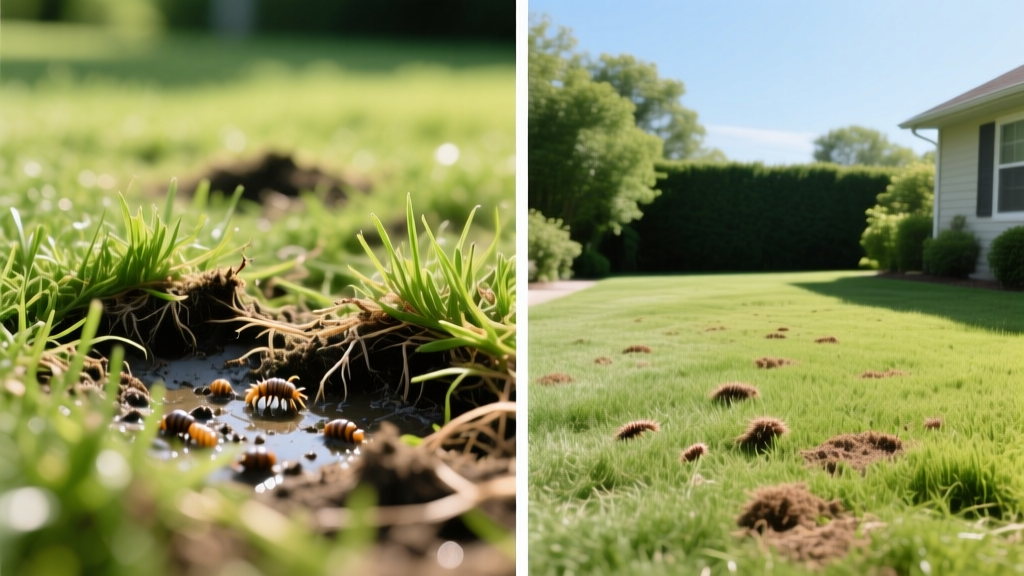
Identifying Signs of Grubs in Lawn Pictures vs. Your Actual Yard
The Visual Deception: Why Lawn Pictures Can Mislead
Homeowners frequently search for signs of grubs in lawn pictures hoping for a quick, definitive match to the brown patches destroying their turf. However, relying solely on internet photos is a diagnostic trap. Lighting conditions, grass species variations, and secondary damage from foraging wildlife can make drought stress, brown patch fungus, and grub damage look virtually identical in photographs. True identification requires moving beyond 2D images and performing physical stress tests on your turf.
White grubs—the larval stage of Japanese beetles, June bugs, and European chafers—feed exclusively on grassroots. This severs the plant's ability to uptake water and nutrients, creating irregular brown patches that typically emerge in late summer or early fall. To accurately diagnose your lawn, you must cross-reference visual cues with tactile soil inspections.
Visual Checklist: Translating Photos to Your Yard
When comparing your lawn to reference pictures, look for these specific structural anomalies rather than just color changes:
- The Carpet Roll Effect: In advanced infestations, the turf loses all root anchorage. If you grab a handful of brown grass and pull, it should roll back like a freshly laid carpet. In pictures, this looks like peeling sod; in your yard, it feels entirely detached from the soil.
- Spongy Turf Texture: Before browning occurs, grub-damaged areas often feel unusually spongy underfoot due to the hollowed-out soil structure beneath the thatch layer.
- Irregular Patch Margins: Unlike fungal diseases that often form distinct rings or uniform circles, grub damage creates jagged, irregular brown margins that expand outward as the larvae migrate through the soil profile.
- Secondary Predator Damage: Pictures of grub damage often inadvertently show the aftermath of skunks, raccoons, and crows. If you see deep, cone-shaped divots or large sections of turf flipped entirely upside down, the visual damage is from predators hunting the grubs, not the grubs themselves.
Warning: The Wildlife Indicator
If crows are systematically pecking small holes in your lawn, or skunks are tearing up 12-inch sod flaps at night, you have a high-density grub population. Wildlife can smell the larvae from the surface and will cause more cosmetic damage to your yard than the insects themselves. Immediate curative treatment is required to stop the foraging cycle.
If crows are systematically pecking small holes in your lawn, or skunks are tearing up 12-inch sod flaps at night, you have a high-density grub population. Wildlife can smell the larvae from the surface and will cause more cosmetic damage to your yard than the insects themselves. Immediate curative treatment is required to stop the foraging cycle.
Decoding the Damage: Grubs vs. Drought vs. Fungus
Use this diagnostic matrix to differentiate between the three most common causes of late-summer lawn browning. While pictures might blur these distinctions, physical inspection will isolate the exact culprit.
| Diagnostic Feature | White Grub Damage | Drought Stress | Brown Patch Fungus |
|---|---|---|---|
| Tug Test Result | Turf detaches easily with zero resistance | Turf holds firmly; roots remain anchored | Turf holds firmly; leaf blades pull out easily |
| Root Appearance | Roots are sheared off; soil is loose | Roots are intact but dry and brittle | Roots are intact; dark lesions on crown |
| Patch Shape | Irregular, sprawling, expanding margins | Uniform browning across entire zones | Circular rings with smoke-gray borders |
| Soil Moisture | Soil may be moist, but grass still wilts | Soil is hard, cracked, and hydrophobic | Soil is heavily saturated and humid |
The 12-Inch Soil Sampling Protocol
Visual identification must be confirmed with a physical soil count. According to turfgrass entomologists at Penn State Extension, the economic injury threshold for most residential lawns is 5 to 10 grubs per square foot. Below this threshold, turf can naturally outgrow the root feeding. Follow this exact protocol to determine your grub density:
- Select the Test Zone: Choose an area at the margin of a brown patch where the grass is just beginning to wilt or turn yellow. Dead, completely brown zones often yield false negatives because the grubs have already migrated deeper or moved on.
- Cut the Sample: Using a flat spade or a dedicated sod cutter, carve a 12-inch by 12-inch square into the turf. Cut exactly 3 inches deep to penetrate the thatch and upper root zone.
- Peel and Inspect: Roll back the sod square. Examine the exposed soil and the underside of the thatch layer.
- Count and Identify: Count the C-shaped, white larvae. Note that University of Kentucky Entomology notes Japanese beetle grubs have a V-shaped raster pattern (bristles) on their underside, while June bug grubs have a zipper-like pattern. This distinction matters for biological controls.
- Calculate Density: Multiply your count by 0.69 if you used a circular shovel, or use the raw count for a 12x12 square (which equals exactly one square foot). If you find more than 7 grubs, treatment is mandatory.
Treatment Decision Tree: Chemical vs. Biological Controls
Once you have confirmed a high-density grub population via physical sampling, select your treatment based on the current month and the grub's life cycle stage. Applying the wrong active ingredient at the wrong time is the most common failure mode in DIY lawn care.
Preventative Window (June 1 - July 15)
If you are treating before damage appears, or if you had a severe infestation last year, use a long-residual systemic insecticide.
- Active Ingredient: Chlorantraniliprole (Trade name: Acelepryn).
- Cost & Application: Approximately $110 to $140 for a commercial-grade liquid concentrate that treats up to 10,000 sq ft. It requires 0.5 inches of irrigation immediately after application to move the chemical into the root zone.
- Efficacy: Provides 4 to 5 months of residual control. It is highly targeted and poses minimal risk to pollinators compared to older neonicotinoids like Imidacloprid.
Curative Window (August 1 - October 15)
If you are seeing active damage and pulling up mature, third-instar grubs, preventatives will not work. You need a fast-acting contact killer.
- Active Ingredient: Trichlorfon (Trade name: Dylox 6.2G).
- Cost & Application: Roughly $65 for a 40lb granular bag covering 10,000 sq ft. Must be watered in heavily (at least 0.5 inches) to dissolve the granules and reach the deeper soil profile where mature grubs feed.
- Efficacy: Kills active grubs within 24 to 72 hours. However, it has a very short residual life (only 7-10 days), meaning it will not protect against future hatches.
Organic & Biological Control
For homeowners avoiding synthetic chemicals, Beneficial Nematodes are the only proven organic alternative, but species selection is critical.
- Specific Strain: You must purchase Heterorhabditis bacteriophora (Hb strain). Do not buy Steinernema carpocapsae; it stays too close to the soil surface to reach deep-feeding grubs.
- Application Rate: Apply at a rate of 1 billion nematodes per acre (approx. 25,000 per square foot).
- Cost & Constraints: Expect to pay $40 to $60 per million nematodes. They are living organisms and must be kept refrigerated until application. Apply only in the late evening or on overcast days, as UV light kills them instantly. The soil must remain consistently moist for 14 days post-application for the nematodes to hunt effectively.
FAQ: Visual Identification Edge Cases
Why does my lawn look like the grub pictures, but the tug test fails?
If the grass is brown but the roots are firmly anchored, you are likely dealing with localized drought stress or a fungal pathogen like Dollar Spot. Grubs physically chew through the roots; if the roots are intact, grubs are not the primary cause of the browning.
Can I treat for grubs in the spring?
Spring treatment is highly inefficient. In April and May, grubs are maturing, pupating, and moving deeper into the soil to transition into adult beetles. They feed very little during this window. Applying Dylox or Acelepryn in spring wastes money and leaves no residual protection for the actual egg-hatching period in late July.
Do grub control products also kill earthworms?
Chlorantraniliprole (Acelepryn) is highly selective and does not harm earthworms or beneficial soil arthropods. Older chemicals like Carbaryl (Sevin) are highly toxic to earthworms and should be avoided in modern turf management programs to preserve soil aeration and health.

