
Pest Control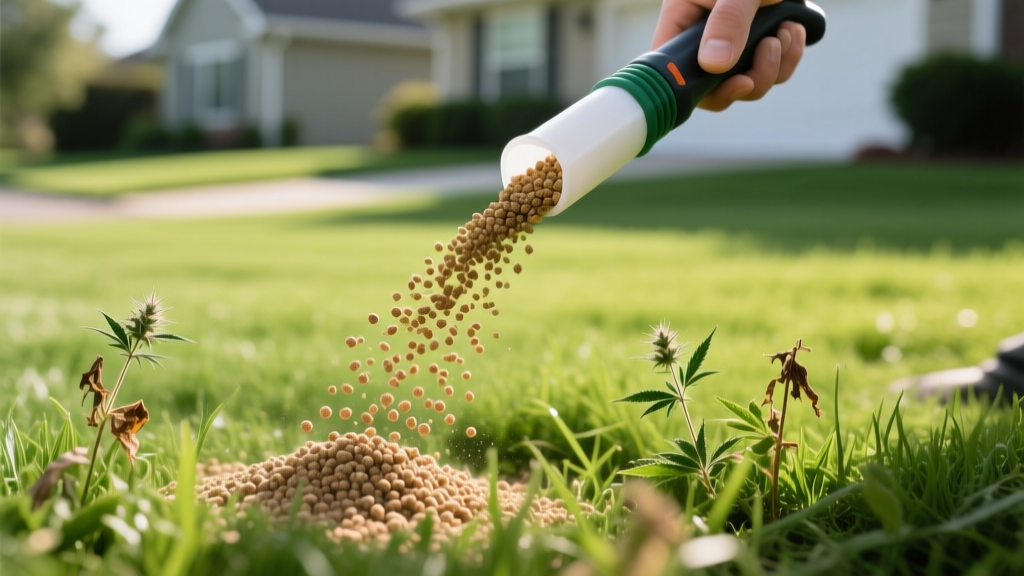
Weed Killer Granules: Spot-Treatment Guide for Lawns
Granular herbicides are traditionally relegated to broadcast spreaders for whole-lawn pre-emergent barriers. However, post-emergent weed killer granules offer a distinct, highly underutilized advantage for spot-treatment: zero aerial drift. When treating isolated patches of creeping charlie, dandelion, or crabgrass near sensitive flower beds or vegetable gardens, liquid sprays carry the inherent risk of volatilization and wind drift. Granules eliminate this risk entirely, provided you master the micro-calibration and moisture requirements unique to solid formulations.
According to University of Minnesota Extension, targeted weed management reduces overall chemical load on your soil while preserving beneficial turfgrass density. This guide details the exact protocols for using weed killer granules as a precision spot-treatment tool rather than a blunt broadcast instrument.
Why Choose Granules Over Liquids for Spot Treatment?
Liquid post-emergents (like concentrated 2,4-D or glyphosate) act fast, but they require careful mixing, pump calibration, and strict wind-speed monitoring. If the wind exceeds 5 mph, liquid droplets can drift onto adjacent ornamental shrubs, causing severe phytotoxicity.
Weed killer granules solve the drift problem. The active ingredients—typically a combination of 2,4-D, dicamba, and MCPP for broadleaf weeds, or quinclorac for grassy weeds—are coated onto a clay, sand, or fertilizer carrier. Because they are solid, they cannot blow in the wind. Furthermore, granular formulations often include a built-in surfactant and a slow-release nitrogen carrier, which feeds the surrounding turf immediately after the weed dies, accelerating the fill-in process.
Warning: The Volatilization Trap
While granules do not drift in the wind, certain ester-based granular herbicides can volatilize (turn into a gas) when soil temperatures exceed 85°F. Always apply granular spot treatments in the early morning when soil temperatures are below 80°F to prevent vapor drift from damaging nearby sensitive plants like tomatoes or hydrangeas.
While granules do not drift in the wind, certain ester-based granular herbicides can volatilize (turn into a gas) when soil temperatures exceed 85°F. Always apply granular spot treatments in the early morning when soil temperatures are below 80°F to prevent vapor drift from damaging nearby sensitive plants like tomatoes or hydrangeas.
Active Ingredient Matching Matrix
Not all granules target the same species. Using a broadleaf granule on a grassy weed will yield zero results. Reference this matrix to select the correct product for your specific spot-treatment needs. Pricing reflects average retail costs for 10-pound bags in 2026.
| Weed Species | Target Category | Required Active Ingredients | Example Product | Est. Cost (10 lbs) |
|---|---|---|---|---|
| Dandelion, Plantain | Broadleaf | 2,4-D, MCPP, Dicamba | Scotts Weed B Gon MAX | $18 - $22 |
| Creeping Charlie, Clover | Hardy Broadleaf | 2,4-D, Dicamba, Quinclorac | Ortho WeedClear for Lawns | $20 - $25 |
| Crabgrass (Post-Emergent) | Grassy Weed | Quinclorac | Bayer Advanced Crabgrass Killer | $24 - $28 |
| Nutsedge | Sedge | Sulfentrazone (Note: Rare in consumer granules; liquid preferred) | N/A (Use Liquid SedgeHammer) | N/A |
The Micro-Calibration Protocol (Spot Math)
The most common failure mode when using weed killer granules for spot treatment is over-application. Product labels dictate rates per 1,000 square feet (e.g., 2.5 lbs per 1,000 sq ft). When you are only treating a 40-square-foot patch of clover near a mailbox, guessing the volume will result in turf burn.
Here is the exact mathematical framework for micro-calibration, as supported by turfgrass management principles from Purdue University Turfgrass Science:
- Calculate the Area: Measure your weed patch. A 4 ft x 10 ft rectangle is 40 sq ft.
- Determine the Ounce-per-Square-Foot Rate: If the label requires 2.5 lbs (40 oz) per 1,000 sq ft, that equals 0.04 oz per sq ft.
- Multiply by Patch Size: 40 sq ft × 0.04 oz = 1.6 oz of granules required.
- Weigh the Dose: Use a digital kitchen scale. Place your empty handheld shaker or mini-spreader on the scale, tare it to zero, and pour in exactly 1.6 oz of granules.
By weighing the exact dose for the specific area, you ensure that when the shaker is empty, you have applied the precise label rate—no more, no less. This eliminates the risk of chemical burn to the surrounding desirable turf.
Execution: The Dew and Adhesion Factor
Unlike liquids, which immediately coat the leaf surface, granules are solid particles. If you broadcast dry granules onto dry weeds at noon, the particles will simply bounce off the waxy cuticle of the weed leaf and fall harmlessly to the soil, where post-emergent broadleaf herbicides are largely ineffective.
For foliar absorption to occur, the active ingredient must dissolve into a liquid state. You must leverage the Dew Protocol:
- Timing: Apply between 6:00 AM and 8:00 AM when natural morning dew is heavy on the leaves.
- Artificial Dew: If treating in the late afternoon, use a garden hose with a misting nozzle to lightly dampen the weed foliage before shaking the granules over the patch. Do not soak the soil; just wet the leaves.
- Adhesion: The moisture dissolves the clay carrier and the built-in surfactants, creating a concentrated, sticky paste on the leaf surface that penetrates the plant's vascular system over the next 24 hours.
Troubleshooting Common Granular Failures
Even with precise calibration, environmental variables can disrupt efficacy. Use this diagnostic guide if your spot treatment fails to kill the target weed within 14 days.
Failure Mode 1: Granule Bounce and Roll
Symptom: Weeds show no yellowing or curling after two weeks. Granules are visible on the soil surface beneath the weed.
Cause: Application was performed on dry foliage, or the weed species has a highly waxy cuticle (like mature broadleaf plantain).
Fix: Switch to a liquid formulation for heavily waxy weeds, or aggressively pre-wet the foliage with a surfactant-water mix before applying the granules.
Failure Mode 2: Desirable Turf Burn (Chlorosis)
Symptom: The target weed died, but the surrounding Kentucky Bluegrass or Fescue turned white or yellow.
Cause: Overlapping passes with a handheld spreader, or applying during high heat (above 85°F) which caused the herbicide to become hyper-active and non-selective.
Fix: Rely strictly on the kitchen-scale micro-calibration method. Never 'eyeball' the amount. Avoid applications when afternoon highs are forecasted to exceed 85°F.
Advanced Technique: Pre-Emergent Spot Barriers for Hardscape Edges
While the focus of this guide is post-emergent spot treatment, granular pre-emergents (like those containing Prodiamine or Dithiopyr) are highly effective when used as localized spot barriers. According to the University of California Integrated Pest Management program, crabgrass and spurge frequently germinate in the micro-climates created along driveway edges and sidewalk cracks, where concrete radiates heat and warms the adjacent soil faster than the rest of the lawn.
Instead of applying a pre-emergent to the entire 5,000 sq ft lawn in early spring, you can use a shaker can to apply a 6-inch wide band of Prodiamine granules strictly along the hardscape perimeters. This targeted spot-treatment creates a chemical barrier exactly where soil temperatures first reach the 55°F germination threshold, saving money and reducing total chemical usage by up to 80%.
'The most effective weed management strategies do not rely on blanket applications. By understanding the specific micro-environments in your lawn—like the heat sinks near driveways or the damp shade near downspouts—you can use granular products as precision tools rather than blunt instruments.'
— Dr. Aaron Patton, Turfgrass Extension Specialist
Mastering weed killer granules for spot-treatment requires a shift in mindset from 'covering ground' to 'targeting biology.' By respecting the micro-calibration math, leveraging morning moisture for foliar adhesion, and matching the active ingredient to the specific weed species, you can maintain a pristine lawn while minimizing chemical exposure to the broader environment.

