
Pest Control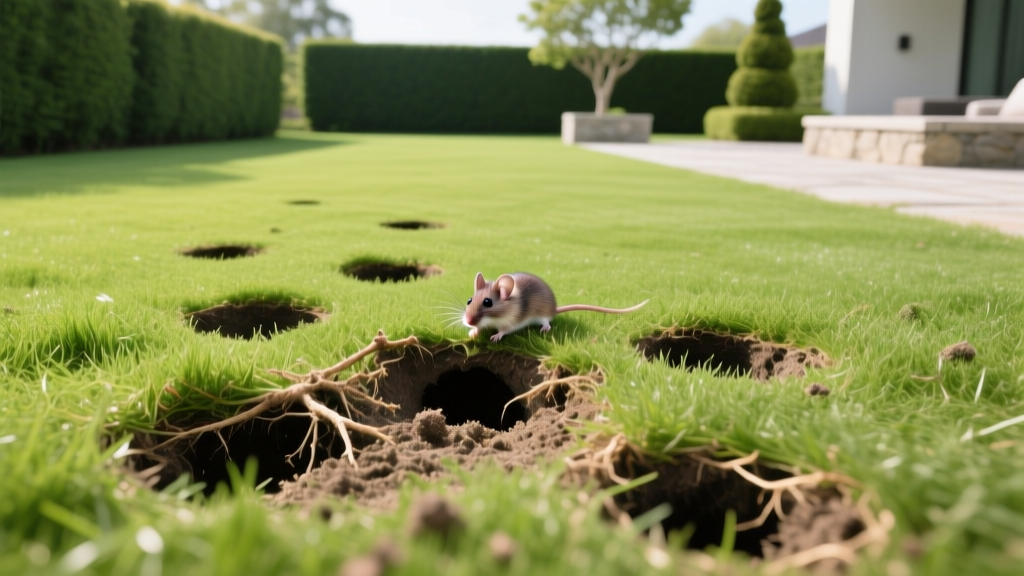
What Are Voles Holes? Identifying and Repairing Turf Damage
The Anatomy of a Vole Hole: What Exactly Are You Looking At?
When homeowners notice small, perfectly round openings scattered across their landscaping, the most common question is: what are voles holes? Unlike the dramatic, volcano-shaped dirt mounds left by moles or pocket gophers, vole holes are subtle, deceptive, and often go unnoticed until significant root damage has occurred. Voles (often called meadow mice) are compact, stout rodents that create extensive, shallow subsurface runway systems to forage for roots, bulbs, and bark while hidden from aerial predators like hawks and owls.
A true vole hole typically measures between 1.5 and 2 inches in diameter—roughly the size of a golf ball. The entrance is usually cleanly clipped, with no excavated soil piled around the rim. Instead, you will notice a distinct, depressed "runway" or trench about 1 to 2 inches wide leading away from the hole, hidden beneath the thatch layer or tall grass. According to Penn State Extension, these surface runways are the primary diagnostic indicator of a meadow vole (Microtus pennsylvanicus) infestation, whereas pine voles (Microtus pinetorum) tend to stay entirely subterranean, leaving only small exit holes near the root zones of trees and shrubs.
Voles vs. Moles vs. Gophers: The Lawn Rodent Matrix
Misidentifying the pest is the most frequent cause of failed eradication efforts. Applying a mole trap to a vole runway will yield zero results. Use the comparison matrix below to accurately diagnose the pest based on the physical evidence left in your turf.
| Diagnostic Feature | Voles (Meadow/Pine) | Moles (Eastern/Star-nosed) | Pocket Gophers |
|---|---|---|---|
| Hole Diameter | 1.5 to 2 inches (golf ball) | No open holes (sealed tunnels) | 2.5 to 3.5 inches (baseball) |
| Soil Mounds | None (clean entrances) | Volcano-shaped, symmetrical | Crescent or horseshoe-shaped |
| Surface Runways | Visible 1-2" wide depressed paths | Raised ridges of turf (surface tunnels) | None (strictly subterranean) |
| Tunnel Depth | Surface to 2 inches deep | Surface to 12+ inches deep | 6 to 18 inches deep |
| Primary Diet | Vegetation (roots, bark, bulbs) | Insects (grubs, earthworms) | Vegetation (roots, tubers) |
Assessing the Damage: Beyond the Holes
The holes themselves are merely entry points; the real threat lies in what voles do while navigating their tunnels. Voles consume roughly 1.5 times their body weight in vegetation daily. In a residential landscape, this translates to devastating losses in specific plant categories.
⚠️ Winter Snow Tunnel Warning:
Voles do not hibernate. During winter, they construct tunnels beneath the snowpack, completely protected from predators. Homeowners often experience "spring shock" when the snow melts to reveal extensive lawn scalping and girdled tree bases. The University of California IPM program notes that winter damage is often the most severe, as voles rely heavily on ornamental bark and turf roots when other food sources are dormant.
Identifying Vole Gnaw Marks
- Trees and Shrubs: Look for irregular gnaw marks at the base of trunks, usually hidden just below the soil line or mulch layer. Vole teeth marks are roughly 1/16 inch wide and 1/32 inch deep, appearing in irregular, overlapping patches. If a trunk is completely "girdled" (bark removed in a full circle), the tree will likely die.
- Turfgrass: Runways will appear as yellowing, spongy strips of dead grass that easily pull away from the soil, revealing the severed root systems beneath.
- Ornamental Bulbs: Hostas, tulips, and lilies may suddenly collapse or fail to emerge in spring, as voles hollow out the starchy bulbs entirely from below.
Step-by-Step Lawn Repair Protocol After Vole Activity
Once you have confirmed vole activity and initiated control measures, the physical damage to the turf must be repaired to prevent weed invasion and soil erosion. Follow this precise agronomic protocol to restore your lawn.
Step 1: Collapse and Fill the Runways
Do not leave the subsurface tunnels intact, as they invite secondary pests or cause ankle injuries. Use a heavy lawn roller (filled with water to achieve roughly 300 lbs of pressure) to collapse the spongy runways. For deeper depressions, mix a topdressing blend of 70% screened topsoil and 30% fine compost. Sweep the mixture into the collapsed trenches using a push broom, ensuring it sits flush with the surrounding grade.
Step 2: Overseed with Resilient Cultivars
Vole-damaged areas are prime real estate for crabgrass and broadleaf weeds. Overseed immediately using a turf-type tall fescue blend (such as Jonathan Green Black Beauty or a local university-recommended mix). Tall fescue develops a deeper, more aggressive root system than Kentucky bluegrass, making it slightly more resilient to future shallow foraging.
- Application Rate: Apply seed at 6 to 8 lbs per 1,000 square feet for repair areas.
- Starter Fertilizer: Apply a high-phosphorus starter fertilizer (e.g., 18-24-12 NPK) at the time of seeding to accelerate root establishment.
- Hydration: Keep the top 1 inch of soil consistently moist for 14-21 days until germination is complete.
Proven Exclusion and Deterrent Strategies
Reactive trapping is rarely enough to manage a colony; voles breed rapidly, with a single female producing up to 5 litters of 4-6 pups per year. Long-term management requires physical exclusion and habitat modification.
Physical Exclusion: Hardware Cloth Cylinders
To protect high-value ornamentals, fruit trees, and young saplings, install physical barriers. Use 19-gauge galvanized steel hardware cloth with a 1/4-inch mesh.
- Cut a piece of hardware cloth 18 to 24 inches wide.
- Form it into a cylinder and wrap it around the base of the tree, leaving a 2-inch gap between the mesh and the trunk to allow for growth.
- Bury the bottom edge at least 6 inches deep in the soil. Voles are shallow diggers, but a 6-inch burial depth prevents them from tunneling directly under the barrier.
- Ensure the cylinder extends at least 12 inches above the anticipated winter snow line.
Chemical and Organic Repellents
If trapping is impractical, repellents can force colonies to relocate. The most effective active ingredients for residential use are castor oil and thiram.
Pro-Tip: Castor Oil Application Rates
Products containing 10% castor oil (e.g., Bonide Mole Max or Tomcat Mole & Gopher Repellent) work by coating the root zones and tunnel walls, causing severe digestive distress to foraging voles without killing them. Apply the liquid concentrate at a rate of 1 gallon of mixed solution per 1,000 square feet using a hose-end sprayer. Reapply every 3 to 4 weeks, or immediately after heavy rainfall exceeding 0.5 inches.
Habitat Modification: The 3-Foot Rule
Voles require dense ground cover to feel safe from predators. Implement the "3-Foot Rule" around all structures and valuable plantings: maintain a strict 3-foot radius of bare soil or inorganic mulch (like crushed gravel) around tree trunks and foundation perimeters. Avoid using thick layers of organic wood mulch against the house, as it provides ideal thermal insulation and nesting material for winter colonies.
When to Call a Professional Wildlife Control Operator
While DIY methods work for small, localized populations, a widespread infestation across a property larger than half an acre often requires professional intervention. Licensed Wildlife Control Operators (WCOs) utilize commercial-grade rodenticides (such as zinc phosphide or diphacinone tracking powders) placed inside tamper-resistant bait stations directly within the active runways.
Cost Expectations (2026 Market Rates):
- Initial Inspection & Mapping: $75 - $150
- Baiting & Exclusion Treatment: $250 - $450 per visit
- Full-Season Monitoring Contract: $800 - $1,200 annually

