
Pest Control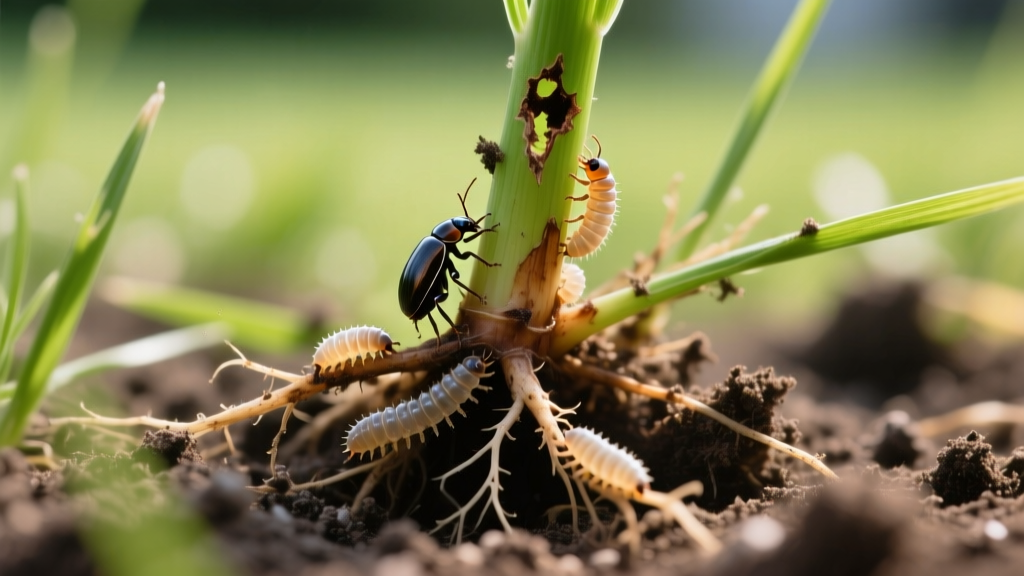
What Bugs Eat Grass Roots and Blades: Identification Guide
The Hidden Culprits: Subsurface Root Destroyers
When homeowners ask, 'what bugs eat grass,' they often assume the damage is happening at the surface. However, the most catastrophic lawn failures are caused by subsurface pests that sever the root system, cutting off the plant's ability to uptake water and nutrients. Identifying these pests requires looking beneath the thatch layer.
White Grubs (Japanese Beetle & June Bug Larvae)
White grubs are the larval stage of scarab beetles. They feed aggressively on grassroots from late summer through early fall. You can identify them by their C-shaped, creamy white bodies and brown heads. The critical damage threshold is 5 to 10 grubs per square foot. If your turf rolls back like a loose carpet and attracts foraging crows or skunks, you have a grub infestation.
According to Penn State Extension, preventive treatments are vastly superior to curative ones. Apply Chlorantraniliprole (found in Scotts GrubEx1, costing roughly $28 to $32 for a 5,000 sq. ft. bag) in early to mid-summer before eggs hatch. For curative treatment of active grubs in early fall, use Trichlorfon (Bayer Advanced 24 Hour Grub Killer Plus, ~$22 for 3,000 sq. ft.), but be aware it degrades quickly in high-pH soils.
Mole Crickets
Prevalent in the Southeastern U.S., mole crickets tunnel through the top 1-2 inches of soil, uprooting grass and feeding on roots and shoots. Their damage mimics drought stress, but the soil will feel spongy underfoot. Curative treatments using Imidacloprid or Bifenthrin granules are most effective when applied in June or July, targeting the vulnerable nymph stage before they grow too large and burrow too deep.
| Pest Species | Damage Zone | Visual Symptoms | Action Threshold | Avg. Treatment Cost (per 1,000 sq ft) |
|---|---|---|---|---|
| White Grubs | Subsurface Roots | Spongy turf, rolls like carpet, animal digging | 5-10 per sq. ft. | $4.50 - $7.00 |
| Mole Crickets | Subsurface/Thatch | Raised soil tunnels, severed grass blades | 2-4 per sq. ft. | $5.00 - $8.50 |
| Chinch Bugs | Surface/Crown | Yellowing halos, distinct dead patches in sun | 20-25 per sq. ft. | $3.00 - $5.00 |
| Fall Armyworms | Surface Foliage | Notched blades, green/brown frass (droppings) | 3-5 per sq. ft. | $4.00 - $6.00 |
The Surface Feeders: Blade and Crown Chewers
Surface pests chew directly on the grass blades or suck the sap from the crown, causing rapid desiccation. These pests are highly visible if you know how to look for them, and they multiply exponentially in hot, dry conditions.
Chinch Bugs
If you are growing St. Augustinegrass or Zoysia and notice irregular patches of yellowing grass that quickly turn brown and die—especially in full sun near driveways or sidewalks—chinch bugs are the likely culprit. Adults are tiny (1/6 inch) with black bodies and white wings featuring a distinct black triangle. They inject a toxin while feeding that blocks water movement within the grass stem.
The University of Florida IFAS Extension notes that chinch bugs have developed significant resistance to pyrethroids in many regions. For severe infestations, rotate active ingredients. Use Bifenthrin (Ortho BugClear, ~$15) for immediate knockdown, followed by Clothianidin (Arena insecticide) for longer residual control. Always water liquid treatments lightly into the thatch layer where the bugs hide.
Fall Armyworms & Sod Webworms
These caterpillars are voracious foliage chewers that can strip a newly sodded lawn to bare dirt in 48 hours. Fall armyworms are green, brown, or almost black with an inverted 'Y' on their head capsule. Sod webworms are smaller, translucent green or brown, and live in silken web-lined tunnels in the thatch. Look for 'frass' (caterpillar droppings that look like green or brown sand) on the soil surface and grass blades with distinct notched edges.
Because they are surface feeders, biological controls are highly effective. Apply Bacillus thuringiensis var. kurstaki (Bt) (Monterey B.t., ~$18 per pint). Bt is a naturally occurring soil bacterium that paralyzes the caterpillar's digestive tract upon ingestion. It must be applied in the late afternoon or evening, as UV light degrades the active spores rapidly.
Diagnostic Warning: Drought vs. Pests
Never apply insecticides to drought-stressed grass. Both chinch bugs and drought cause localized brown patches in sunny areas. Before treating, pull at the edge of the brown patch. If the grass breaks off easily at the soil line with chewed roots, it is pests. If the roots are firmly anchored but the blades are folded and brittle, you are likely dealing with hydrophobic soil or irrigation failure, not insects.
The 'Soap Flush' Diagnostic Test
Stop guessing what bugs eat grass in your yard. The soap flush test forces subsurface and thatch-dwelling pests to the surface for accurate identification. This is the industry-standard diagnostic protocol used by turfgrass professionals.
- Mix the Solution: Combine 2 tablespoons of lemon-scented liquid dishwashing detergent with 2 gallons of water in a watering can. The soap irritates the pests' exoskeletons without killing them.
- Select the Zone: Choose a 2-foot by 2-foot (4 sq. ft.) area at the margin of the damaged zone, where healthy green grass meets the dying brown grass. This is where active feeding is occurring.
- Saturate the Soil: Pour the solution evenly over the 4 sq. ft. area, allowing it to penetrate the thatch and top inch of soil.
- Wait and Count: Wait 3 to 5 minutes. Watch closely as caterpillars, mole crickets, and chinch bugs crawl to the surface to escape the soap.
- Calculate Density: Count the pests. Divide by 4 to get the per-square-foot density, then compare against the action thresholds in the table above.
Treatment Decision Matrix: Organic vs. Conventional
Choosing the right chemistry depends on your household's environmental tolerance, the presence of pets, and the specific pest life cycle. The Environmental Protection Agency (EPA) mandates strict adherence to label rates, which are legally binding.
| Control Method | Active Agent | Target Pests | Speed of Control | Environmental Impact & Safety |
|---|---|---|---|---|
| Conventional Synthetic | Bifenthrin / Imidacloprid | Grubs, Chinch Bugs, Crickets | Fast (24-48 hours) | High toxicity to aquatic life and pollinators. Keep off until dry. |
| Biological Insecticide | Bt (Bacillus thuringiensis) | Armyworms, Webworms | Moderate (3-5 days) | Zero toxicity to mammals, birds, or bees. Highly targeted. |
| Beneficial Nematodes | Heterorhabditis bacteriophora | White Grubs, Flea larvae | Slow (7-14 days) | Completely organic. Requires moist soil and specific temps (60-85°F). |
| Botanical Extract | Azadirachtin (Neem Oil) | Chinch Bugs, Surface chewers | Slow (Disrupts molting) | Low toxicity. Breaks down rapidly in sunlight. Requires frequent reapplication. |
Post-Treatment Lawn Recovery Protocols
Killing the pests is only half the battle. Once the insects are eradicated, the damaged turf requires immediate intervention to prevent weed invasion and soil erosion.
- Core Aeration: If subsurface pests like grubs or mole crickets have compacted the soil and destroyed root networks, run a core aerator over the affected zones. This breaks up the spongy thatch layer and creates channels for water and fertilizer to reach surviving roots.
- Targeted Overseeding: For cool-season lawns (Fescue, Kentucky Bluegrass), slit-seed the damaged areas with a compatible cultivar immediately after the curative insecticide application. Ensure the insecticide used does not have a pre-emergent herbicide mixed in, which will halt grass seed germination.
- Starter Fertilizer Application: Apply a high-phosphorus starter fertilizer (e.g., 10-18-10 NPK) at a rate of 1 lb of nitrogen per 1,000 sq. ft. to stimulate rapid root regeneration in the surviving grass crowns.
By combining precise identification via the soap flush test with targeted, threshold-based treatments, you can halt turf destruction and restore your lawn's density without over-applying unnecessary chemicals.

