
Pest Control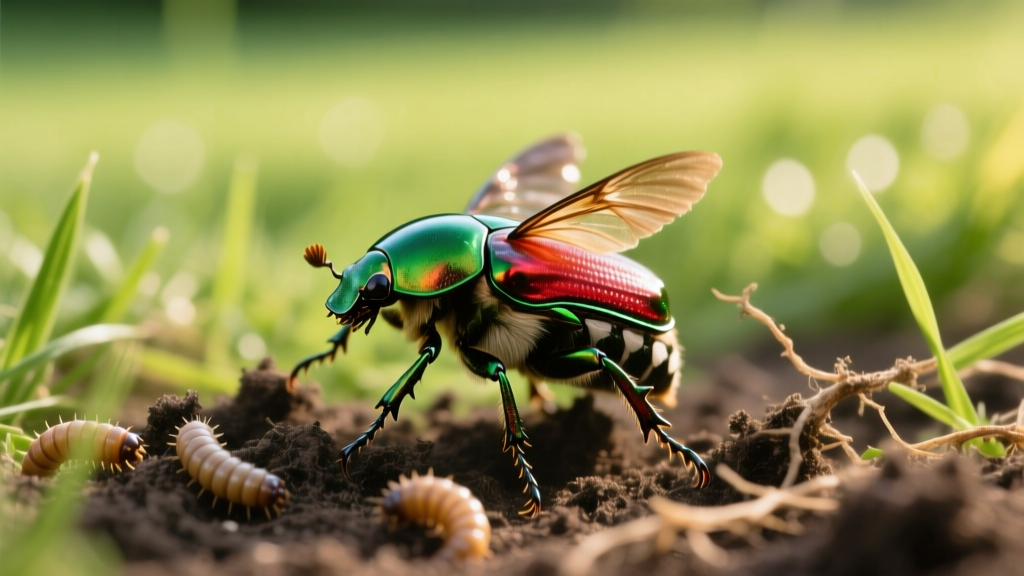
What Do Grub Worms Turn Into? Lawn Beetle Lifecycle & Control
When you dig into your thinning turf and find plump, white, C-shaped larvae chewing on your grassroots, you are looking at the immature stage of a much larger problem. Homeowners often treat the immediate damage without understanding the biological clock ticking beneath their soil. To effectively break the cycle of turf destruction, you must understand the adult stage of the pest.
The Direct Answer: What Do Grub Worms Turn Into?
Grub worms turn into scarab beetles (family Scarabaeidae). Depending on your geographic region and the specific species in your soil, the grubs destroying your lawn will eventually metamorphose into one of three primary turf pests:
Quick Identification Fact: Not all white grubs are the same. While they all belong to the scarab family, Japanese beetles, June bugs (May beetles), and European chafers have vastly different flight patterns, adult feeding habits, and regional dominance. Identifying the adult beetle tells you exactly when the next generation of eggs will be laid.
According to Ohio State University Extension, the transition from a soil-dwelling grub to a flying adult beetle dictates the entire timeline for your annual lawn care and pest management strategy. If you only treat the grubs in the fall, you miss the critical window to prevent the adults from laying the next year's eggs.
The 4-Stage Scarab Beetle Lifecycle
Understanding the metamorphosis is critical for timing your interventions. Scarab beetles undergo complete metamorphosis (holometabolism), passing through four distinct stages. While timelines shift slightly based on species and local climate, the general progression for temperate North American lawns follows this schedule:
| Life Stage | Duration | Lawn Impact & Behavior |
|---|---|---|
| 1. Egg | 2–3 Weeks (Late Summer) | Laid 1–3 inches deep in moist soil by adult females. Zero damage to turf. |
| 2. Larva (Grub) | 10–11 Months | The destructive phase. Feeds on grassroots, causing turf to roll back like carpet. Overwinters deep in the soil. |
| 3. Pupa | 2–4 Weeks (Late Spring) | Transformation chamber. Grub stops feeding and morphs into an adult beetle underground. Zero turf damage. |
| 4. Adult Beetle | 1–2 Months (Summer) | Emerges to mate and feed on ornamental foliage (e.g., roses, linden trees). Does not eat grass, but lays the eggs that start the cycle over. |
Identifying the Culprit: The Raster Pattern Test
Because adult beetles fly away and are rarely caught in the act of laying eggs, turf professionals identify the species while they are still in the grub stage. According to Penn State Extension, the most reliable method for species identification is examining the raster pattern—the specific arrangement of bristles and spines on the grub's tail end (the anal segment).
Grab a magnifying glass, gently squeeze the grub to expose its hindquarters, and match the pattern:
Japanese Beetle (Popillia japonica)
- Adult Appearance: Metallic green body with copper-brown wing covers.
- Grub Raster Pattern: A distinct V-shaped arrangement of spines on the raster.
- Regional Threat: Highly destructive in the Northeast, Mid-Atlantic, and Midwest. Adults skeletonize ornamental leaves.
June Bugs / May Beetles (Phyllophaga spp.)
- Adult Appearance: Stout, reddish-brown to black beetles, notorious for swarming porch lights in early summer.
- Grub Raster Pattern: Two parallel rows of spines resembling a zipper.
- Regional Threat: Widespread across North America. They have a 2-to-3-year lifecycle, meaning grubs can feed and grow much larger (up to 1.5 inches) than other species, causing severe localized root pruning.
European Chafer (Rhizotrogus majalis)
- Adult Appearance: Light brown or tan, resembling a smaller, paler June bug.
- Grub Raster Pattern: A Y-shaped pattern of spines.
- Regional Threat: The dominant grub pest in the Great Lakes region and parts of the Northeast. They feed later into the fall and earlier in the spring than Japanese beetles, extending the window of turf damage.
Breaking the Lifecycle: Targeted Treatment Strategy
Knowing what grub worms turn into allows you to deploy treatments at the exact biological vulnerability points. University of Kentucky Entomology emphasizes that timing your active ingredients to the grub's life stage is the difference between total eradication and wasted money.
Warning on Curative Treatments: Applying preventative chemicals in September will not work. By late fall, grubs have developed thick cuticles and are migrating deep into the soil profile to overwinter, rendering surface-applied contact insecticides largely ineffective.
1. Preventative Chemical Control (Targeting Eggs & Young Larvae)
The most cost-effective strategy for high-value lawns is applying a long-residual preventative insecticide before the eggs hatch.
- Active Ingredient: Chlorantraniliprole (Brand name: Acelepryn or Scotts GrubEx1).
- Application Window: April through mid-June. The chemical binds to the soil and remains active when eggs hatch in August.
- Cost & Coverage: Professional-grade Acelepryn liquid costs approximately $140–$160 per 1.67-gallon jug, treating up to 10,000 square feet at preventative rates. Consumer-grade GrubEx1 granules cost about $25 for a 5,000 sq. ft. bag.
2. Curative Chemical Control (Targeting Active, Feeding Grubs)
If you missed the preventative window and notice brown, peeling turf in late August or September, you need a fast-acting curative contact insecticide.
- Active Ingredient: Trichlorfon (Brand name: Dylox).
- Application Window: Late August through September, when grubs are small, actively feeding near the surface, and highly susceptible.
- Cost & Coverage: A 10 lb bag of Dylox 6.2 granules costs roughly $30–$40 and covers 5,000 square feet. It breaks down rapidly in the soil (within 7–10 days), so it leaves no long-term residue.
3. Biological Control (Organic Lifecycle Disruption)
For homeowners managing organic lawns or protecting pollinator-heavy gardens, biological agents target the grubs without harming earthworms or beneficial soil microbes.
- Milky Spore (Paenibacillus popilliae): A bacterium that specifically targets Japanese beetle grubs. Once established, it persists in the soil for 10–15 years. Cost: ~$40 for 10 oz (treats 2,500 sq ft). Note: It is entirely ineffective against European Chafer or June Bug grubs.
- Beneficial Nematodes (Heterorhabditis bacteriophora): Microscopic worms that hunt grubs in the soil, entering their bodies and releasing lethal bacteria. Cost: ~$35–$45 for 10 million nematodes (covers ~2,500 sq ft). Must be applied in late summer when soil temperatures are consistently above 60°F and kept heavily irrigated.
Frequently Asked Questions
Do grub worms turn into moths or butterflies?
No. Grub worms are the larval stage of beetles (Coleoptera), not moths or butterflies (Lepidoptera). Moth and butterfly larvae are caterpillars, which look entirely different and typically feed on plant foliage above ground, not grassroots below ground. The only underground caterpillars that damage lawns are sod webworms, which do not have the plump, C-shaped, legless appearance of a true grub.
If I kill all the adult beetles on my trees, will my lawn be safe from grubs?
Not necessarily. Adult scarab beetles are strong fliers and can travel several miles from neighboring properties, golf courses, or unmanaged fields to lay eggs in your irrigated, healthy turf. While trapping or spraying adult beetles on your ornamentals protects your foliage, it will not stop a migrating female from dropping eggs into your lawn. Soil-targeted grub control remains the most reliable defense.
Why do animals dig up my lawn looking for grubs?
Raccoons, skunks, crows, and armadillos are highly attuned to the protein-rich grubs living in your root zone. If you notice torn-up, flipped sod, the animal damage is a secondary symptom of a primary grub infestation. Treating the grubs with a curative insecticide like Trichlorfon and repairing the turf will remove the food source and stop the nocturnal digging.

