
Pest Control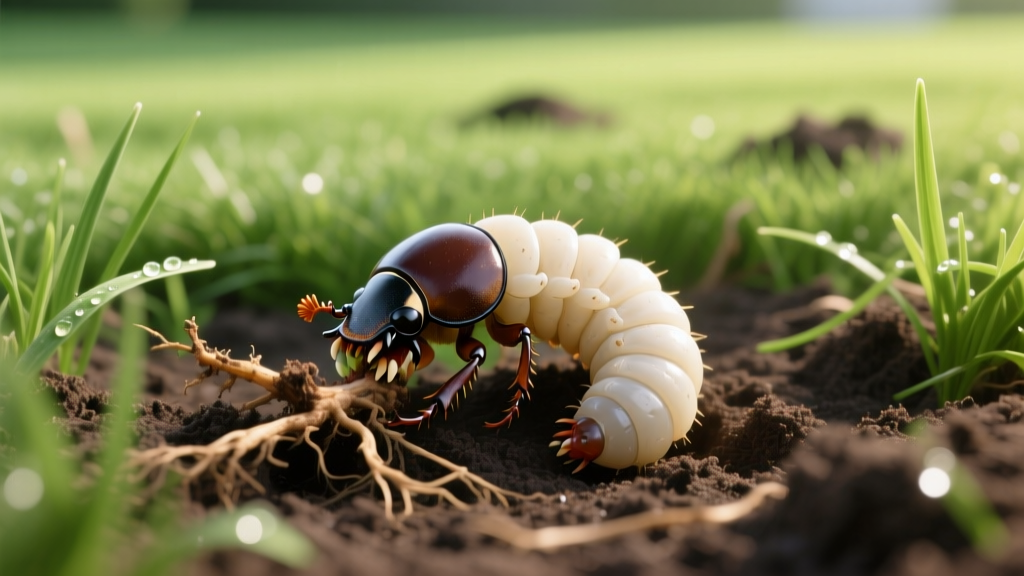
What Do Grubs Eat? Understanding White Grub Diets and Lawn Damage
The Core Diet: What Do Grubs Eat Below the Soil?
When homeowners ask, "what do grubs eat?", the most direct answer is the fibrous root systems of turfgrass. However, the biological reality of their feeding behavior is more destructive than simple consumption. "Grub" is a catch-all term for the larval stage of scarab beetles, including the Japanese beetle (Popillia japonica), European chafer (Rhizotrogus majalis), and various June beetles (Phyllophaga spp.). These C-shaped larvae do not typically eat the entire plant; instead, their mandibles sever the primary roots and delicate root hairs that anchor the grass and absorb moisture.
This severing mechanism is what causes the characteristic damage. By cutting off the root system from the crown, the grub effectively induces localized drought stress. The grass above ground turns brown and dies not because it was entirely consumed, but because its water and nutrient supply lines were destroyed. According to University of Kentucky Entomology, a single third-instar European chafer grub can sever several cubic inches of root mass per week during its peak feeding window in early autumn, making them significantly more destructive per capita than Japanese beetle larvae.
Primary vs. Secondary Food Sources
While living turfgrass roots are the primary target, grubs are opportunistic feeders. Their diet hierarchy shifts based on soil conditions and larval stage:
- Living Roots (Primary): The main caloric source required for the grub to reach pupation. They prefer the succulent, newly grown roots of cool-season grasses.
- Decaying Organic Matter (Secondary): In the absence of living roots, or during early first-instar stages, grubs will consume decomposing thatch and humus. However, a diet consisting solely of thatch will not sustain them to maturity.
- Root Vegetables (Collateral): In garden beds adjacent to lawns, grubs will readily pivot to eating the tubers of potatoes, carrots, and the root balls of ornamental perennials.
Turfgrass Vulnerability Matrix
Not all lawns respond to grub feeding equally. The extent of the damage depends heavily on the root depth and recuperative vigor of your specific grass species. Shallow-rooted grasses suffer catastrophic failure much faster than deep-rooted varieties.
| Grass Species | Root Depth Profile | Vulnerability to Grubs | Recovery Potential |
|---|---|---|---|
| Kentucky Bluegrass | Shallow (2-6 inches) | High | Moderate (via rhizomes) |
| Tall Fescue | Deep (12-24+ inches) | Moderate | Low (bunch-type growth) |
| Bermudagrass | Deep & Aggressive | Low-Moderate | High (stolons/rhizomes) |
| Zoysiagrass | Dense & Tough | Low | Moderate (slow growth) |
The Diagnostic Framework: Confirming Grub Activity
Because grubs feed entirely subterranean, surface symptoms often mimic other lawn diseases. Before applying any chemical treatment, you must confirm the presence of grubs and quantify the population density. Penn State Extension recommends treating only when populations exceed economic thresholds, as a few grubs per square foot are a normal part of a healthy soil ecosystem.
The "Tug Test" and Soil Sampling Protocol
- Identify the Margin: Locate the boundary where brown, dead grass meets healthy, green grass. Grubs are actively feeding at this leading edge, not in the center of the dead patch.
- Perform the Tug Test: Grab a handful of the brown turf and pull upward. If the grass lifts like a loose carpet with no soil attached, the roots have been severed by grubs.
- Excavate and Count: Using a flat-edged spade, cut three sides of a 12x12 inch square (1 square foot) to a depth of 3 inches. Peel back the turf flap and sift through the topsoil.
- Evaluate Thresholds: Count the C-shaped white larvae. Treatment is justified if you find 5-7 grubs per square foot for European chafers, or 8-10 grubs per square foot for Japanese beetles.
Differentiating Grub Damage from Look-Alike Stressors
Misidentifying the cause of brown patches leads to wasted money on ineffective pesticides. Use this diagnostic checklist to separate grub damage from common look-alikes:
- Grub Damage vs. Drought Stress: Drought causes uniform browning across the entire lawn or specific sun-exposed zones, but the turf remains firmly rooted. Grub damage appears in irregular, localized patches, and the turf detaches easily from the soil.
- Grub Damage vs. Chinch Bugs: Chinch bugs feed on the surface of the grass blades and stems, injecting a toxin that causes yellowing halos around brown spots. The roots remain completely intact, and the turf cannot be rolled back like a carpet.
- Grub Damage vs. Fungal Pathogens (Brown Patch): Fungal diseases like Rhizoctonia solani (Brown Patch) create distinct circular lesions on the grass blades themselves, often with a dark "smoke ring" border in the morning. The root system remains anchored, though the crown may rot.
Seasonal Feeding Timelines and Chemical Interventions
Understanding what grubs eat is only half the battle; knowing when they eat it dictates your treatment strategy. Grubs are highly responsive to soil temperature. As soil temperatures drop below 50°F in late autumn, third-instar grubs migrate 4 to 8 inches deep into the soil profile to overwinter, rendering surface-applied treatments useless.
Preventative Treatments (Spring to Mid-Summer)
Preventatives target young, first- and second-instar grubs as they hatch and begin their initial shallow feeding. The gold standard active ingredient is Chlorantraniliprole (found in Acelepryn and Scotts GrubEx1). This chemical requires 60 to 90 days to fully translocate into the root zone. Apply between May and July. Expect to pay approximately $45 to $60 for a bag covering 10,000 square feet. It is highly targeted and poses minimal risk to non-target soil organisms like earthworms.
Curative Treatments (Late Summer to Early Autumn)
If you miss the preventative window and discover active damage in August or September, you must use a fast-acting curative. Trichlorfon (Dylox 6.2) is the industry standard for rapid knockdown. It degrades quickly in the soil (often within 7 to 10 days) but kills actively feeding grubs within 24 to 48 hours. Curative treatments cost roughly $35 to $45 per 10,000 square feet. Dylox must be watered in immediately with at least 0.25 inches of irrigation to push the active ingredient into the top 2 inches of soil where the grubs are feeding.
"Timing is the single most critical factor in grub management. Applying a curative insecticide like Trichlorfon in November, after the grubs have migrated deep into the soil for winter, is a complete waste of resources and an unnecessary environmental introduction."
— Adapted from Turfgrass Integrated Pest Management Guidelines
Frequently Asked Questions
Do grubs eat grass seed or new shoots?
Grubs primarily target established, fibrous root systems rather than seeds. However, if you are overseeding a lawn with a high grub population, the larvae may sever the fragile initial taproot of the germinating seed, causing the seedling to die shortly after sprouting.
Will milky spore disease control all grub species?
No. Paenibacillus popilliae (Milky Spore) is a biological control that specifically targets Japanese beetle larvae. It is entirely ineffective against European chafers and June beetles, which are often the most destructive root-feeders in northern climates. Furthermore, milky spore requires specific soil temperature ranges to establish and can take 2 to 3 years to reach effective spore counts in the soil.
Do animals digging in the lawn mean I have grubs?
Frequently, yes. Raccoons, skunks, and crows will tear up turf to eat grubs. However, these animals also dig for earthworms and other soil insects. If the digging is accompanied by turf that rolls back easily without roots attached, a grub infestation is the likely catalyst.

