
Pest Control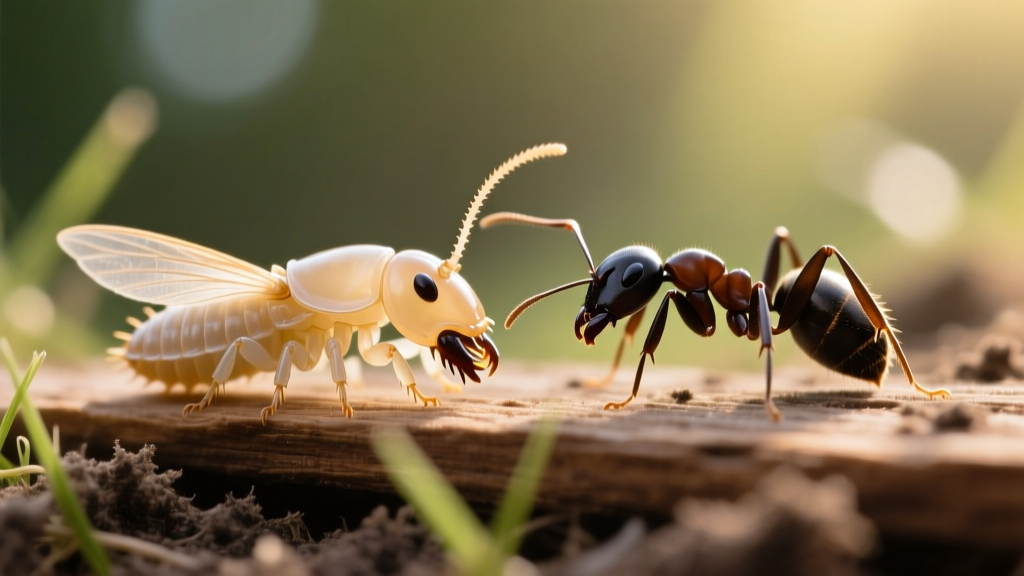
What Do Termites Look Like? Visual ID Guide vs Ants
The Core Question: What Do Termites Look Like?
When homeowners ask, 'what do termites look like,' the answer depends entirely on the insect's role within the colony. Termites are not a single uniform insect; they are a highly organized society divided into distinct castes, each with unique physical characteristics. Unlike carpenter ants, which merely excavate wood to build nests, termites consume cellulose, making their physical identification a critical first step in protecting your home's structural integrity.
According to the Environmental Protection Agency (EPA), termites cause billions of dollars in structural damage annually. Accurate visual identification prevents misapplication of pest control products and ensures you deploy the correct active ingredients—such as Fipronil or Noviflumuron—before the colony compromises your foundation.
Warning: Never rely solely on winged insects to identify a termite problem. By the time you see swarmers (alates), the colony has likely been established and feeding on your property for three to five years.
Termite Castes: A Visual Breakdown
A mature subterranean termite colony can contain anywhere from 60,000 to over a million individuals. To accurately answer what termites look like, you must understand the three primary castes you might encounter during an inspection.
1. Workers (The Destroyers)
Workers make up the vast majority of the colony and are the termites responsible for eating your home. They are entirely blind, wingless, and measure between 1/8 and 3/8 of an inch in length. Their bodies are soft, creamy white, and somewhat translucent. Because they lack a hard exoskeleton, they are highly susceptible to desiccation (drying out), which is why they rarely venture into the open air and instead travel inside mud tubes or directly within wood galleries.
2. Soldiers (The Defenders)
Soldiers are also wingless and blind, but they are easily distinguished by their disproportionately large, yellowish-brown heads and massive, dark mandibles. They measure roughly 1/4 inch long. Their heads are often so large that they cannot feed themselves; workers must feed them regurgitated cellulose. If you break open a mud tube or damaged wood and see pale insects with oversized, snapping heads, you are looking at soldiers.
3. Swarmers / Alates (The Reproducers)
Swarmers are the most commonly seen termites because they leave the nest to mate. They measure 1/2 to 1 inch in length, including their wings. Unlike workers and soldiers, swarmers have dark brown to black bodies and two pairs of long, translucent, milky-white wings that are exactly equal in length. After a brief mating flight, they shed their wings, which are often found piled on windowsills or near foundation walls.
Termites vs. Carpenter Ants: The Comparison Matrix
The most common misidentification in pest control is confusing termite swarmers with winged carpenter ants. Both emerge in the spring, both swarm around light sources, and both are associated with wood. However, their anatomical differences dictate entirely different treatment protocols. The University of Kentucky Entomology Department highlights these key morphological distinctions for accurate field identification.
| Feature | Termite Swarmers | Carpenter Ant Swarmers |
|---|---|---|
| Antennae | Straight, beaded, and moniliform (like a string of pearls) | Elbowed (geniculate) with a distinct bend |
| Waist | Broad, thick connection between thorax and abdomen | Narrow, pinched, distinct hourglass waist |
| Wings | Two pairs of equal length, extending far past the abdomen | Two pairs; front wings are noticeably longer than hind wings |
| Body Color | Dark brown to black, but body appears somewhat uniform | Black, red, or multi-colored with distinct body segments |
Beyond the Insect: Visual Signs of an Infestation
Because worker and soldier termites hide deep within wood or soil, you are more likely to identify an infestation by the environmental evidence they leave behind rather than the insects themselves.
- Mud Tubes (Shelter Tubes): Subterranean termites construct these highways to travel between their soil colony and your wood food source while retaining moisture. They are typically 1/4 to 1 inch in diameter, made of packed soil, wood particles, and termite saliva. Check the foundation, crawl space piers, and utility penetrations.
- Frass (Fecal Pellets): Drywood termites push their feces out of small 'kick-out' holes in the wood. Frass looks like coarse coffee grounds or sawdust. Under magnification, the pellets are hexagonal, roughly 1 millimeter long, and have distinct concave sides.
- Wood Galleries: Termite damage follows the soft springwood grain, leaving the hard summerwood intact. This creates a honeycomb or layered appearance. Unlike carpenter ant galleries, which are smooth and clean, termite galleries are often lined with a mixture of soil and feces, giving them a dirty, mud-caked appearance.
- Discarded Wings: Piles of identical, milky-white wings near exterior doors, window sills, or spider webs indicate a recent swarming event.
Regional Variations: Subterranean vs. Drywood vs. Formosan
What termites look like also shifts slightly depending on the species prevalent in your geographic region.
Eastern Subterranean Termites
The most widespread species in North America. Swarmers are dark brown to black with grayish-blue wings. They require constant contact with soil moisture and build the classic exterior mud tubes.
Western Drywood Termites
Common in coastal California and the Southwest. Swarmers have dark red heads and black bodies with smoke-colored wings. They do not build mud tubes and infest dry, above-ground structural timber directly.
Formosan Subterranean Termites
An aggressive invasive species dominant in the Gulf Coast and Hawaii. Swarmers are larger (up to 1/2 inch body length) with a yellowish-brown hue. They can build massive above-ground 'carton' nests inside walls, bypassing the need for soil contact entirely.
Action Plan: What to Do If You Spot Them
If you confirm the presence of termites through visual identification, immediate and precise action is required. Do not disturb the mud tubes or spray them with over-the-counter aerosol insecticides; this will cause the colony to retreat and relocate, making professional eradication significantly harder.
- Document the Evidence: Take high-resolution photos of the insects, mud tubes, or frass. Measure the length of the mud tubes and note the exact location on your foundation.
- Schedule a WDI Inspection: Hire a licensed pest control operator for a formal Wood Destroying Insect (WDI) report. Ensure they use moisture meters and borescopes to check behind drywall.
- Evaluate Liquid Trenching (DIY Perimeter Defense): If you are treating an exterior perimeter for a detached shed or fence line, use a non-repellent termiticide like Taurus SC (9.1% Fipronil). Dig a trench 6 inches wide and 6 inches deep directly against the foundation. Mix 0.8 fluid ounces of Taurus SC per gallon of water, and apply 4 gallons of the finished solution per 10 linear feet of trench. The termites will not detect the Fipronil, allowing them to carry the lethal dose back to the colony.
- Consider Baiting Systems: For long-term colony elimination, professionals install bait stations (like Sentricon or Advance Termite Bait System) spaced exactly 10 feet apart around the perimeter. These stations utilize chitin synthesis inhibitors like Noviflumuron, which prevents termites from molting, ultimately collapsing the entire colony over 60 to 90 days.
Frequently Asked Questions
Can termites bite humans or pets?
While soldier termites possess large mandibles designed to crush ants and other insects, they are not aggressive toward mammals. Termite bites on humans or pets are exceptionally rare and generally harmless, as they do not transmit diseases. Their primary threat is strictly structural.
Why do termites look like white ants?
The term 'white ant' is a colloquial misnomer. Termites are actually more closely related to cockroaches (order Blattodea) than to ants (order Hymenoptera). Their pale coloration is an evolutionary adaptation to their subterranean, lightless environment, where pigmentation offers no survival advantage.
How fast do termites eat wood?
A mature colony of 60,000 subterranean termites can consume approximately 1/5 of an ounce of wood per day. While this sounds slow, left unchecked over three to five years, this continuous feeding can severely compromise load-bearing joists, support beams, and subflooring.

