
Pest Control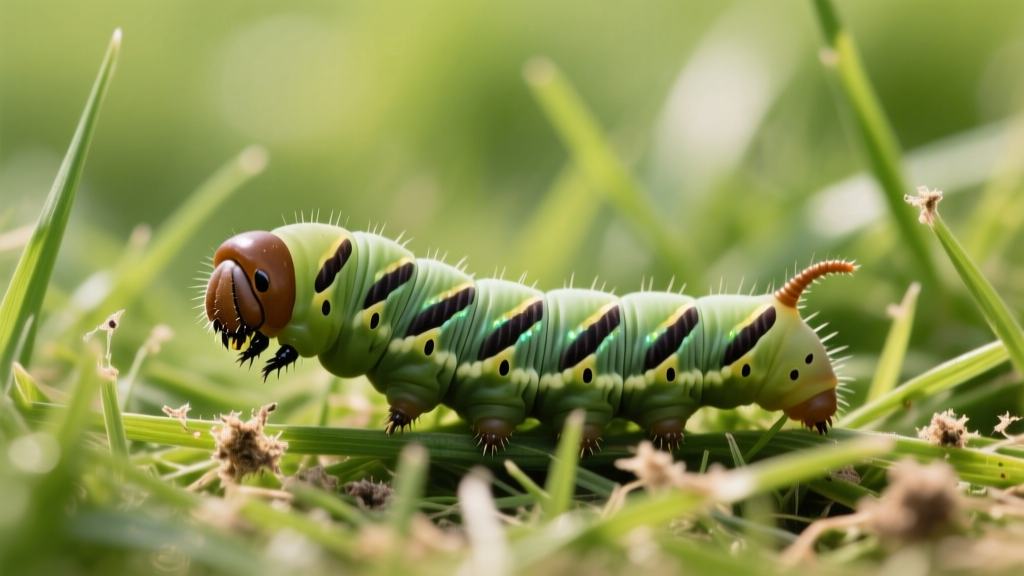
What Does an Armyworm Look Like? Visual ID & Lawn Damage Guide
The fall armyworm (Spodoptera frugiperda) is one of the most destructive turfgrass pests in the southern and transitional zones of the United States. A severe infestation can defoliate a 5,000-square-foot lawn in under 48 hours, leaving behind nothing but brown, ragged stems. Because they feed voraciously and move in massive numbers, early visual identification is the only way to prevent catastrophic turf loss.
This guide breaks down exactly what an armyworm looks like at every life stage, how to differentiate it from look-alike pests, and the specific chemical and biological protocols required to eradicate them.
What Does an Armyworm Look Like? (Larval Identification)
The larval stage is the only life stage that damages your lawn. When answering "what does an armyworm look like," turf managers look for three distinct anatomical markers that separate them from common cutworms and webworms.
- The Inverted Y: The most reliable identifier is a prominent, pale-yellow inverted "Y" shape on the front of the head capsule (the suture lines). This mark remains visible across all color variations.
- The Four Dots: Examine the second-to-last abdominal segment (the 8th segment). You will see four large, dark spots arranged in a perfect square. This square pattern is unique to armyworms.
- Longitudinal Stripes: Mature larvae feature distinct pale-yellow or white longitudinal stripes running down the sides of their bodies, bordered by darker brown or black bands.
Coloration is highly variable and depends on the larva's diet and population density. You will find them in shades of bright green, yellowish-brown, dark brown, and nearly black. At maturity (the 6th instar), they measure between 1.25 and 1.5 inches in length. When disturbed, they exhibit a classic defensive behavior: curling tightly into a "C" shape and dropping to the soil surface.
Moth and Egg Identification (The Precursors)
Spotting the adult moths or egg masses gives you a 7-to-10-day head start before the destructive larvae emerge.
Adult Moths
Adult fall armyworm moths have a wingspan of roughly 1.5 inches. The forewings are dark gray or brown with a mottled pattern and a distinct, opaque white spot near the wingtip. The hindwings are lighter, typically a translucent gray-white. They are nocturnal fliers and are often seen swarming around porch lights in late summer and early fall.
Egg Masses
Females lay eggs in clusters of 100 to 200, usually on the tips of tall grass blades, fence posts, or the undersides of nearby tree leaves. The eggs are covered in a protective layer of grayish-pink "fuzz" (scales rubbed off the mother moth's abdomen). They look like tiny, fuzzy, scale-like patches and hatch within 2 to 4 days in warm weather.
Differentiating Armyworms from Other Turf Pests
Homeowners frequently misidentify armyworms, leading to ineffective treatments. Use this comparison matrix to confirm your pest.
| Pest | Mature Size | Key Visual Identifier | Damage Pattern | Time Active |
|---|---|---|---|---|
| Fall Armyworm | 1.25 - 1.5 inches | Inverted Y on head; 4 dots on 8th segment | Shears grass to the crown; leaves green frass | Late afternoon / Overcast days |
| Sod Webworm | 0.75 - 1.0 inch | Dark brown spots along a pale green body | Chews blades unevenly; spins silk webbing in thatch | Nighttime only |
| Black Cutworm | 1.5 - 2.0 inches | Greasy black/grey body; no distinct head markings | Cuts grass stems at soil level; leaves bare dirt patches | Nighttime only |
Recognizing Damage and the Soapy Water Flush Test
Early-stage armyworms (1st to 3rd instars) engage in "window feeding," scraping away the green chlorophyll layer of the grass blade while leaving the transparent upper epidermis intact. This gives the lawn a frosted or scorched appearance. As they mature, they consume the entire leaf blade, shearing the turf down to the soil line.
Look for bright green, sawdust-like droppings (frass) on the soil surface or caught in the thatch layer. If you suspect an infestation but cannot see the caterpillars, perform a soapy water flush.
The Soapy Flush Protocol:
- Mix 2 tablespoons of liquid lemon-scented dish soap (like Dawn) into 1 gallon of water.
- Pour the solution evenly over a 1-square-yard area of damaged or suspicious turf.
- Wait 3 to 5 minutes. The soap irritates the larvae's skin, forcing them to the surface.
- Count the caterpillars. Finding more than 3 to 4 larvae per square yard warrants immediate chemical or biological intervention.
Targeted Treatment Protocols & Cost Breakdown
Treatment efficacy depends entirely on the larval instar (growth stage). According to Texas A&M AgriLife Extension, biological controls fail against mature larvae, requiring synthetic knockdown agents.
Biological Controls (Organic & Early Instar)
For 1st through 3rd instar larvae (under 0.5 inches long), Bacillus thuringiensis var. kurstaki (Bt) is highly effective and safe for pollinators. Products like Monterey Bt or Thuricide cost roughly $15 to $20 per 8 oz bottle, treating up to 1,000 square feet. Bt must be ingested by the caterpillar, so apply it to dry foliage in the late afternoon; it degrades rapidly in UV light.
Synthetic Insecticides (Conventional & Late Instar)
When larvae exceed 0.5 inches, or when an outbreak is already causing severe defoliation, you need fast-acting synthetic pyrethroids or anthranilic diamides.
- Bifenthrin (e.g., Talstar P): A contact pyrethroid providing rapid knockdown. Costs approximately $45 per quart, which dilutes to treat 20,000 square feet. It offers 2 to 3 weeks of residual control.
- Lambda-cyhalothrin (e.g., Scimitar GC): Another fast-acting pyrethroid, highly effective against large larvae. Priced around $60 per half-gallon.
- Chlorantraniliprole (e.g., Acelepryn): The gold standard for professional prevention and cure. It is a systemic anthranilic diamide that moves into the grass tissue. While expensive ($160+ for 8 oz), a single application treats up to 20,000 square feet and provides 60 to 90 days of residual control, protecting against subsequent moth flights.
Application Timing Rule: Armyworms are most active during the cooler parts of the day. Always apply liquid insecticides in the early morning (before 9 AM) or late evening (after 6 PM). Delay mowing for 48 hours after application to allow the chemical to settle into the thatch and lower stems where the larvae hide.
Long-Term Cultural Prevention
Chemical treatments kill existing populations, but cultural practices dictate whether your lawn survives the next moth migration. The University of Florida IFAS notes that armyworms heavily target lush, over-fertilized turf.
- Thatch Management: Maintain thatch depth below 0.5 inches. Thick thatch provides a humid, protected microclimate for larvae to hide during the heat of the day, shielding them from contact insecticides and avian predators.
- Nitrogen Moderation: Avoid high-nitrogen synthetic fertilizer spikes in late July and August. Rapid, succulent grass growth acts as a beacon for egg-laying female moths.
- Mowing Height: Keep warm-season grasses (Bermuda, Zoysia) at 1.5 to 2.5 inches, and cool-season grasses (Fescue, Kentucky Bluegrass) at 3 to 4 inches. Taller grass develops deeper root systems, allowing it to recover faster from minor window-feeding damage.
By mastering visual identification—specifically the inverted Y and the four-dot square—you can catch fall armyworms in their early instars, saving your turf and significantly reducing your chemical intervention costs.

