
Pest Control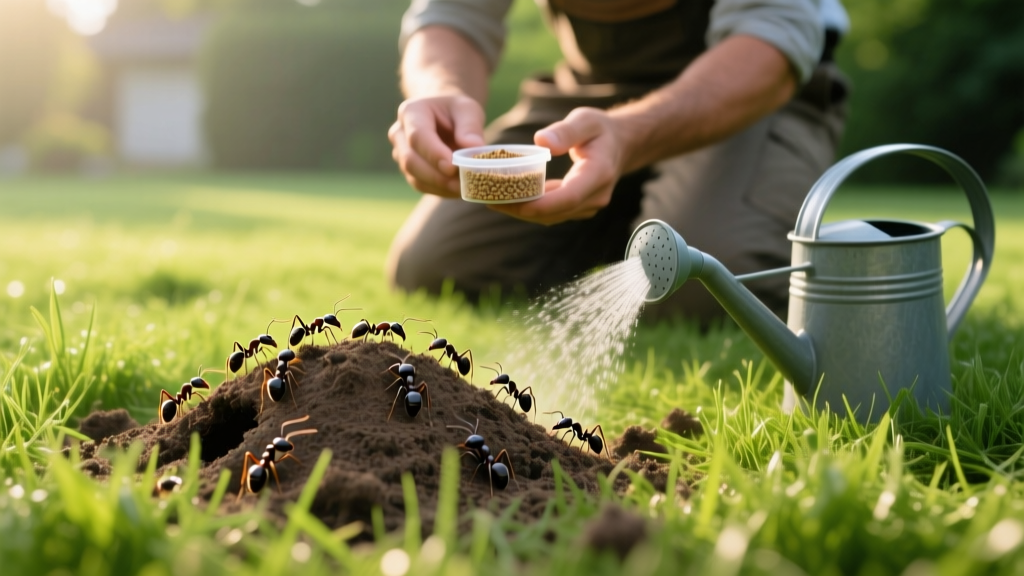
What Kills Ant Hills in Lawns: Baits vs. Drenches
The Anatomy of a Lawn Ant Infestation
When homeowners ask what kills ant colonies in their yards, the answer depends entirely on the species, the soil composition, and the depth of the queen. A visible ant mound is merely the excavation site for an intricate subterranean network that can extend three to four feet below the surface. Treating only the visible mound with surface sprays provides a false sense of security; the reproductive queens simply retreat deeper into the soil profile and rebuild.
To permanently eliminate lawn-dwelling ants, you must deploy treatments that exploit their social feeding behaviors or physically penetrate the deepest gallery chambers. Below, we break down the exact chemical and organic mechanisms that eradicate ant populations, complete with specific active ingredients, mixing ratios, and real-world costs.
Identifying the Target: Common Lawn Ants
Different ant species construct different mound architectures, which dictates the treatment method. According to the University of California Statewide IPM Program, misidentifying the species often leads to treatment failure, particularly when dealing with moisture-seeking ants versus sun-basking mounds.
| Species | Mound Characteristics | Primary Lawn Damage | Best Treatment Approach |
|---|---|---|---|
| Red Imported Fire Ant (Solenopsis invicta) | Fluffy, loose soil; no central entrance hole; up to 18 inches high | Aggressive swarming; stings; root disruption in garden beds | Broadcast granular baits followed by individual mound drenches |
| Pavement Ant (Tetramorium caespitum) | Small craters along concrete seams, driveways, and retaining walls | Soil displacement undermining hardscapes; minor root damage | Liquid perimeter drenches and gel baits near concrete |
| Field Ant (Formica spp.) | Large, firm mounds of soil and plant debris; often in shaded turf | Smothering of surrounding turfgrass; uneven mowing surfaces | Liquid mound drenches; baits are less effective due to diet |
Method 1: Granular Baits (The Eradication Approach)
Granular baits are the gold standard for what kills ant populations at the colony level. These products combine a slow-acting toxicant with a highly attractive carrier (usually soybean oil or corn grit). Foraging worker ants carry the granules back to the mound, regurgitate the toxic oil, and feed it to the larvae and queens through a process called trophallaxis. Because the active ingredient takes 48 to 96 hours to induce mortality, the colony does not associate the food source with the deaths, preventing bait shyness.
Top Active Ingredients and Product Specifics
- Indoxacarb (0.04%): Found in professional-grade products like Advion Fire Ant Bait. Indoxacarb is a bio-activated toxin that requires insect enzymes to become lethal. Cost: Approximately $22 for a 20-oz shaker. Application: 1.5 lbs per acre for broadcast, or 1-2 tablespoons directly around (not on) individual mounds.
- Hydramethylnon (0.73%) + Pyriproxyfen (0.036%): Found in Amdro Firestrike. Hydramethylnon disrupts cellular metabolism, while Pyriproxyfen is an insect growth regulator (IGR) that sterilizes the queen. Cost: Roughly $12 for a 10-lb bag. Highly cost-effective for large properties.
CRITICAL APPLICATION RULE: Never disturb the mound before applying bait. If you kick the mound or poke it with a stick, the colony enters a defensive state and will ignore foraging behavior for up to 48 hours. Apply bait in a 2-foot circle around the perimeter of the mound when soil temperatures are between 70°F and 85°F, and no rain is forecasted for 48 hours.
Method 2: Liquid Mound Drenches (The Fast Knockdown)
When an ant mound is located near high-traffic areas, playgrounds, or garden beds where immediate elimination is required, liquid drenches are the solution. Drenching involves mixing a liquid insecticide with water and pouring it directly into the mound to flood the gallery chambers. This method physically forces the toxicant into the deepest tunnels, killing the queen on contact or through rapid residual absorption.
Formulating a Chemical Drench
The most reliable active ingredient for liquid drenches is Bifenthrin (e.g., Talstar P or Bifen IT), a pyrethroid that provides rapid knockdown and a long-lasting soil residual. Cypermethrin is another highly effective alternative.
- Mixing Ratio: Combine 1 fluid ounce of 7.9% Bifenthrin concentrate per 1 gallon of water.
- Volume Requirement: You must mix at least 2 to 3 gallons of solution per large mound to ensure the liquid reaches the bottom of the 3-foot gallery system.
- The Funnel Technique: For heavy clay soils that resist rapid water absorption, use a wooden dowel to poke three or four holes 12 inches deep around the mound's perimeter. Pour the drench into these holes to bypass the impermeable surface crust.
- Timing: Apply in the early morning or late evening when ants are closer to the surface. Mid-day applications in hot weather cause the liquid to evaporate or pool on the surface before penetrating deeply.
Method 3: Organic and Biological Controls
For homeowners managing edible garden beds or those seeking environmentally sensitive options, organic treatments offer viable colony-level control. The Texas Imported Fire Ant Research and Management Project highlights two primary organic methods that effectively disrupt colony viability without synthetic pyrethroids.
- Spinosad (0.01% to 0.06%): A naturally derived toxin produced by the soil bacterium Saccharopolyspora spinosa. Spinosad baits (like Monterey Garden Insect Spray or specific fire ant bait formulations) are OMRI-listed for organic agriculture. They act on the insect's nervous system and are highly effective when used as a mound drench or broadcast bait. Cost: ~$15 to $25 per bottle.
- Beneficial Nematodes (Steinernema feltiae): Microscopic, unsegmented worms applied via hose-end sprayer. They enter the ant larvae and release bacteria that kill the host within 48 hours. This is a long-term biological control that requires moist soil and must be applied at dusk to avoid UV degradation. Cost: ~$30 for a package treating 3,000 square feet.
THE BOILING WATER MYTH: Pouring boiling water on an ant mound will kill the ants it touches, but it rarely penetrates deep enough to kill the queen. Furthermore, it will instantly sterilize the soil, destroy beneficial soil microbes, and permanently kill the surrounding turfgrass roots, leaving a dead patch in your lawn for months. Stick to targeted chemical or organic drenches.
Decision Matrix: Selecting Your Treatment
Use this framework to determine the most efficient protocol for your specific property and infestation level.
| Scenario | Recommended Protocol | Expected Timeline | Estimated Cost per Acre |
|---|---|---|---|
| Widespread infestation (>20 mounds per acre) | Broadcast Indoxacarb or Hydramethylnon bait | 3 to 4 weeks for total colony collapse | $15 - $25 |
| Isolated mounds near hardscapes or patios | Bifenthrin liquid mound drench | 24 to 48 hours for visible elimination | $5 - $10 (per gallon mix) |
| Mounds inside edible vegetable garden beds | Spinosad liquid drench or organic bait | 3 to 7 days | $15 - $20 |
| Preventative long-term soil management | Beneficial Nematodes applied in spring/fall | Ongoing biological suppression | $40 - $60 |
Frequently Asked Questions
Does Diatomaceous Earth (DE) kill ant colonies?
Food-grade Diatomaceous Earth acts as a desiccant, scratching the exoskeleton of insects and causing them to dehydrate. However, it only kills workers that walk directly through the dust. It does not trigger a trophallaxis response, meaning the queen will continue laying eggs. DE is useful as a temporary barrier around home foundations but is ineffective for eradicating established lawn mounds, especially after rain or heavy dew, which neutralizes its abrasive properties.
How do I know if the bait is working?
Within 12 to 24 hours of applying granular bait, you should notice a significant decrease in foraging worker activity on the surface. By day 5, the mound should appear abandoned or significantly reduced in size. If the mound remains highly active after 48 hours, the bait may have been compromised by moisture, or the colony's current dietary preference has shifted from proteins/fats to carbohydrates, requiring a different bait matrix.
Can I mix bait and liquid drench on the same mound?
Never apply a liquid drench and a granular bait to the same mound simultaneously. The repellent nature of the pyrethroid in the drench will cause the colony to seal off the tunnels, preventing workers from foraging and picking up the bait. If a bait application fails after 14 days, you may follow up with a liquid drench to destroy the remaining population.
For comprehensive guidelines on pesticide safety and environmental protection, always consult the Environmental Protection Agency (EPA) before initiating large-scale broadcast treatments in residential watersheds.

