
Pest Control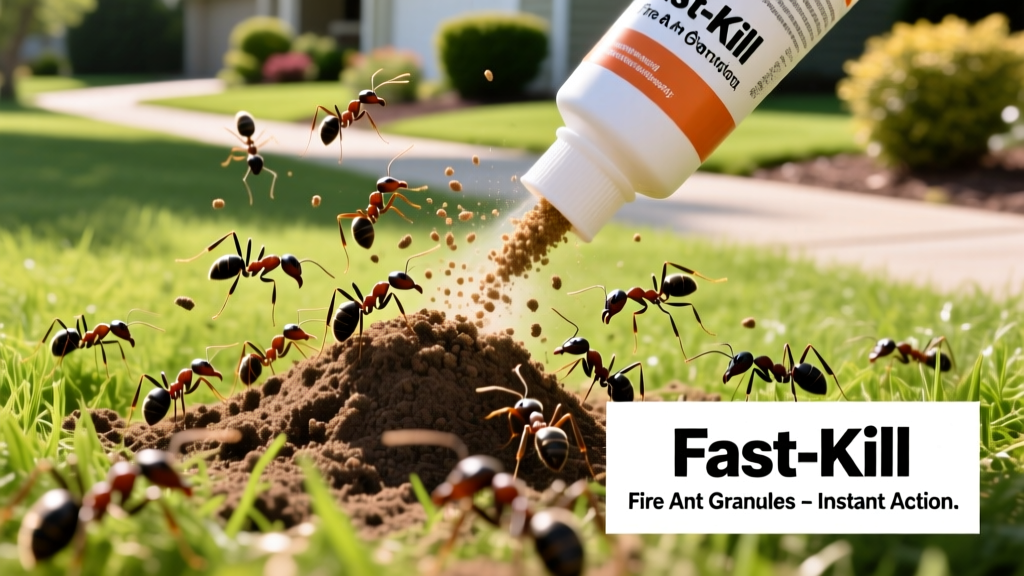
What Kills Fire Ants Immediately? Fast-Acting Mound Treatments
The "Immediate Kill" Reality Check: Surface vs. Colony
When homeowners ask what kills fire ants immediately, they are usually staring at an active, swarming mound and want the visible threat neutralized within minutes. The short answer is that fast-acting contact insecticides—specifically pyrethroid liquid drenches and botanical oils like d-limonene—will kill foraging workers and shallow-dwelling reproductives on contact. However, understanding the biological limitations of "immediate" treatments is critical to preventing a much larger infestation.
According to the Texas A&M Fire Ant Project, a mature Red Imported Fire Ant (RIFA) colony contains up to 500,000 workers, but the most vital member—the queen—resides 18 to 24 inches below the soil surface. Fast-acting surface sprays and shallow dusts rarely penetrate deep enough to kill the queen instantly. If the queen survives, the colony will either rebuild the mound or, worse, initiate "budding," where the colony splits into multiple satellite mounds across your lawn.
⚠️ The Budding Trigger: Applying a fast-acting, non-repellent contact killer too slowly or in insufficient volume stresses the colony. The surviving queen detects the chemical threat and triggers reproductive swarming, turning one large mound into five smaller, harder-to-treat mounds within 48 hours.
Fast-Acting Mound Drench Comparison Matrix
To achieve an immediate kill of the visible mound while maximizing downward penetration, liquid mound drenches are vastly superior to granular baits (which take 3 to 14 days) or surface dusts. Below is a comparison of the most effective fast-acting active ingredients available to homeowners and professionals in 2026.
| Active Ingredient | Brand Example | Speed of Kill | Cost Per Mound | Best Use Case |
|---|---|---|---|---|
| Bifenthrin (7.9%) | Talstar P / Ortho | 10–30 Minutes | $1.50 - $2.25 | Large mounds, long residual barrier |
| Lambda-cyhalothrin | Spectracide Triazicide | 15–45 Minutes | $0.80 - $1.20 | Budget-friendly rapid knockdown |
| Acephate (97%) | Orthene T / Hi-Yield | 5–15 Minutes | $0.10 - $0.25 | Deep penetration, agricultural zones |
| d-limonene (5.5%) | Orange Guard | Instant (Contact) | $2.50 - $3.50 | Organic gardens, pet-safe areas |
Regulatory Note on Acephate
While Acephate provides the fastest systemic kill and penetrates deep into the soil profile, it is heavily restricted. As of 2026, Acephate products are banned or severely restricted for residential lawn use in states like California, New York, and Washington due to groundwater contamination concerns. Always verify your local Department of Agriculture regulations before purchasing systemic organophosphates.
Step-by-Step: Executing a Liquid Mound Drench
The EPA's Safe Pest Control guidelines emphasize that proper application technique is just as important as the chemical chosen. A common failure mode is pouring the drench too quickly, which causes the liquid to run off the sides of the mound rather than penetrating the central galleries.
- Calculate the Volume: A standard 18-inch diameter mound requires 1.5 to 2 gallons of mixed solution. Smaller mounds (under 12 inches) need 1 gallon.
- Mix the Solution: For Bifenthrin (Talstar P), mix 1 fluid ounce of concentrate per gallon of water. For liquid Spinosad or d-limonene ready-to-use sprays, no mixing is required.
- Disturb the Crust: Using a long stick or metal rod, gently poke a single hole about 2 inches into the very center of the mound. Do not aggressively smash the mound, as this triggers an immediate evacuation response.
- Apply Slowly: Pour the first half-gallon directly into the center hole at a slow, steady trickle. Allow the soil to absorb it. Then, use a watering can with a rose attachment to gently sprinkle the remaining volume over the entire exterior of the mound and a 2-foot radius around the base.
- Do Not Water In: Unlike granular treatments, liquid drenches should not be followed by heavy irrigation, which dilutes the active ingredient before it can bind to the soil organic matter.
Botanical Contact Killers: D-Limonene and Spinosad
For homeowners managing vegetable gardens, orchards, or areas where pets and children play, synthetic pyrethroids may be undesirable. In these scenarios, botanical contact killers provide immediate results without long-term soil toxicity.
D-Limonene (Citrus Oil Extract)
D-limonene works by dissolving the waxy lipid layer of the fire ant's exoskeleton, causing rapid dehydration and death upon direct contact. Products like Orange Guard (5.5% d-limonene) kill workers instantly. However, d-limonene has zero residual activity. Once it dries, it offers no protection against re-infestation, and it requires heavy saturation (up to 3 gallons per large mound) to ensure the liquid reaches the lower galleries.
Spinosad Liquid Drenches
Derived from the soil bacterium Saccharopolyspora spinosa, Spinosad is an organic-approved neurotoxin. While slightly slower than d-limonene (taking 30 to 60 minutes for visible knockdown), liquid Spinosad drenches (such as Captain Jack's Deadbug Brew mixed at 2 oz per gallon) offer a mild residual effect in the soil, continuing to kill emerging workers for up to 48 hours after application.
Pro-Tip for Organic Treatments: Apply d-limonene or Spinosad drenches in the early morning (between 6:00 AM and 8:00 AM) when temperatures are below 75°F. Fire ants cluster near the surface in the cool morning hours, maximizing the number of ants exposed to the immediate contact kill.
The Mandatory 7-Day Bait Follow-Up Protocol
Relying solely on immediate contact killers is a strategic error in long-term lawn management. Because the queen is insulated by feet of soil and thousands of worker bodies, she frequently survives the initial drench. To achieve total colony elimination, you must pair your immediate knockdown treatment with a delayed-action bait.
Exactly 7 to 10 days after applying your fast-acting liquid drench, broadcast a slow-acting insect growth regulator (IGR) or metabolic bait across your entire lawn. Advion Fire Ant Bait (active ingredient: Indoxacarb 0.04%) or Extinguish Plus (Methoprene + Hydramethylnon) are the industry standards. The surviving foragers will carry the bait back to the stressed queen. Because the bait mimics food and acts slowly, the colony does not recognize it as a threat, ensuring the queen ingests the lethal dose, resulting in total colony collapse within 2 to 3 weeks.
Frequently Asked Questions
Does pouring boiling water on a mound kill fire ants immediately?
Yes, boiling water (212°F) will instantly kill any ant it physically touches, typically eliminating 60% to 70% of the colony if you use 2 to 3 gallons. However, this method is highly dangerous to the user, destroys the surrounding grass roots, and alters the soil microbiome. It is not recommended for large-scale lawn management.
Can I use gasoline or motor oil to kill fire ants fast?
Never use petroleum products, bleach, or ammonia on fire ant mounds. Aside from being illegal and highly toxic to the environment and local groundwater, these substances do not penetrate the complex soil galleries effectively. They will contaminate your soil for years and fail to kill the deep-dwelling queen.
Why did the mound move 3 feet away after I sprayed it?
This is a survival mechanism called "budding." If your contact spray was applied too late in the day (when ants are deep underground) or in insufficient volume, the colony senses the chemical barrier. The queen and a subset of workers will physically tunnel away from the treated zone and pop up a few feet away to establish a satellite mound. Always drench in the early morning and follow up with baits.

