
Pest Control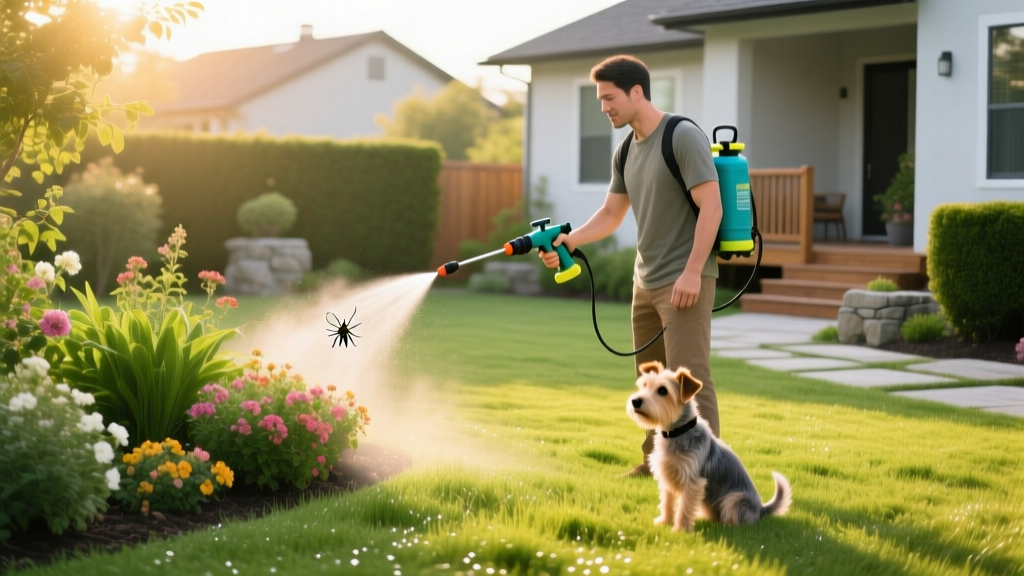
What Kills Fleas Instantly? Fast-Acting Yard and Pet Solutions
The Science of 'Instant' Flea Mortality
When homeowners ask what kills fleas instantly, they are usually looking for an immediate end to a severe infestation. In entomology, 'instant' refers to knockdown time—the period it takes for an active ingredient to paralyze the insect's nervous system—rather than the time required for complete biological death. True instant-kill agents target the flea's voltage-gated sodium channels, forcing them to remain open. This causes continuous nerve firing, rapid spasms, and paralysis within seconds to minutes.
However, a critical distinction must be made between treating the host (your pet) and treating the environment (your yard). While oral medications can kill adult fleas on a dog or cat in under 30 minutes, yard sprays require direct contact and typically take 1 to 4 hours to achieve 100% mortality, even if the initial knockdown is immediate. Understanding this difference is the first step in selecting the right product.
Warning: Never use yard sprays containing Permethrin or Bifenthrin directly on pets. These are strictly environmental treatments and are highly toxic to mammals if ingested or applied topically without veterinary formulation.
Chemical Agents That Kill Fleas on Contact
To achieve the fastest possible kill rate in a lawn or garden environment, you must use adulticides with high contact toxicity. According to the Environmental Protection Agency (EPA), synthetic pyrethroids remain the gold standard for rapid environmental flea control due to their low mammalian toxicity and rapid insecticidal action.
Permethrin and Bifenthrin (Yard Sprays)
Permethrin (found in products like Martin's Permethrin SFR, roughly $25 for 32 oz) and Bifenthrin (found in Talstar P, roughly $50 for 3/4 gallon) are broad-spectrum pyrethroids. When sprayed onto shaded lawn areas where fleas harbor, they disrupt the insect's nervous system on contact.
- Knockdown Time: 15 to 30 minutes.
- Complete Mortality: 2 to 4 hours.
- Application Rate: For Bifenthrin (Talstar P), mix 1 oz of concentrate per gallon of water to cover 1,000 square feet. For severe infestations, increase to 2 oz per gallon.
- Residual Effect: Up to 30 days outdoors, provided it is not washed away by heavy irrigation.
Nitenpyram (Oral Systemic Killers for Pets)
If your goal is to kill fleas instantly on your pet before bringing them back into the house or yard, Nitenpyram (brand name Capstar, ~$30 for 6 tablets) is the only true 'instant' killer. It is an oral neonicotinoid that enters the pet's bloodstream. When a flea bites the treated animal, it ingests the compound and dies.
- Onset of Action: 15 to 30 minutes.
- Complete Mortality: Over 90% of adult fleas on the host are dead within 4 hours.
- Limitation: It has zero residual effect. It only kills fleas currently on the animal and does nothing for the yard.
Comparing Fast-Acting Killers vs. Insect Growth Regulators
A common mistake in flea management is relying solely on instant-kill adulticides. While they eliminate the immediate threat, they do not stop the life cycle. The Centers for Disease Control and Prevention (CDC) notes that adult fleas represent only 5% of a total flea population; the remaining 95% exists as eggs, larvae, and pupae in the soil and thatch. To fully eradicate an infestation, instant killers must be paired with Insect Growth Regulators (IGRs).
| Active Ingredient | Action Type | Kill Time | Target Life Stage |
|---|---|---|---|
| Bifenthrin / Permethrin | Adulticide (Contact) | 15 mins - 4 hours | Adults |
| Nitenpyram | Adulticide (Systemic) | 15 - 30 minutes | Adults (on host) |
| Pyriproxyfen (IGR) | Juvenile Hormone Mimic | Days to Weeks | Eggs and Larvae |
| Methoprene (IGR) | Juvenile Hormone Mimic | Days to Weeks | Larvae and Pupae |
Pro Tip: Always tank-mix a pyrethroid (like Bifenthrin) with an IGR (like Pyriproxyfen, sold as Archer IGR) for yard applications. The pyrethroid provides the instant knockdown you need today, while the IGR prevents the next generation from maturing over the next 7 months.
The Myth of Instant Desiccant Powders
Many organic gardening guides recommend Diatomaceous Earth (DE) or silica aerogel as 'instant' natural flea killers. This is scientifically inaccurate. Desiccants work by abrading the waxy outer layer of the flea's exoskeleton, causing it to dehydrate and die.
According to Cornell University's NYSIPM program, desiccants require the insect to crawl through the dust and subsequently die from water loss. This process takes anywhere from 12 to 48 hours. Furthermore, DE loses its efficacy entirely when exposed to morning dew, rain, or lawn irrigation, making it a poor choice for outdoor yard applications unless applied in completely dry, covered areas like under porches or in dry crawl spaces.
Step-by-Step Protocol for Rapid Yard Eradication
If you are facing a sudden, massive flea emergence in your lawn, follow this precise protocol to maximize the speed and efficacy of your chemical application.
- Mow the Lawn to 2 Inches: Fleas avoid direct sunlight. Cutting the grass short exposes the soil and thatch layer to UV rays, which naturally kills some larvae and allows your spray to penetrate the canopy.
- Clear Organic Debris: Rake up leaves, pine needles, and clippings. Flea larvae feed on organic detritus and adult flea feces; removing this starves the developing population.
- Mix the Tank Solution: In a 2-gallon pump sprayer, combine 2 oz of 7.9% Bifenthrin concentrate, 2 oz of Pyriproxyfen IGR, and 1 teaspoon of a non-ionic surfactant (to help the liquid stick to grass blades). Fill the rest with water.
- Apply to Shade and Transition Zones: Fleas rarely live in the middle of a sun-baked lawn. Focus 90% of your spray effort on the perimeter of the yard, under shrubs, along fence lines, and in shaded pet resting areas.
- Activate with Light Irrigation: Wait 24 hours for the chemical to dry and bind to the soil, then water the lawn lightly (about 0.1 inches). This pushes the active ingredients down into the thatch layer where larvae hide, without washing them away into storm drains.
Safety Protocols for Pets, Pollinators, and Aquatic Life
Speed of kill must never compromise environmental safety. Pyrethroids like Permethrin and Bifenthrin are highly toxic to aquatic organisms and bees.
'When applying fast-acting pyrethroids outdoors, establishing a 10-foot buffer zone between the treated lawn and any water features, koi ponds, or natural waterways is non-negotiable. The knockdown effect that makes these chemicals so effective against fleas is equally devastating to aquatic invertebrates.'
Pet Safety: Keep all dogs, cats, and livestock off the treated lawn until the liquid spray has completely dried (typically 2 to 4 hours depending on humidity). Once dry, the chemical binds to the soil and plant tissue, rendering it safe for mammalian contact. Cat Owners: Never use Permethrin-based products in environments where cats roam, as felines lack the liver enzyme (glucuronosyltransferase) required to metabolize permethrin, leading to fatal neurotoxicity even from secondary environmental exposure.
Frequently Asked Questions
Does vinegar kill fleas instantly?
No. Vinegar (acetic acid) is a mild repellent but possesses zero adulticidal properties. It will not kill adult fleas, larvae, or eggs on contact, nor will it alter the pH of your yard enough to disrupt their life cycle.
Can I use rubbing alcohol to kill fleas in the yard?
While isopropyl alcohol kills fleas on direct contact by dissolving their exoskeleton, it evaporates within seconds. It leaves no residual effect, is highly flammable, and will severely desiccate and burn your lawn grass. It is not a viable outdoor treatment.
How fast do flea bombs (foggers) work indoors?
Total release foggers typically knock down adult fleas within 1 to 2 hours. However, the aerosol droplets rarely penetrate deep into carpet fibers or upholstery where pupae hide. Foggers are largely considered obsolete by modern entomologists in favor of targeted crack-and-crevice sprays combined with IGRs.

