
Pest Control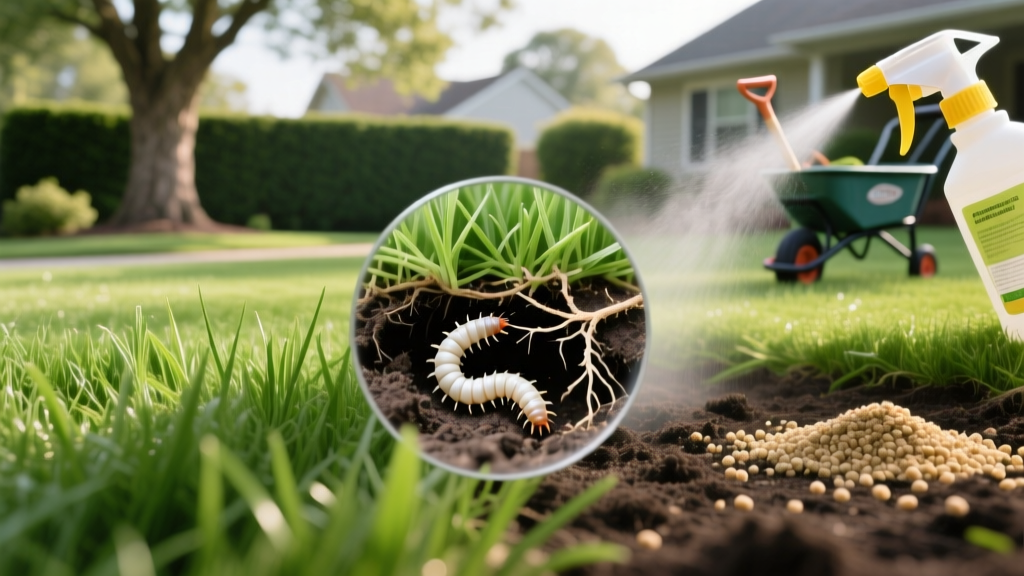
What Kills Grub Worms Fast? Curative vs Preventative Treatments
The Grub Worm Threat: Identification and Root Destruction
White grubs are the larval stage of scarab beetles, including Japanese beetles, European chafers, and June bugs. They feed aggressively on turfgrass roots just below the soil surface, severing the plant's ability to uptake water and nutrients. The primary symptom of a severe infestation is turf that feels spongy underfoot and can be rolled back like a loose carpet. Secondary damage often occurs when foraging skunks, raccoons, and crows tear up the lawn to eat the protein-rich larvae.
Before asking what kills grub worms, you must confirm their presence. Peel back one square foot of damaged turf. If you count more than 10 to 15 C-shaped, six-legged larvae with brown head capsules per square foot, treatment is immediately required. Treating a lawn with fewer than 5 grubs per square foot is a waste of money and unnecessarily introduces pesticides into the soil ecosystem.
The Chemistry of Grub Control: Curative vs. Preventative
The question of what kills grub worms effectively depends entirely on the time of year and the life cycle of the pest. Grub control products fall into two distinct chemical categories: fast-acting curatives for active infestations, and slow-release preventatives designed to kill newly hatched larvae before they cause damage.
| Active Ingredient | Product Example | Kill Speed | Best Application Window | Est. Cost per 1,000 sq ft |
|---|---|---|---|---|
| Trichlorfon | Dylox 6.2 / Bayer 24-Hour | 24 - 48 Hours | Late Summer (Aug - Sept) | $18 - $24 |
| Chlorantraniliprole | Scotts GrubEx1 / Acelepryn | 60 - 90 Days | Spring (April - May) | $6 - $9 |
| Clothianidin | Arena 50 WDG | 7 - 14 Days | Early Summer (June) | $25 - $32 |
| Hb Nematodes | BioSafe / Arbico Organics | 3 - 7 Days | Late Summer (Aug - Sept) | $35 - $45 |
As of 2026, regulatory shifts have restricted the use of certain neonicotinoids (like imidacloprid) in several states due to pollinator concerns. Consequently, the EPA and university extensions increasingly recommend anthranilic diamides (Chlorantraniliprole) for preventative care, as they exhibit extremely low toxicity to bees and earthworms while remaining highly lethal to scarab larvae.
Emergency Curative Protocol: Using Trichlorfon
When an infestation is discovered in late summer or early fall, you need an immediate curative. Trichlorfon (commonly sold as Dylox 6.2) is an organophosphate that acts on the insect's nervous system, killing mature grubs within 24 to 48 hours. However, its efficacy is highly dependent on soil chemistry and application mechanics.
⚠️ Critical Soil pH Warning: Trichlorfon undergoes rapid alkaline hydrolysis. If your soil pH is above 7.2, the active ingredient will break down and become completely ineffective within 3 to 5 days. Always perform a soil pH test before applying Dylox. If your soil is highly alkaline, switch to a biological control or a different chemical class.
Step-by-Step Curative Application
- Mow and Dethatch: Mow the lawn to 2 inches and remove any thatch layer thicker than 0.5 inches. Thatch acts as a physical barrier, trapping the pesticide before it reaches the soil where the grubs are feeding.
- Apply Granules: Use a rotary spreader to apply Trichlorfon at the label-specified rate (typically 1.5 to 2 lbs of product per 1,000 square feet).
- Immediate Watering: Trichlorfon requires moisture to move into the root zone. Water the lawn immediately after application with at least 0.5 inches of water to wash the granules off the grass blades and into the top 2 inches of soil.
- Monitor and Repeat: Check the lawn 48 hours later. Because Trichlorfon degrades quickly in the soil (leaving no residual protection), a second application may be necessary if the infestation is severe and staggered hatching is occurring.
Biological Warfare: Nematodes and Milky Spore
For homeowners seeking organic solutions, biological controls offer a highly targeted approach to grub eradication without disrupting soil microbiology. However, they require precise environmental conditions to succeed.
Beneficial Nematodes (Heterorhabditis bacteriophora)
The Hb strain of beneficial nematodes is a microscopic worm that actively hunts grubs, enters their bodies, and releases symbiotic bacteria that kill the host within 48 hours. According to UC Davis IPM guidelines, nematodes are highly effective but fragile. They must be stored in a refrigerator (35°F - 40°F) until the moment of application. Apply them at dusk or on a cloudy day, as UV light and heat will kill them instantly on the grass surface. The soil temperature must be between 60°F and 85°F, and the lawn must be kept consistently moist for 10 days post-application to allow the nematodes to migrate through the soil profile.
The Milky Spore Myth
Milky Spore (Paenibacillus popilliae) is frequently marketed as a cure-all for grubs. In reality, it only infects Japanese beetle larvae. It will not kill European chafer or June bug grubs. Furthermore, Milky Spore is a long-term inoculation strategy, not a curative one. It takes 2 to 5 years for the spore count to build up in the soil to effective levels, making it useless for a homeowner looking for immediate relief from an active infestation.
Preventative Maintenance: Timing is Everything
If you want to avoid the stress and cost of curative treatments, preventative applications are the gold standard. Chlorantraniliprole (Scotts GrubEx1) is the industry standard for residential prevention. Unlike older chemicals, it does not require immediate watering and is safe for pollinators once dry.
The critical failure point for homeowners is mis-timing the application. Chlorantraniliprole takes 60 to 90 days to fully translocate into the root zone. Applying it in July or August is entirely ineffective for that season's grub hatch. For optimal results, apply GrubEx between April 1 and May 15. This ensures the chemical is fully integrated into the grassroots by the time eggs hatch in mid-to-late summer.
Common Mistakes That Render Grub Treatments Useless
Even the best active ingredients will fail if the application mechanics are flawed. Avoid these frequent errors:
- Ignoring the Thatch Layer: A thatch layer exceeding 0.5 inches will absorb liquid and granular pesticides, preventing them from reaching the soil. Core aeration or power raking is mandatory before treatment in heavily thatched lawns.
- Treating in Drought Conditions: Grubs migrate deeper into the soil (up to 8 inches) during dry spells to find moisture. Contact insecticides like Trichlorfon cannot reach them at this depth. Irrigate the lawn deeply 24 hours before applying a curative to draw the grubs back up into the top 2 inches of the root zone.
- Misidentifying the Damage: Brown patches caused by fungal diseases (like brown patch or dollar spot) or dog urine spots are frequently mistaken for grub damage. Always perform the 'tug test' and peel back the sod to verify the presence of larvae before spending money on pesticides.
Understanding the specific life cycle of scarab beetles in your region and matching the correct active ingredient to the current season is the only reliable way to protect your turf. For comprehensive regional data on grub hatching timelines, consult your local university extension office, such as the Penn State Extension turfgrass program, to calibrate your application calendar perfectly.

