
Pest Control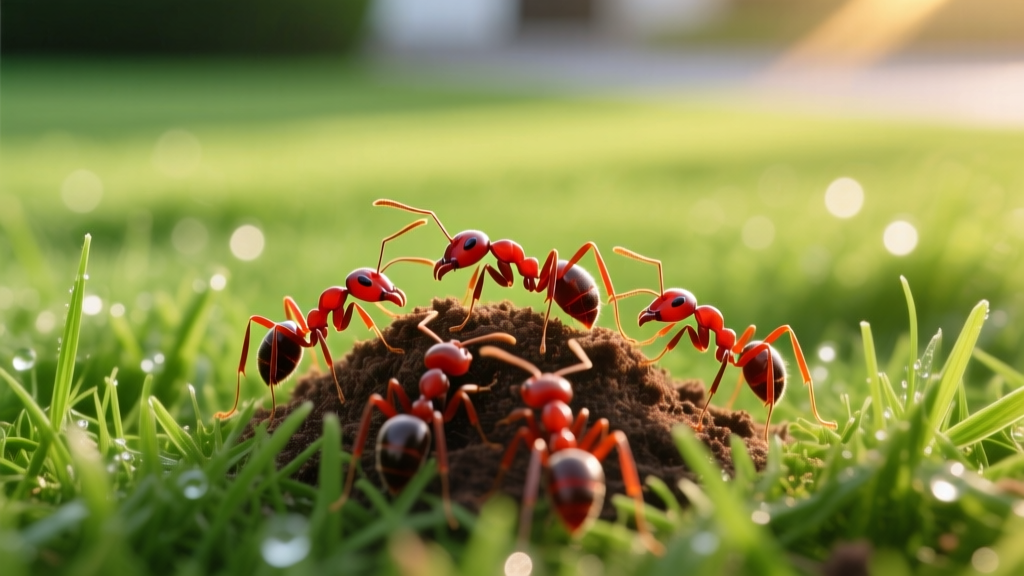
What Kills Red Ants in Lawns? Fast-Acting Treatments & Baits
When a homeowner asks what kills red ants, the answer requires understanding that you are not just fighting individual insects; you are fighting a highly organized, subterranean superorganism. Red ants—most notably the Red Imported Fire Ant (RIFA, Solenopsis invicta)—can establish colonies of up to 500,000 workers. Spraying visible foragers with a contact insecticide only eliminates the scouts, leaving the queen and the brood entirely unaffected. To permanently eradicate red ants from your lawn, you must deploy a strategy that exploits their biology, utilizing slow-acting toxic baits, precise mound drenches, and targeted growth regulators.
Identifying Your Red Ant Invaders: The Threat Matrix
Before selecting a treatment, confirm the species. Misidentifying the ant can lead to ineffective chemical choices. According to the University of Florida IFAS Extension, the Red Imported Fire Ant is the most aggressive and damaging species in the southern United States, but other red-tinted ants require different management thresholds.
| Species | Mound Characteristics | Aggression Level | Colony Structure |
|---|---|---|---|
| Red Imported Fire Ant (RIFA) | Dome-shaped, up to 18 inches wide. No visible entrance holes on top. | Extreme. Swarms and stings en masse when disturbed. | Monogyne (1 queen) or Polygyne (multiple queens). |
| Red Harvester Ant | Large, flat craters surrounded by cleared gravel/pebbles. Deep central hole. | High. Painful sting, but generally less aggressive than RIFA. | Monogyne (Single queen). Colonies live 15+ years. |
| European Red Ant (Formica) | Low, sprawling mounds often near rotting wood or tree bases. | Moderate. Will bite and spray formic acid, but rarely swarm aggressively. | Polydomous (Multiple interconnected nests). |
What Kills Red Ants: The Chemical Arsenal
The most effective way to kill an entire red ant colony is to trick the workers into carrying a delayed-action toxin directly to the queen. Fast-acting chemicals trigger alarm pheromones, causing the colony to seal off the treated tunnels and relocate. You need slow-acting active ingredients.
1. Indoxacarb (The Pro-Insecticide Approach)
Top Product: Advion Fire Ant Bait (0.04% Indoxacarb)
Cost: ~$55 - $65 per 20lb bag
Indoxacarb is a pro-insecticide. It is biologically inactive when the ant first ingests it. Once inside the ant's gut, specific enzymes metabolize it into a highly toxic compound that blocks sodium channels in the nervous system. Because this metabolic process takes 24 to 72 hours, the foragers have ample time to regurgitate the bait and feed it to the brood and the queen through trophallaxis. Apply at a rate of 1.5 lbs per acre (roughly 1/2 cup per individual mound).
2. Hydramethylnon + Pyriproxyfen (The Dual-Action Matrix)
Top Product: Amdro Kills Fire Ants (0.73% Hydramethylnon, 0.1% Pyriproxyfen)
Cost: ~$25 per 18lb bag
Hydramethylnon disrupts cellular metabolism, starving the ant of energy. It typically kills within 3 to 5 days. The addition of Pyriproxyfen, an Insect Growth Regulator (IGR), is the critical E-E-A-T differentiator here. Pyriproxyfen mimics juvenile hormone, rendering the queen sterile and preventing larvae from maturing. Even if the queen survives the initial poisoning, the colony will collapse within 30 to 45 days as the worker population ages out without replacement. For broadcast application using a Scotts EdgeGuard Mini spreader, set the dial to 3.5.
3. Acephate (The Contact Mound Drench)
Top Product: Ortho Orthene Fire Ant Killer (50% Acephate)
Cost: ~$12 per 1lb shaker
Acephate is a fast-acting organophosphate used strictly for individual mound drenching when an immediate knockdown is required (e.g., a mound located near a child's play area). It is a systemic contact poison. You mix 1 ounce of powder per gallon of water and slowly pour 2 gallons over the mound. It kills on contact but does not transfer well enough to guarantee the eradication of satellite colonies in polygyne populations.
Organic & Natural Eradication Methods
For homeowners managing lawns near sensitive waterways, organic vegetable gardens, or areas frequented by pets, synthetic chemicals may be restricted. The Clemson University Home & Garden Information Center notes that organic control requires more frequent applications but can achieve high mortality rates when timed correctly.
- Spinosad Baits: Derived from soil-dwelling bacteria (Saccharopolyspora spinosa), Spinosad is highly toxic to ants but safe for mammals once dry. Products like Captain Jack's Deadbug Brew can be used as a liquid drench. Apply in the late evening to prevent UV degradation, as sunlight breaks down Spinosad rapidly.
- Beneficial Nematodes: Applying Steinernema carpocapsae nematodes via a hose-end sprayer introduces microscopic worms into the soil that hunt ant larvae. This does not kill the colony overnight, but it forces the red ants to abandon the treated area within 2 to 3 weeks as the brood is destroyed. Cost is approximately $35 per 10 million nematodes, covering up to 3,000 sq ft.
- The Diatomaceous Earth (DE) Myth: Many guides recommend DE for red ants. While DE desiccates the exoskeleton of insects, it is entirely useless in humid lawns or after morning dew. Once DE absorbs ambient moisture, it loses its abrasive properties. Reserve DE for dry, indoor baseboard applications only.
Strategic Framework: Broadcast Baiting vs. Individual Mound Treatment
Choosing the wrong application method wastes money and leaves satellite colonies intact. Use this decision matrix to determine your attack plan based on infestation density.
Decision Matrix: Which Strategy to Use?
Scenario A: High Density (More than 5 mounds per 1,000 sq ft)
Action: Broadcast Baiting. Treating individual mounds is economically and practically impossible. Broadcast a Hydramethylnon/IGR bait across the entire lawn. Wait 7 days, then spot-treat surviving mounds with an Acephate drench.
Scenario B: Low Density (Fewer than 3 isolated mounds)
Action: Individual Mound Baiting. Sprinkle 1/2 cup of Indoxacarb bait in a 3-foot circle around the perimeter of the mound. Do not sprinkle it directly on top, as this may alarm the workers and cause them to seal the surface entrances.
Scenario C: Immediate Threat (Mound on patio or near play equipment)
Action: Liquid Mound Drench. Use a fast-acting Acephate or Spinosad liquid drench to kill the colony within 24 hours, followed by a preventative broadcast bait application two weeks later.
Critical Mistakes That Trigger Colony Budding
The most common reason homeowners fail to kill red ants is inadvertently triggering colony budding. According to the Texas Imported Fire Ant Research and Management Project, polygyne fire ant colonies (those with multiple queens) will react to sudden environmental stress by splitting. If you attack a mound with a fast-acting contact spray like Bifenthrin or Cypermethrin, the surviving queens and a fraction of the workers will flee the main nest and establish three or four new satellite mounds within a 20-foot radius. You effectively multiply your infestation.
Warning: Avoid These Application Errors
- Never disturb the mound before baiting. Do not poke the mound with a stick or kick it to 'open it up.' The bait must be carried in naturally by foraging workers.
- Do not apply bait to wet grass. If the grass is wet from dew or irrigation, the bait granules will absorb moisture, become moldy, and the ants will reject them as a food source.
- Check the weather forecast. Ensure there is no rain forecasted for at least 24 hours post-application. Rain washes the active ingredient off the attractive corn grit carrier.
Post-Eradication Lawn Recovery
Once the red ants are eliminated, you will be left with hardened, clay-like mounds that can damage mower blades and create tripping hazards. Do not attempt to level these mounds while the colony is still active, as the ants will simply rebuild. After confirming the colony is dead (no foraging activity for 5+ days), use a steel garden rake to break up the dome. Top-dress the area with a 50/50 mix of compost and play sand, then overseed with a region-appropriate turfgrass seed to blend the repaired zone into the surrounding lawn.

