
Pest Control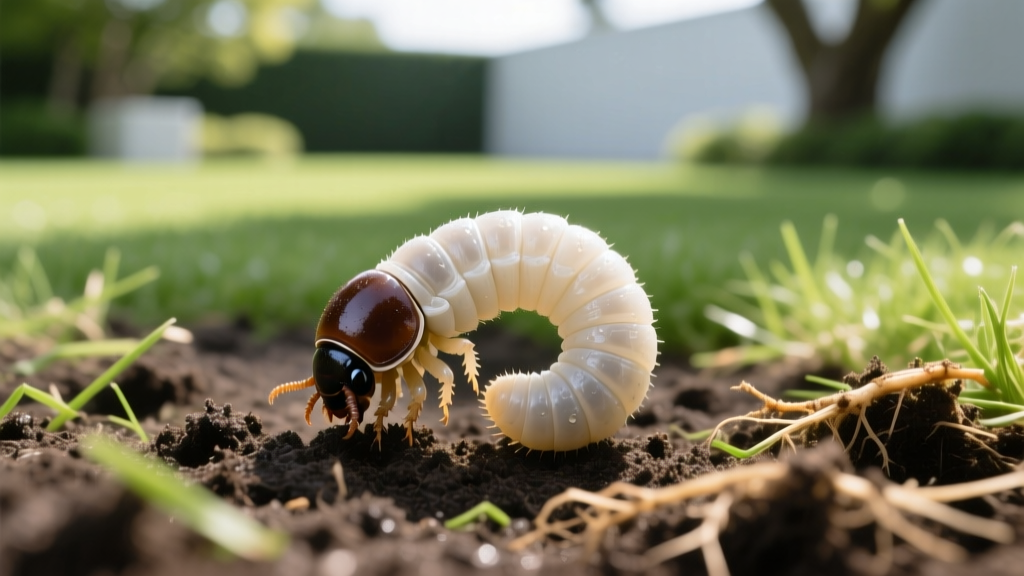
What Does a Lawn Grub Look Like? ID Guide & Treatment Steps
When brown, spongy patches appear on your turf and the grass rolls back like loose carpet, you are likely dealing with the subterranean larvae of scarab beetles. Before applying any chemical or biological control, accurate pest identification is mandatory. Misidentifying the pest leads to wasted money, unnecessary chemical exposure, and continued turf destruction. This guide breaks down the exact physical characteristics of lawn grubs, how to differentiate them from look-alike pests, and the precise diagnostic and treatment protocols required to reclaim your yard.
The Visual Anatomy of a Lawn Grub
Grubs are the immature, larval stage of various scarab beetles, including the Japanese beetle, European chafer, and June bug (Phyllophaga). Regardless of the specific species, they share a distinct morphological profile that makes them relatively easy to identify once you know what to look for.
- Body Shape: Grubs naturally curl into a tight "C-shape" when resting or disturbed. This is a primary defensive posture.
- Coloration: The body is typically a creamy, translucent white, while the head capsule is a distinct, hardened dark brown or reddish-brown.
- Legs: They possess exactly three pairs of jointed, segmented legs located directly behind the head capsule on the thorax. These legs are often shorter than the width of the body.
- Size: Depending on the species and instar (growth stage), they range from 1/4 inch to 1 1/4 inches in length. Mature third-instar grubs are the largest and most destructive.
Entomologist Pro-Tip: The Raster Pattern
To identify the exact species of grub, you must examine the raster—the arrangement of microscopic bristles, spines, and bare patches on the underside of the last abdominal segment (the tail end). You will need a 10x jeweler's loupe to see this clearly. The raster pattern dictates which beetle species is invading your lawn.
To identify the exact species of grub, you must examine the raster—the arrangement of microscopic bristles, spines, and bare patches on the underside of the last abdominal segment (the tail end). You will need a 10x jeweler's loupe to see this clearly. The raster pattern dictates which beetle species is invading your lawn.
Species Identification Matrix
Not all grubs are created equal. The European chafer is generally more destructive to cool-season turf than the Japanese beetle, while June bugs have a multi-year life cycle that requires different management timelines. Use this matrix to identify your specific invader based on mature third-instar characteristics.
| Species | Head Capsule | Raster Pattern (Tail Underside) | Average Length |
|---|---|---|---|
| Japanese Beetle | Yellowish-brown | V-shaped, distinct "zipper" line | Up to 1 inch |
| European Chafer | Dark brown | No zipper; two parallel rows of spines | Up to 1 1/4 inches |
| June Bug (May Beetle) | Reddish-brown | Wide, irregular zipper pattern | Up to 1 1/2 inches |
Grub vs. Billbug vs. Caterpillar: Avoiding Misidentification
Applying a grub-specific insecticide to a billbug or sod webworm infestation will yield zero results. Here is how to differentiate common turf-destroying larvae:
Billbug Larvae
Billbugs are weevils. Their larvae look remarkably similar to white grubs (creamy white, C-shaped, brown head), but they have a critical difference: billbug larvae are entirely legless. Furthermore, their head capsule is typically a lighter tan or reddish color, and their body tapers more sharply at the tail end. Billbug damage often presents as sawdust-like frass (excrement) at the base of the grass blades.
Sod Webworms and Cutworms
These are caterpillars (larvae of moths), not beetles. They do not curl into a tight C-shape and are not creamy white. Sod webworms are usually gray, green, or brown with distinct spots along their backs. Cutworms are dark, greasy-looking, and curl into a tight spiral only when touched. More importantly, caterpillars possess fleshy, unjointed "prolegs" along their abdomen, unlike the three pairs of jointed thoracic legs found on grubs.
The 1-Square-Foot Diagnostic Dig
Seeing a single grub does not mean your lawn is infested. Turfgrass can easily tolerate low grub populations. To determine if chemical intervention is financially and ecologically justified, you must quantify the population density using the standard 1-square-foot dig test.
- Select Test Sites: Choose 3 to 4 areas where the grass is showing early signs of stress (wilting, browning, or sponginess), as well as the margins between healthy and dead grass.
- Cut the Sod: Using a sharp flat spade or a specialized sod cutter, cut three sides of a 12-inch by 12-inch square. Leave the fourth side attached to act as a hinge.
- Peel and Inspect: Peel the turf back like a carpet to expose the top 3 to 4 inches of the soil profile. This is the root zone where grubs feed.
- Count and Record: Manually pick through the soil and count the grubs. Record the number for each test site.
- Replace the Sod: Fold the turf back into place and step on it firmly to ensure root-to-soil contact. Water the area immediately.
Threshold Decision Framework
• 0-5 grubs per sq. ft.: No treatment necessary. The turf can outgrow the minor root feeding.
• 6-8 grubs per sq. ft.: Borderline. Treat if the lawn is under additional stress (drought, heavy foot traffic) or if wildlife (skunks, raccoons, crows) are actively digging up the yard to eat them.
• 9+ grubs per sq. ft.: High infestation. Immediate curative or preventative treatment is required to prevent total turf loss.
• 0-5 grubs per sq. ft.: No treatment necessary. The turf can outgrow the minor root feeding.
• 6-8 grubs per sq. ft.: Borderline. Treat if the lawn is under additional stress (drought, heavy foot traffic) or if wildlife (skunks, raccoons, crows) are actively digging up the yard to eat them.
• 9+ grubs per sq. ft.: High infestation. Immediate curative or preventative treatment is required to prevent total turf loss.
2026 Treatment Protocols & Chemical Timelines
According to Penn State Extension, timing your application to the grub's life cycle is vastly more important than the sheer volume of product applied. Grubs are most vulnerable when they are small and actively feeding near the soil surface.
Preventative Control (April through June)
Preventatives target the newly hatched, first-instar grubs in mid-to-late summer. The industry standard active ingredient is Chlorantraniliprole (found in Scotts GrubEx1 and professional Acelepryn). It is highly effective, has low toxicity to non-target pollinators, and provides residual control. Expect to pay between $45 and $65 for a 5,000 sq. ft. bag. Apply in May or early June, and water it in with at least 1/4 inch of irrigation to move the chemical into the root zone.
Curative Control (August through October)
If you missed the preventative window and find large, destructive third-instar grubs in late summer, you need a fast-acting curative. Trichlorfon (found in Bayer Advanced 24 Hour Grub Killer Plus) is the standard curative agent. It degrades rapidly in the soil (within a few weeks), meaning it won't provide spring protection, but it kills active grubs within 24 hours. Pricing averages $35 to $50 per 5,000 sq. ft. Note that Trichlorfon is less effective in soils with high clay content or high thatch layers, as the chemical binds tightly to organic matter.
Biological and Organic Controls
For homeowners avoiding synthetic chemicals, beneficial nematodes (Heterorhabditis bacteriophora) are the most reliable organic curative. These microscopic worms seek out grubs, enter their bodies, and release fatal bacteria. They must be applied in late summer when soil temperatures are between 60°F and 85°F, and the lawn must be kept consistently moist for two weeks post-application. Expect to pay around $40 to $60 for a hose-end sprayer covering 3,000 sq. ft. Milky Spore (Paenibacillus popilliae) is another organic option, but as Ohio State University Extension notes, it is only effective against Japanese beetle grubs and can take 3 to 5 years to establish fully in the soil.
"The biggest mistake homeowners make is applying a curative product like Dylox in the spring. By May, the mature grubs have stopped feeding and are pupating deep in the soil. The chemical is wasted, and the turf damage you see in spring was actually caused by the grubs feeding the previous fall."
— Dr. David Shetlar, Urban Landscape Entomologist (The Ohio State University)
Frequently Asked Questions
Do grubs turn into the beetles I see flying around in summer?
Yes. Grubs are the larval stage of scarab beetles. A Japanese beetle grub will pupate in the soil in late spring and emerge as the metallic green-and-copper Japanese beetle in early summer. A June bug grub may spend up to three years in the soil as a grub before pupating and emerging as the large, clumsy brown June bug.
Why are animals tearing up my lawn if the grubs are underground?
Skunks, raccoons, armadillos, and crows have highly developed olfactory senses and can smell the protein-rich grubs feeding just a few inches below the surface. If you see deep, cone-shaped holes (skunks) or large rolled-back flaps of sod (raccoons/crows), the animals are doing the digging for you. Treating the grubs will naturally stop the animal damage by removing the food source.
Does watering my lawn attract grubs?
Heavy irrigation in July and August actually encourages grub survival. Female beetles seek out moist, irrigated soil to lay their eggs because the soft ground makes digging easier and prevents the eggs from drying out. If your neighbors let their lawns go dormant during summer droughts, but you keep yours heavily irrigated, your lawn will become the primary egg-laying target for the neighborhood beetle population.

