
Pest Control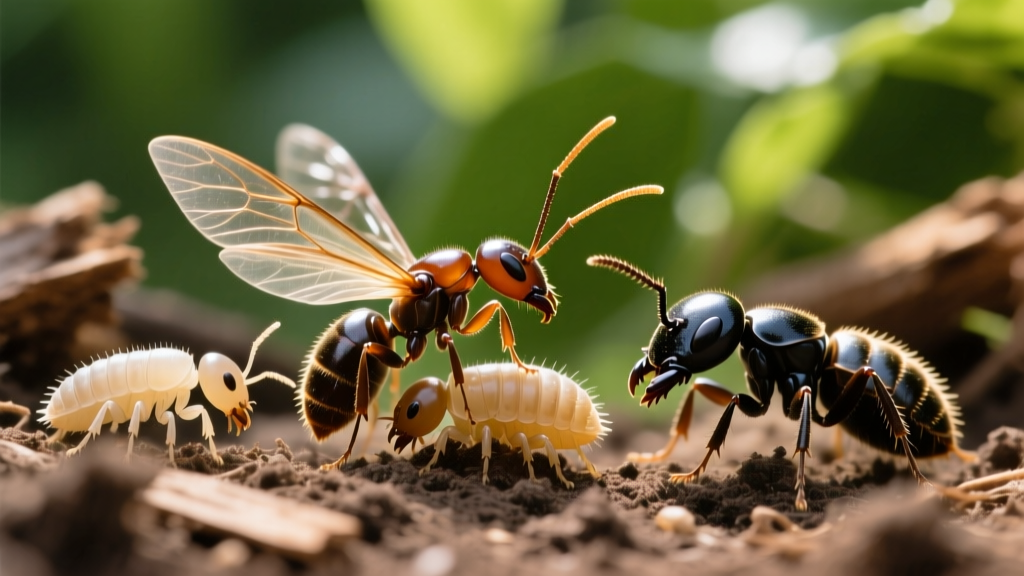
What a Termite Looks Like: Visual Guide to Castes, Swarmers, and Lookalikes
Homeowners often mistake termites for ants, leading to delayed treatments and severe structural damage. Understanding what a termite looks like requires examining the specific caste, as workers, soldiers, and swarmers possess drastically different physical profiles. Furthermore, distinguishing a termite swarmer from a flying carpenter ant is a critical skill for accurate pest identification.
The Three Termite Castes: Visual Breakdown
Termites are eusocial insects, meaning they live in highly organized colonies divided into distinct castes. Each caste has a specialized physical appearance adapted to its role within the colony.
Workers
Workers make up the vast majority of the colony and are responsible for foraging and consuming wood. They are rarely seen in the open because they are highly sensitive to light and dry air. Visually, workers are pale, creamy white, or translucent. They lack wings and have soft, elongated bodies measuring between 1/8 and 3/8 of an inch in length. Because they lack a hard exoskeleton, they appear almost grub-like.
Soldiers
Soldiers defend the colony against predators, primarily ants. They share the pale, soft-bodied appearance of workers but are easily identified by their disproportionately large, yellowish-brown or dark amber heads. Their most striking feature is their oversized, hardened mandibles (jaws), which are designed for crushing and blocking tunnels. Soldiers typically measure 1/4 to 1/2 of an inch long.
Swarmers (Alates)
Swarmers are the reproductive caste, responsible for leaving the nest to establish new colonies. Unlike workers and soldiers, swarmers have dark brown or black bodies. Their most defining visual trait is the presence of two pairs of long, translucent, and roughly equal-length wings that extend well past the tip of their abdomen. Including their wings, swarmers measure between 1/2 and 1 inch in length.
| Caste | Size | Coloration | Key Visual Feature | Primary Role |
|---|---|---|---|---|
| Worker | 1/8" - 3/8" | Creamy white / Translucent | Soft, grub-like body; no wings | Foraging, wood consumption, nest building |
| Soldier | 1/4" - 1/2" | Pale body, amber head | Oversized, hardened mandibles | Colony defense |
| Swarmer | 1/2" - 1" (with wings) | Dark brown / Black | Two pairs of equal-length wings | Reproduction, starting new colonies |
Termite vs. Carpenter Ant: Spotting the Difference
During spring swarming season, winged termites and winged carpenter ants are frequently confused. Misidentification leads to incorrect treatment protocols, as ant baits are entirely ineffective against termites. According to the National Pest Management Association (NPMA), homeowners should examine three specific anatomical zones to tell them apart.
- The Waist: Termites have a broad, straight connection between the thorax and abdomen, giving them a uniform, rectangular profile. Carpenter ants have a distinct, sharply pinched waist (petiole) that creates an hourglass shape.
- The Antennae: Termite antennae are straight and slightly beaded, resembling a string of tiny pearls. Ant antennae are distinctly "elbowed" or bent at a sharp angle near the base.
- The Wings: Termite swarmers possess four wings of equal size and shape that are fragile and easily shed. Carpenter ants have four wings, but the front pair is noticeably longer than the hind pair, and the wings are heavily veined and durable.
Subterranean vs. Drywood vs. Dampwood Termites
While the caste system applies universally, the species of termite dictates slight visual variations and, more importantly, the type of damage you will find.
Subterranean Termites
The most destructive species in the United States. Workers are pale and soft, but the visual hallmark of a subterranean infestation is not the insect itself, but the mud tubes. These termites require constant moisture and build pencil-width (1/4 to 1 inch) tunnels of soil, saliva, and feces to travel between the soil and the wood they are consuming.
Drywood Termites
Drywood termites do not require contact with soil and infest dry structural timber or furniture. Their swarmers are slightly larger and have a distinct reddish-brown head and dark brown body. Visually, they are most often identified by their frass (fecal pellets), which they push out of tiny kick-out holes. Frass looks like coarse sand or coffee grounds, but under magnification, the pellets have six distinct concave sides.
Dampwood Termites
These termites infest wood with high moisture content, such as rotting stumps or leaky porch supports. They are significantly larger than subterranean termites, with soldiers reaching up to 3/4 of an inch and swarmers exceeding 1 inch. They do not build mud tubes and rarely leave visible frass, making them harder to detect visually until structural failure occurs.
⚠️ Critical Warning: Do Not Disturb Mud Tubes
If you spot subterranean termite mud tubes on your foundation, do not break them open or sweep them away. Termites will simply abandon that specific tube, build a new one in a hidden location, and continue feeding on your home. Leave the tubes intact so a pest control professional can use them to locate the main colony and apply targeted treatments.
Professional Treatment Protocols and Costs
Identifying what a termite looks like is only the first step; eradication requires specialized chemical protocols. The Environmental Protection Agency (EPA) strongly advises against DIY chemical treatments for active structural infestations due to the complexity of soil trenching and the hazards of improper pesticide application.
Liquid Soil Barriers (Non-Repellents)
The industry standard for subterranean termites is a non-repellent liquid termiticide, most commonly Fipronil (e.g., Termidor SC at a 9.1% concentration). Because it is non-repellent, termites cannot detect the chemical barrier. They tunnel through it, pick up a lethal dose, and transfer it to the rest of the colony via grooming and trophallaxis (food sharing).
- Application: Requires trenching 6 inches deep and 6 inches wide around the entire foundation, drilling through concrete slabs, and rodding into the soil.
- Cost: Typically priced at $8 to $12 per linear foot. An average 2,500 sq. ft. home will cost between $1,800 and $2,800 for a complete perimeter treatment.
Termite Baiting Systems
For homes with complex landscaping, wells, or environmental concerns regarding soil chemicals, bait stations like the Sentricon System are utilized. Stations are installed every 10 feet around the perimeter. Once termites find the station, the wood monitor is replaced with a cellulose matrix laced with Hexaflumuron, an insect growth regulator that prevents termites from molting, eventually collapsing the colony.
- Cost: Initial installation and first-year monitoring ranges from $1,500 to $2,500. Annual renewal and monitoring fees are typically $300 to $500.
According to Penn State Extension, both methods are highly effective when applied correctly, but liquid barriers offer immediate colony suppression, while bait systems may take 3 to 6 months to eliminate the threat.
Frequently Asked Questions
Can termites bite humans or pets?
While soldier termites possess strong mandibles designed to crush rival insects, they are highly unlikely to bite humans or pets. Their jaws are not adapted for piercing skin, and they will actively retreat from light and vibration rather than attack. The primary threat termites pose is strictly structural and financial.
What time of year do termite swarmers appear?
Subterranean termite swarms typically trigger in the spring, often on warm, sunny mornings immediately following a heavy rain event. Drywood termites, however, often swarm in the late summer or early fall. Finding discarded, translucent wings on window sills or near exterior doors is a definitive visual indicator that a swarm has recently occurred.
How fast do termites eat wood?
A mature subterranean termite colony can contain anywhere from 60,000 to over 1 million workers. At peak consumption, a large colony can eat up to 15 pounds of wood per week. However, visible structural damage usually takes 3 to 5 years of continuous, undetected feeding to manifest in residential framing.

