
Pest Control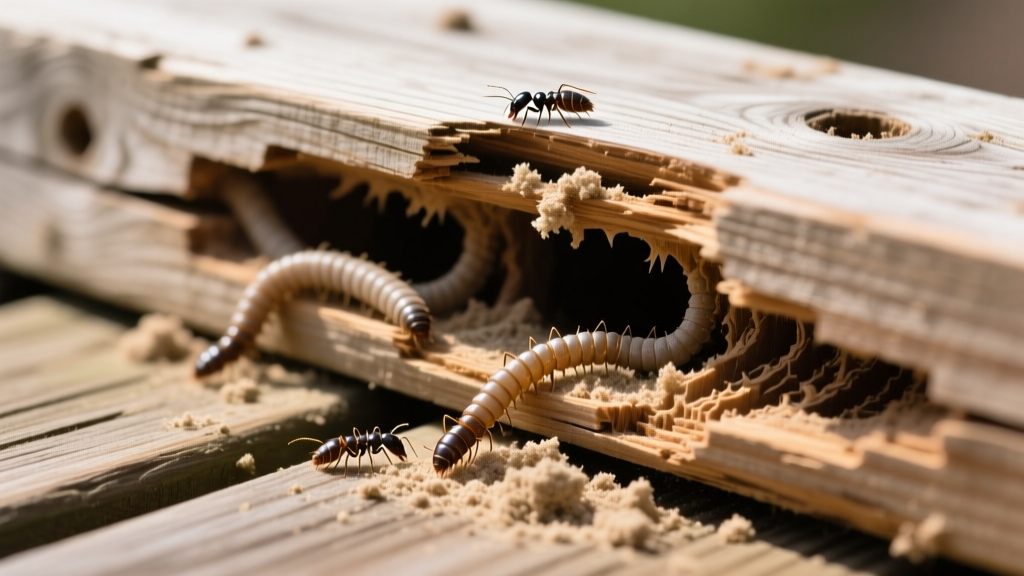
What Do Termites Look Like on Wood? 7 Visual Signs of Damage
The Anatomy of Termite Wood Damage
When homeowners search for what termites look like on wood, they are rarely looking for the insects themselves. Termites are photophobic and avoid light, meaning the physical bugs remain hidden deep inside timber or underground. Instead, identifying a termite infestation requires recognizing the distinct architectural and structural modifications they leave behind on the wood. The visual evidence changes drastically depending on the species, the moisture content of the timber, and the age of the colony.
According to the U.S. Environmental Protection Agency (EPA), termites cause over $5 billion in property damage annually in the United States. Because they consume cellulose from the inside out, surface-level wood may appear pristine while the structural integrity is entirely compromised. Understanding the specific visual markers of termite consumption is the first step in preventing catastrophic structural failure.
Critical Distinction: Subterranean vs. Drywood
Subterranean termites require contact with soil and build mud structures to travel to wood. Their damage is characterized by soil-packed galleries. Drywood termites live entirely inside the wood, requiring no soil contact, and their damage is characterized by clean galleries and expelled fecal pellets (frass).
7 Visual Indicators: What Termites Look Like on Wood
To accurately diagnose an infestation, inspect your foundation, crawl spaces, and wooden framing for these seven specific visual signatures.
- Exploratory Mud Tubes (Subterranean): These are the most definitive visual sign. Termites construct these tunnels from soil, wood particles, and saliva to maintain humidity while traveling between their colony and the food source. They typically measure 1/4 to 1 inch in width and run vertically along foundation walls, piers, or directly up wooden support posts.
- Hexagonal Frass Pellets (Drywood): Drywood termites push their feces out of the wood through tiny 'kick-out' holes (1-2mm in diameter). This frass accumulates in small mounds beneath the infested wood. Under magnification, these pellets are distinctly hexagonal with six concave sides, measuring roughly 1 millimeter in length.
- Blistered or Peeling Paint: Subterranean termites bring moisture into the wood they are consuming. This excess moisture can cause the paint on the surface of baseboards, window sills, or drywall to bubble, blister, or peel, mimicking water damage.
- Hollow-Sounding Timber: While not strictly visual, tapping wood with a screwdriver handle and hearing a papery, hollow thud indicates the interior cellulose has been consumed, leaving only a thin veneer of surface wood or paint.
- Maze-Like Gallery Patterns: If you break open infested wood, subterranean termites leave a distinct pattern. They preferentially eat the softer 'springwood' growth rings and leave the harder 'summerwood' intact, creating a layered, honeycomb, or maze-like appearance packed with a muddy soil mixture.
- Clean, Smooth Galleries (Drywood): Unlike subterranean species, drywood termites consume both spring and summer wood. Their internal galleries are smooth, clean, and completely free of soil or mud, often featuring a velvety texture.
- Pinholes in Wood and Drywall: Look for tiny, perfectly round holes (about the size of a pinhead) on the surface of wooden beams or drywall. These are exit points created by drywood termite nymphs to push out frass or for swarmers to exit the colony.
Termite Species Damage Comparison Matrix
Different termite species interact with wood in fundamentally different ways. Use this matrix to narrow down the culprit based on the visual evidence present on your timber.
| Feature | Subterranean Termites | Drywood Termites | Dampwood Termites |
|---|---|---|---|
| Gallery Appearance | Layered, follows wood grain, packed with soil/mud | Smooth, clean, cuts across both hard and soft grain | Large, smooth galleries, often in decayed wood |
| Frass / Debris | None expelled; used to build mud tubes | Hexagonal pellets expelled through kick-out holes | Fecal pellets, but rarely expelled; stays inside |
| Moisture Requirement | High; requires soil contact or external water source | Low; extracts moisture from the wood itself | Very High; requires wood with >25% moisture content |
| Wood Preference | Softwoods, structural framing, flooring | Hardwoods, furniture, attic framing, fascia boards | Decaying logs, stumps, wood in contact with soil |
Differentiating Termite Damage from Wood Rot and Carpenter Ants
Homeowners frequently misidentify wood rot or carpenter ant damage as termite activity. Misdiagnosis leads to ineffective and expensive treatments. Use this diagnostic decision tree to verify the damage.
Visual Damage Diagnostic Tree
Step 1: Examine the interior of the hollowed wood.
- If the galleries are lined with mud, soil, or a gritty substance → Subterranean Termites.
- If the galleries are perfectly smooth, clean, and resemble sanded wood → Proceed to Step 2.
Step 2: Inspect the debris (frass) outside or inside the gallery.
- If the debris consists of uniform, hard, hexagonal pellets → Drywood Termites.
- If the debris looks like coarse sawdust, wood shavings, and contains dead insect parts → Carpenter Ants (Ants do not eat wood; they merely excavate it to build nests).
Step 3: Assess the structural integrity and moisture of the surrounding wood.
- If the wood is spongy, crumbly, easily breaks apart into cubes, and smells musty → Wood Decay Fungi (Brown or White Rot), not insects.
Actionable Next Steps: Inspection Protocols and 2026 Costs
If visual signs confirm termite activity on your wood, immediate professional intervention is required. According to the University of California Agriculture and Natural Resources IPM program, delaying treatment allows colonies to expand exponentially, turning minor cosmetic damage into severe structural hazards.
DIY Pre-Inspection Toolkit
Before calling an exterminator, use these specific tools to map the extent of the damage:
- Pinless Moisture Meter (e.g., General Tools MM717, ~$35): Termites thrive in moist environments. Scan your baseboards and window frames. Readings above 19% moisture content indicate a high-risk zone for dampwood or subterranean termites.
- Endoscope/Borescope Camera (e.g., Teslong 1080p, ~$45): Drill a 1/4-inch hole into a suspected wall void or wooden beam and insert the camera to visually confirm active gallery networks without destroying the drywall.
- Awl or Flathead Screwdriver: Probe wooden sill plates and joists. If the tool penetrates the wood with minimal pressure, the internal cellulose has been compromised.
Current Treatment Costs and Methodologies
Treatment pricing varies based on the species identified and the linear footage of the home. Expect the following baseline costs for professional remediation in 2026:
- Liquid Soil Barrier (e.g., Altriset or Termidor SC): $1,200 to $2,500. This involves trenching around the foundation and injecting a non-repellent termiticide that termites carry back to the colony. Best for Subterranean species.
- Bait Station Systems (e.g., Sentricon Always Active): $1,500 to $3,000 initial installation, plus $300-$500 annual monitoring. Stations are placed every 10 feet around the perimeter. Ideal for environmentally sensitive properties.
- Whole-Structure Fumigation (Vikane Gas): $1,500 to $4,000+. Required for widespread Drywood termite infestations where the colony is inaccessible inside the wood. The home must be tented for 48 to 72 hours.
Frequently Asked Questions
Can you see termites crawling on the surface of the wood?
Rarely. Worker termites are blind, sensitive to light, and desiccate quickly in open air. If you see insects crawling openly on wood, they are likely carpenter ants or wood-boring beetles. Termites will only be visible on the surface during a swarm (when winged reproductives emerge) or if you physically break open their mud tubes or infested timber.
Does termite-damaged wood need to be replaced?
It depends on the load-bearing status of the timber. Non-structural wood (like baseboards or decorative trim) should be removed and destroyed to eliminate hidden satellite colonies. For structural joists and beams, a structural engineer must assess the remaining cross-sectional area. Often, 'sistering' a new board alongside the damaged one is sufficient if the termite colony has been fully eradicated via chemical treatment.

