
Pest Control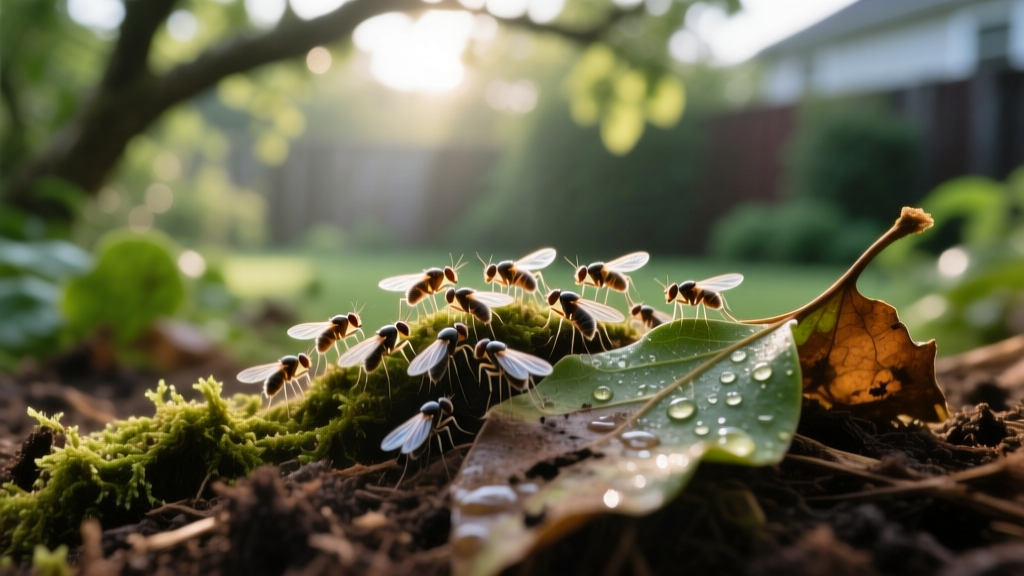
Where Are These Gnats Coming From? 5 Hidden Yard Sources
The Moisture Paradox: Why Your Yard is a Gnat Nursery
When you step onto your patio and are immediately met with a cloud of tiny flying insects, the immediate question is: where are these gnats coming from? The answer almost always traces back to one factor: localized, excessive moisture combined with decaying organic matter. While adult gnats are a nuisance, they are merely the visible symptom of a massive larval infestation happening just beneath your soil surface.
Before deploying chemical sprays, it is critical to understand that most yard gnats are either fungus gnats (Bradysia species) or non-biting midges (Chironomidae). Both require continuously damp environments to complete their 21-to-28-day life cycles. Eradicating them requires shifting your focus from the air to the ground.
Warning: Do not confuse fungus gnats with biting midges (no-see-ums) or mosquitoes. Fungus gnats are weak fliers, roughly 1/8-inch long, and do not bite humans. If you are experiencing bites, you are dealing with a different pest requiring a distinct treatment protocol.
The 5 Hidden Breeding Grounds in Your Landscape
To stop the swarm, you must locate the source. Gnats do not migrate from neighboring properties in large numbers; they breed exactly where you see them. Audit your property for these five specific micro-habitats.
1. Over-Saturated Soil and Thatch Buildup
Lawns with a thatch layer exceeding 0.5 inches trap moisture against the soil surface. When combined with clay-heavy soil that drains poorly, the top inch of the lawn becomes a permanent incubator for gnat larvae. The larvae feed on the fungi and decaying root hairs trapped in the thatch.
2. Compost Bins with Imbalanced C:N Ratios
A compost pile heavy in nitrogen-rich 'green' materials (grass clippings, kitchen scraps) without enough carbon-rich 'browns' (dry leaves, cardboard) turns into an anaerobic, soggy sludge. This high-moisture environment is a premium breeding ground for gnats. Aim for a Carbon-to-Nitrogen ratio of 25:1 to 30:1 to keep the pile aerobic and relatively dry.
3. Clogged French Drains and Downspout Extensions
Check the terminus of your downspouts and French drains. If the corrugated piping is crushed, clogged with leaf litter, or discharging directly into a low-lying depression, it creates a permanent puddle. Even a puddle the size of a dinner plate is sufficient to hatch thousands of gnats weekly.
4. Potted Plants with Peat-Heavy Potting Mix
Container plants on patios and decks are notorious gnat factories. Most commercial potting mixes rely heavily on peat moss, which retains moisture for extended periods. If you water your hostas or container tomatoes daily, the top layer of the peat never dries out, providing a continuous food source for gnat larvae.
5. Decaying Landscape Timbers and Mulch Volcanoes
Wood mulch piled high against tree trunks (mulch volcanoes) or rotting landscape timbers retain moisture and foster fungal growth. As the wood breaks down, it creates the exact damp, fungi-rich environment that fungus gnats require to lay their eggs (up to 200 eggs per female over her lifespan).
Fungus Gnats vs. Biting Midges: Know Your Enemy
Accurate identification dictates your treatment strategy. Use this comparison matrix to confirm your pest before purchasing biological controls.
| Characteristic | Fungus Gnats (Bradysia spp.) | Biting Midges (Culicoides spp.) |
|---|---|---|
| Size | 1/8 inch (3-4 mm) | 1/32 to 1/8 inch (1-3 mm) |
| Flight Pattern | Weak, erratic, hovering near soil | Stronger, often swarming at dusk/dawn |
| Biting | No (mouthparts are vestigial) | Yes (females require blood for eggs) |
| Primary Habitat | Damp soil, potted plants, thatch | Mudflats, salt marshes, tree holes |
| Best Biological Control | Bti and Steinernema feltiae | Bti (specifically formulated for midges) |
The 3-Tier Eradication Protocol
Killing adult gnats with aerosol sprays is a temporary fix that fails to address the root cause. Implement this three-tiered approach to collapse the population within 14 to 21 days.
Tier 1: Cultural Controls (Moisture Management)
Gnats cannot survive in dry soil. You must alter the micro-climate of your yard.
- Deep, Infrequent Watering: Switch from daily 10-minute sprinkler runs to twice-weekly 30-minute sessions. Allow the top 2 inches of soil to dry completely between waterings.
- Core Aeration: If your lawn suffers from compaction, rent a core aerator to pull 3-inch plugs. This improves drainage and accelerates the drying of the soil surface.
- Mulch Correction: Pull mulch back 3 inches from tree trunks and limit the depth to a maximum of 2 inches to allow the underlying soil to breathe.
Tier 2: Biological Warfare (Targeting the Larvae)
This is where you achieve permanent control. According to UC IPM guidelines, biological controls are highly effective when applied to the soil where larvae feed. Furthermore, Penn State Extension emphasizes that targeting the larval stage is the only way to break the reproductive cycle.
- Bti (Bacillus thuringiensis israelensis): This naturally occurring soil bacterium produces crystalline proteins that destroy the digestive tract of gnat and mosquito larvae. Purchase Summit Year-Round Mosquito Dunks (approx. $8 for a 6-pack). Break one dunk into quarters and dissolve a quarter-piece in a 5-gallon watering can. Use this treated water to drench your potted plants and soggy lawn areas. Bti is harmless to humans, pets, and earthworms.
- Beneficial Nematodes (Steinernema feltiae): For severe lawn infestations, apply microscopic nematodes. These organisms actively hunt and infect gnat larvae in the soil. Purchase from specialized suppliers like Arbico Organics (approx. $30 for 10 million nematodes, covering up to 2,000 sq. ft.). Apply in the early evening or on a cloudy day, as UV light destroys them. Keep the soil moist for 7 days post-application to allow the nematodes to migrate.
Tier 3: Adult Population Knockdown
While biologicals work on the larvae, trap the existing adults to prevent them from laying more eggs.
- Yellow Sticky Traps: Gnats are highly attracted to the color yellow. Insert 3x5 inch yellow sticky cards (brands like Kensizer or Gideon) into potted plants and along lawn borders. Replace them every 7 days or when 70% covered.
- Pyrethrin Sprays: For immediate relief on a patio, use a botanical insecticide containing pyrethrins (e.g., Bonide Eight Insect Control, approx. $12). Spray foliage and patio perimeters in the evening. Note: Pyrethrins are highly toxic to bees; never spray blooming flowers.
Pro Tip: If you use a rain barrel to irrigate your garden, it is likely a massive gnat breeding site. Always secure a fine mesh screen (1/16 inch or smaller) over the barrel opening, or drop a full Bti dunk directly into the barrel every 30 days.
Troubleshooting Matrix: Why Your Treatment Failed
If you have applied treatments but the swarm persists, review this diagnostic table to identify your point of failure.
| Symptom | Probable Cause | Corrective Action |
|---|---|---|
| Gnats return 3 days after Bti treatment | Bti was applied to bone-dry soil or washed away by heavy rain. | Reapply Bti after soil is lightly moistened; ensure no heavy rain is forecast for 24 hours. |
| Nematodes showed zero efficacy | Nematodes were exposed to heat/UV during shipping or application. | Apply strictly at dusk; ensure soil temperature is between 50°F and 85°F. |
| Swarm is localized to one tree bed | Mulch volcano or hidden leak in nearby irrigation drip line. | Pull mulch back, inspect drip emitters for continuous weeping, and let soil dry. |
| Adults trapped, but new ones emerge | Larval source is indoors (houseplants) or in a hidden outdoor drain. | Audit all indoor potted plants; flush outdoor French drains with a bleach solution. |
Frequently Asked Questions
Do gnats cause damage to my lawn or plants?
In low numbers, no. However, in severe infestations, fungus gnat larvae can feed on the fine root hairs and root tips of seedlings and young grass shoots, causing stunted growth, yellowing, and increased susceptibility to root rot pathogens like Pythium.
Will apple cider vinegar traps work outdoors?
Apple cider vinegar traps are effective for fruit flies indoors, but they are largely ineffective outdoors against fungus gnats or midges. The wind disperses the scent, and the traps cannot compete with the massive breeding volume of a damp yard. Stick to yellow sticky traps and Bti soil drenches for outdoor defense.
How long does it take to break the gnat life cycle?
At typical summer temperatures (70°F to 80°F), the gnat life cycle from egg to adult takes about 21 to 28 days. By combining Bti soil drenches (to kill larvae) with yellow sticky traps (to catch adults), you can effectively collapse the local population within 14 to 21 days, provided you simultaneously correct the underlying moisture issues.

