
Pest Control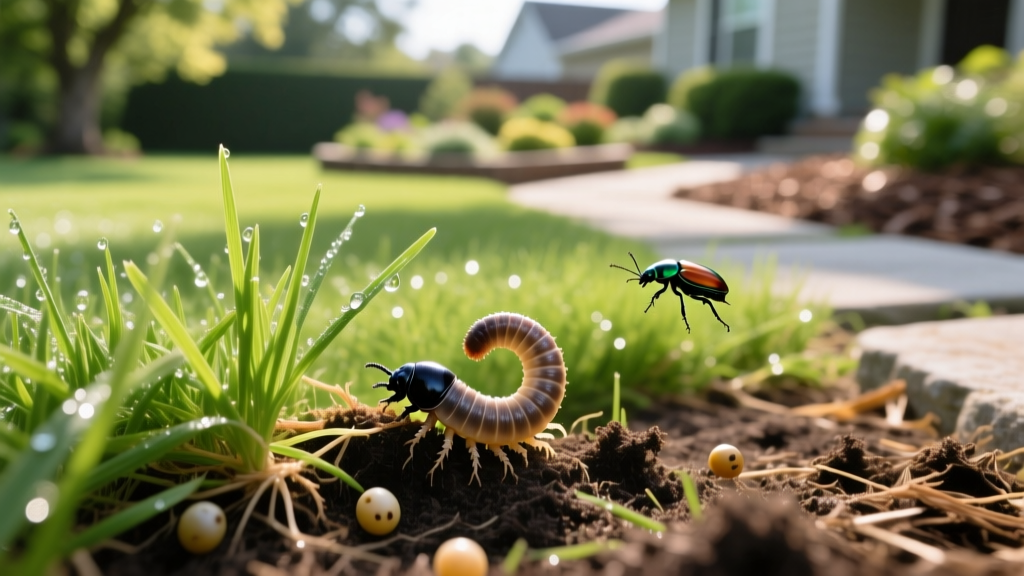
Where Do Grubs Come From? The Complete Life Cycle & Yard Defense Guide
The Origin Story: Where Do Grubs Actually Come From?
When homeowners discover brown, easily detachable patches of turf in late summer, the immediate question is usually: where do grubs come from? The direct answer is that grubs are the larval stage of scarab beetles. Specifically, the most destructive lawn grubs in North America originate from three primary species: the Japanese beetle (Popillia japonica), the European chafer (Rhizotrogus majalis), and the June bug or Masked chafer (Cyclocephala spp.).
Adult beetles emerge from the soil in early summer to mate and feed on ornamental foliage. After mating, the females burrow into the top 2 to 3 inches of your lawn’s soil to lay between 15 and 50 eggs. These eggs require specific environmental conditions—primarily warm soil and adequate moisture—to hatch into the C-shaped, root-feeding larvae we know as grubs. Understanding this origin point is the foundation of any effective insect and rodent yard defense strategy, as targeting the lifecycle at the egg or early-larval stage prevents catastrophic root loss later in the season.
Quick Identification: The Big Three Culprits
- Japanese Beetle Grubs: Have a distinct V-shaped raster pattern (hair arrangement) on their abdomen. Highly prevalent in the Eastern and Midwestern US.
- European Chafer Grubs: Lack a distinct raster pattern; their anal slit is Y-shaped. They feed later into the fall and cause the most severe winter damage in northern climates.
- Masked Chafer (June Bug) Grubs: Have a distinct transverse row of bristles on the abdomen. Common in the Midwest and Western US.
The Grub Life Cycle Timeline
To intercept grubs, you must map your yard defense to their biological clock. According to Penn State Extension, the lifecycle is strictly tied to seasonal soil temperature shifts. Misjudging this timeline by even three weeks can render chemical treatments completely ineffective.
| Month | Life Stage | Lawn Impact & Defense Action |
|---|---|---|
| June - July | Adult Flight & Egg Laying | Minimal damage. Action: Apply preventative granular insecticides. |
| August | Egg Hatch & 1st Instar | Root pruning begins. Grubs are small and highly susceptible to treatment. |
| Sept - Oct | 2nd & 3rd Instar | Peak feeding. Visible brown patches. Action: Apply fast-acting curatives. |
| Nov - March | Overwintering (Deep Soil) | Grubs migrate 4-8 inches deep. No feeding. Treatments are useless here. |
| April - May | Pupation | Grubs stop feeding to transform into adult beetles. Damage ceases. |
Environmental Triggers: Why Your Lawn?
Scarab beetles do not lay eggs randomly. They actively select turf environments that maximize larval survival. Michigan State University Extension notes that irrigated lawns are prime targets. Female beetles seek out moist soil because grub eggs desiccate and die in dry conditions. If you irrigate heavily during July, you are essentially rolling out a red carpet for egg-laying females.
Additionally, lawns with a thatch layer exceeding 0.5 inches provide a thermal buffer that keeps soil temperatures stable, further encouraging egg survival. Reducing irrigation during peak adult flight (July) and dethatching in the spring are critical cultural defenses that complement chemical interventions.
Proactive Yard Defense: Chemical Interventions
When cultural controls are insufficient, targeted insecticides are required. The market divides into two distinct categories: preventatives and curatives. Choosing the wrong one at the wrong time is the leading cause of treatment failure.
Preventative Treatments (The Long Game)
Preventatives must be applied before eggs hatch, typically between mid-April and early June. They remain active in the soil profile, killing grubs as they begin to feed in August.
- Chlorantraniliprole (e.g., Scotts GrubEx1): The industry standard for residential use. It is highly targeted, sparing beneficial earthworms and pollinators. A standard 10-lb bag covers 5,000 square feet and costs approximately $25 to $28 in 2026. Critical requirement: It must be watered in with 0.25 inches of irrigation within 48 hours to move the active ingredient into the root zone.
- Imidacloprid (e.g., BioAdvanced 24-Hour Grub Killer Plus): A neonicotinoid that acts faster than chlorantraniliprole but has a shorter residual window. Best applied in June. Costs roughly $18 for a 5,000 sq ft bag.
Curative Treatments (The Emergency Response)
If you missed the preventative window and spot brown, dying patches in late August or September, you need a curative. Curatives are contact poisons designed to kill large, actively feeding 2nd and 3rd instar grubs.
- Trichlorfon (e.g., Bayer Advanced 24 Hour Grub Killer Plus / Dylox): The most effective curative available to homeowners. It degrades rapidly in high-pH soils (above 7.2), so it must be watered in immediately. Expect to pay around $35 for a 5,000 sq ft bag. It will stop active damage within 48 hours.
Warning on Spring Curatives: Many homeowners apply Dylox in April or May when they see dead patches from the previous year. This is a complete waste of money. By spring, the grubs have stopped feeding and are pupating. The damage you see is already done, and the insects are immune to curatives at this stage.
Biological & Organic Defense Mechanisms
For homeowners managing organic landscapes or those near sensitive waterways, biological controls offer highly effective, albeit slower, alternatives.
Beneficial Nematodes (Heterorhabditis bacteriophora)
Not all nematodes kill grubs. You must specifically source the Heterorhabditis bacteriophora (Hb) strain, which actively hunts scarab larvae. A pack of 10 million nematodes (covering roughly 2,000 sq ft) costs about $30 to $40. Application rules: Soil temperature must be between 60°F and 65°F. Apply at dusk to avoid UV degradation, and irrigate immediately to wash them off the grass blades and into the soil. They require moist soil to survive and hunt.
Milky Spore (Paenibacillus popilliae)
Milky spore is a bacterium that specifically targets Japanese beetle grubs. It is applied via grid inoculation across the lawn. While highly effective long-term, University of Kentucky Entomology reports it takes 3 to 5 years for the spore count to build up sufficiently to provide total control. It is a legacy investment (approx. $60 for a 10-year 4,000 sq ft coverage) rather than a quick fix for an active infestation.
Real-World Troubleshooting: Why Treatments Fail
Even with premium products, homeowners frequently report active grub damage post-treatment. Based on turfgrass diagnostic data, these are the primary failure modes:
- Failure to Water In: Granular preventatives like GrubEx sit on the thatch layer. Without 0.25 to 0.5 inches of water, UV light degrades the chemical, or birds consume the granules. The active ingredient never reaches the soil.
- Alkaline Soil Neutralization: Trichlorfon (Dylox) breaks down in a matter of days in soils with a pH above 7.2. If your soil is highly alkaline, curative treatments will fail. Test your soil pH first; if it's high, rely strictly on chlorantraniliprole preventatives.
- Misdiagnosing the Pest: Not all brown patches are grubs. Chinch bugs, sod webworms, and fungal diseases like brown patch mimic grub damage. Perform the "tug test": grab a handful of brown grass and pull. If it rolls back like a carpet with no roots attached, you have grubs. If the roots are intact but the blades are chewed, you have a surface-feeding insect or fungus.
By mapping your yard defense to the precise origin and lifecycle of scarab beetles, you shift from reactive damage control to proactive turf preservation. Monitor soil moisture in July, apply preventatives in May, and keep curatives on standby for late-summer emergencies.

