
Pest Control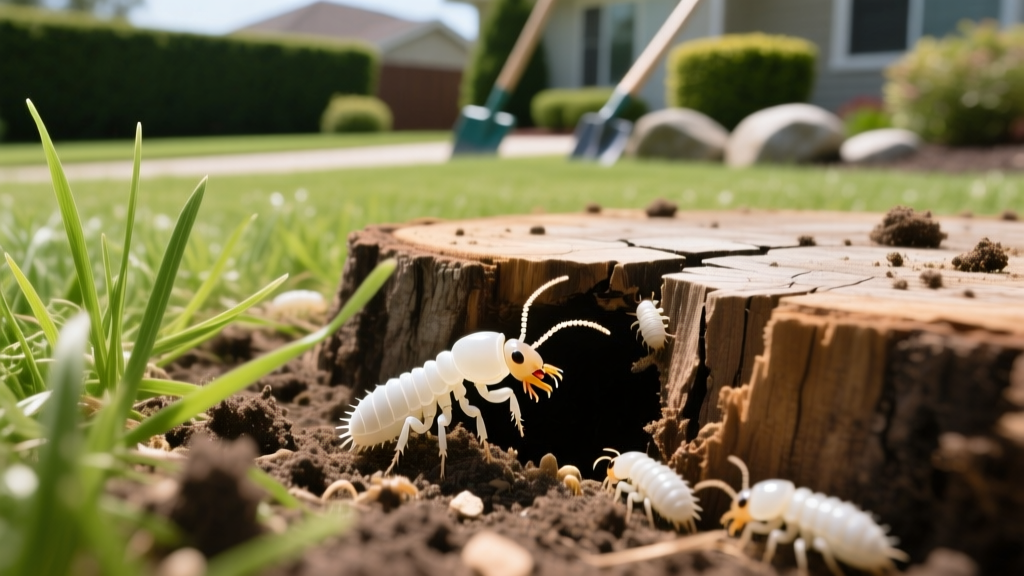
White Termites in the Yard: Identification and Perimeter Defense
Spotting pale, translucent insects in your garden soil or mulch beds often triggers immediate alarm among homeowners. Commonly referred to as 'white termites,' these insects are not a distinct species but rather the worker caste of subterranean termites (Reticulitermes spp. or Coptotermes spp.). Unlike the dark-winged swarmers that emerge in spring, worker termites are blind, wingless, and creamy white, spending their entire lives foraging underground or inside wood. Finding them in your yard indicates an active colony is foraging near your property, making immediate perimeter defense essential to prevent structural infestation.
The 'White Termite' Misconception vs. Biological Reality
There is no such thing as a 'white ant.' The insects homeowners dig up in their yard beds are almost exclusively termite workers. In a subterranean termite colony, the worker caste makes up 90% to 95% of the population. Their primary biological function is to forage for cellulose, digest it, and feed the rest of the colony, including the queen, soldiers, and nymphs.
⚠️ Yard Defense Warning: Do not assume termites found in your yard mulch will stay in the yard. Subterranean termites can forage up to 300 feet from their central nest. A colony feeding on a decaying tree stump at the edge of your property can simultaneously be building mud tubes against your home's foundation.
While finding workers in the soil confirms termite presence, it does not automatically mean your house is compromised. However, it does mean your yard is an active foraging zone, requiring a strategic barrier to intercept them before they reach your foundation.
Diagnostic Matrix: White Termites vs. Yard Look-Alikes
Before purchasing termiticides, verify that the white insects in your soil are actually termites. Yard soil and compost bins are teeming with pale, legless, or soft-bodied insects that are entirely harmless to your home's structure.
| Feature | Termite Workers | Ant Larvae | Potworms (Enchytraeids) |
|---|---|---|---|
| Legs | Six distinct, jointed legs on the thorax | Completely legless (maggot-like) | Legless, worm-like body |
| Head Capsule | Distinct, hardened pale-yellow head | Small, dark brown or black head capsule | No distinct head capsule |
| Body Segments | Broad waist; no distinct constriction | Curled, C-shaped, segmented grub | Highly segmented, thread-like |
| Antennae | Beaded, straight antennae visible on head | None visible | None visible |
| Threat Level | High (Structural wood damage) | None (Harmless yard insects) | Beneficial (Soil aeration/compost) |
Yard Hotspots: Where Foraging Workers Concentrate
Subterranean termites require constant contact with soil moisture to survive. When scouting your yard, focus your inspections on areas where moisture and cellulose intersect.
- Hardwood Mulch Beds: While termites do not eat mulch as a primary food source (they prefer the higher cellulose content of structural pine or spruce), mulch provides the perfect dark, moist highway to travel from the soil to your home's siding.
- Buried Fence Posts: Wooden fence posts set directly into concrete or soil without a metal post anchor are prime entry points. The concrete often cracks, trapping moisture and accelerating wood decay, which attracts foraging workers.
- Tree Stumps and Root Flares: Decaying stumps left in the yard act as secondary feeding sites. A single mature stump can sustain a satellite colony of thousands of workers.
- Woodpiles: Firewood stacked directly on the soil, especially within 20 feet of the home's foundation, serves as an ideal staging ground for termites.
Perimeter Defense Strategy: Trenching and Baiting
If you have confirmed the presence of white termite workers in your yard beds, establishing a defensive perimeter is critical. According to the Environmental Protection Agency (EPA), a dual approach utilizing liquid non-repellent termiticides and chitin synthesis inhibitor baits offers the most robust defense for residential properties.
Method 1: Liquid Non-Repellent Trenching (Termidor SC)
Liquid barriers using Fipronil 9.1% (commonly sold as Termidor SC) utilize a 'transfer effect.' Because the chemical is non-repellent, white termites do not detect it. They tunnel through the treated soil, pick up the active ingredient, and transfer it to the rest of the colony through grooming and trophallaxis (food sharing).
Application Specifics: Mix 0.8 fluid ounces of Termidor SC per gallon of water. Dig a continuous trench 6 inches wide and 6 inches deep around the entire foundation. Apply 4 gallons of the finished solution per 10 linear feet of trench. A standard 20 oz bottle costs approximately $95 and treats roughly 60 linear feet.
- Clear the Perimeter: Rake back all mulch and soil so it is at least 6 inches below the top of the foundation slab or weep holes.
- Dig the Trench: Use a trenching shovel to excavate the 6x6 inch trench directly against the foundation wall.
- Drill Concrete (If Necessary): Where the foundation meets a concrete patio or driveway, use a hammer drill with a 1/2-inch masonry bit to drill holes every 12 inches, extending through the slab to the soil below.
- Apply and Backfill: Pour the mixed solution into the trench and drilled holes, then backfill the soil to create the treated zone.
Method 2: Perimeter Bait Stations (Trelona ATBS)
If trenching is impossible due to landscaping or hardscaping, bait stations using Novaluron 0.5% (Trelona ATBS) are highly effective. Novaluron is an insect growth regulator that halts the molting process. When white worker termites consume the bait, they return to the colony and feed it to the nymphs, eventually collapsing the population.
Install stations 10 to 20 feet apart around the perimeter of the structure, placing them in mulch beds or soil near known foraging areas. A 15-station DIY kit typically costs between $160 and $200. Inspect stations every 60 days and replace the cellulose cartridges when termite feeding is observed.
Edge Cases: When DIY Yard Defense Fails
Standard trenching and baiting protocols are highly effective against native subterranean termites (Reticulitermes flavipes). However, certain environmental and biological edge cases require professional intervention.
'Homeowners often misidentify the sheer scale of a Formosan subterranean termite colony. While a native colony might contain 100,000 workers, a mature Formosan colony in the yard can exceed 5 million individuals, capable of consuming structural timber at an accelerated rate. Yard baiting alone is rarely sufficient for Formosan eradication without professional-grade structural foaming.'
— Adapted from University of Kentucky Entomology Extension guidelines on invasive termite species management.
Formosan Subterranean Termites (Coptotermes formosanus): If you live in the Gulf Coast, Southeast, or parts of Southern California, and you notice massive swarms of yellowish-brown termites at night in late spring, you may be dealing with Formosans. Their colonies are so vast that yard perimeter treatments are easily bypassed. Professional pest control operators (PCOs) must use specialized interior foaming agents and high-volume baiting matrices to achieve control.
High Water Tables and Drainage Issues: Liquid termiticides like Fipronil bind tightly to organic matter in the soil. However, if your yard suffers from severe drainage issues, standing water, or a high water table, the chemical barrier can be diluted or washed away, leaving gaps in your defense. In these scenarios, correcting the grading and installing French drains must precede any chemical application.
Frequently Asked Questions
Will putting gravel instead of mulch around my foundation stop white termites?
Gravel does not provide cellulose, so termites will not eat it. However, a thick layer of gravel can actually retain subsurface moisture and provide a dark, protected environment for termites to build mud tubes undetected. A better approach is to maintain a 12-inch bare soil or concrete apron directly against the foundation, keeping all organic matter, including gravel and mulch, at a distance.
I found white termites in my compost bin. Is my house at risk?
Compost bins generate heat and break down cellulose, making them attractive to foraging workers. While their presence confirms termites are in your yard soil, the compost bin itself is acting as a decoy food source. Move the compost bin at least 30 feet away from your home's foundation and initiate a perimeter baiting or trenching strategy around the house.
How long does a liquid Termidor barrier last in the yard soil?
When applied correctly at the 0.06% rate (0.8 fl oz per gallon) and trenched properly, Fipronil binds to the soil and remains active for 5 to 10 years, depending on soil pH, rainfall, and disturbance. Avoid deep tilling or planting deep-rooted shrubs directly in the treated zone, as this will physically break the chemical barrier.

