
Pest Control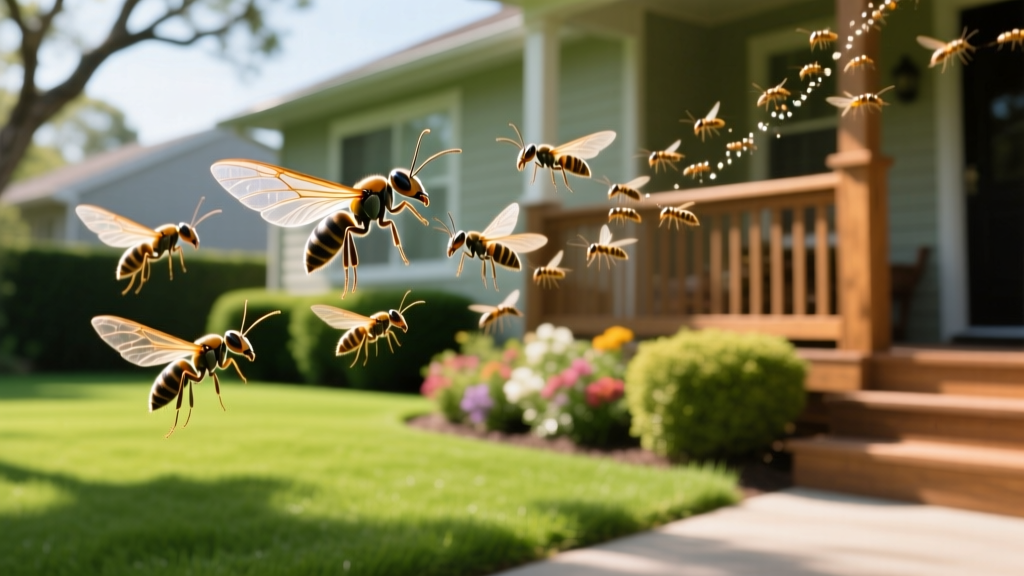
Why Do Flying Termites Suddenly Appear Near Your Home?
The Environmental Triggers: Why Do Flying Termites Suddenly Appear?
When homeowners ask why flying termites suddenly appear in their yard or against their siding, the answer lies in a precise intersection of soil thermodynamics, moisture levels, and colony maturity. These winged insects, known scientifically as alates or swarmers, do not randomly decide to leave their nests. Their emergence—called a nuptial flight—is triggered by highly specific environmental thresholds.
Subterranean termite colonies typically require three to five years to mature enough to produce alates. Once the colony reaches this reproductive stage, the swarm is triggered by:
- Soil Temperature Thresholds: The soil temperature at a depth of 2 to 3 inches must consistently reach 70°F to 75°F. This is why Eastern subterranean termites (Reticulitermes flavipes) overwhelmingly swarm between March and May in temperate zones.
Barometric Pressure and Moisture: Swarms almost exclusively occur the morning after a significant rainfall event. The rain softens the soil, making it easier for alates to excavate exit tubes, and ensures the damp environment required for their survival post-flight. - Phototaxis: Alates are positively phototactic, meaning they are strongly attracted to light. This is why you will suddenly see them clustering around exterior light fixtures, sunlit windows, and bright foundation walls.
According to the University of Kentucky Entomology Department, the primary goal of these swarmers is not to eat wood, but to mate and establish new colonies. The workers and soldiers remain hidden underground; seeing the alates is the most visible, and often the only, indicator that a massive, wood-destroying colony is active beneath your lawn or foundation.
Termite Alates vs. Carpenter Ants: The Identification Matrix
Misidentifying a termite swarm as a carpenter ant swarm can lead to disastrous delays in treatment. While both insects produce winged reproductive castes in the spring, their physical morphology is distinctly different. Use this rapid field-test matrix to confirm the pest.
| Anatomical Feature | Flying Termites (Alates) | Flying Carpenter Ants |
|---|---|---|
| Waist Structure | Broad, uniform waist (thorax and abdomen are nearly the same width) | Pinched, narrow pedicel (distinct hourglass shape between thorax and abdomen) |
| Wing Sizing | Two pairs of equal-length wings that extend well past the abdomen | Two pairs of wings; front wings are significantly longer than hind wings |
| Antennae Shape | Straight and beaded, resembling a string of tiny pearls | Elbowed (bent at a sharp 45-degree angle near the base) |
| Wing Shedding | Wings break off easily at a natural suture line; found in piles on sills | Wings do not easily break off; ants typically retain them until death |
Decoding the Swarm: Species-Specific Timing
The exact timing and behavior of the swarm provide immediate clues about which species is threatening your property. The U.S. Environmental Protection Agency (EPA) notes that identifying the species is critical, as treatment protocols vary wildly between subterranean and drywood varieties.
Eastern Subterranean Termites (Reticulitermes flavipes)
Swarm Window: March through May.
Behavior: Swarms during daylight hours, typically between 10:00 AM and 2:00 PM, immediately following a warm spring rain. Swarmers are dark brown to black with smoky gray wings.
Formosan Subterranean Termites (Coptotermes formosanus)
Swarm Window: May through June.
Behavior: Highly aggressive and destructive. Unlike Eastern species, Formosan alates swarm at dusk or early evening and are heavily attracted to exterior porch lights and streetlamps. They are larger and pale yellow-brown.
Drywood Termites (Incisitermes minor)
Swarm Window: Late summer through early fall (August to November).
Behavior: Common in coastal and southern states. They do not require soil contact and swarm from within the structural wood itself, often leaving small exit holes and piles of hexagonal fecal pellets (frass) behind.
Immediate Action Protocol: What to Do During a Swarm
Panic often leads homeowners to make critical errors that compromise future professional treatments. If a swarm erupts inside your home or against your foundation, follow these exact steps:
- Do Not Use Aerosol Insecticides: Spraying Raid or similar contact killers on swarmers is counterproductive. It only kills the harmless reproductive alates while alerting the hidden worker colony to the chemical threat, causing them to retreat deeper into the structure or initiate secondary budding.
- Vacuum the Alates: Use a shop-vac or standard vacuum to remove the swarmers from windowsills and floors. Empty the canister outside immediately.
- Locate the Exit Point: Trace the swarm back to its source. Look for mud tubes on foundation walls, baseboards, or window frames where the insects are emerging.
- Isolate the Exit: Place a clear plastic bag or glass jar over the swarm exit hole and tape the edges securely. This traps emerging alates, allowing a pest control professional to quantify the severity of the swarm and collect specimens for exact species identification.
Critical Warning: Never caulk, paint over, or seal a termite swarm exit hole before a professional inspection. Sealing the exit forces the colony to route moisture and workers through alternative, harder-to-detect pathways inside your drywall.
Professional Eradication and 2026 Cost Benchmarks
Because flying termites indicate a mature, established colony, DIY bait stations or surface sprays are entirely ineffective. Eradication requires targeting the hidden worker caste. According to North Carolina State Extension, modern termite management relies on two primary professional methodologies.
1. Non-Repellent Liquid Termiticides (Trenching)
Professionals dig a 6-inch by 6-inch trench around the entire foundation and inject a non-repellent chemical like Termidor SC (active ingredient: Fipronil 9.1%) or Taurus SC. Because the chemical is undetectable, foraging workers pass through the treated soil, pick up the active ingredient, and transfer it to the rest of the colony via grooming and trophallaxis (food sharing), ultimately collapsing the colony.
- Average Cost: $7.00 to $10.00 per linear foot.
- Total Project Range: $1,400 to $2,500 for a standard 2,000 sq. ft. home.
- Longevity: 10+ years in undisturbed soil.
2. In-Ground Bait Monitoring Systems
Systems like Sentricon Always Active utilize stations placed every 10 feet around the perimeter. The stations contain Recruit HD bait (active ingredient: Noviflumuron), a chitin synthesis inhibitor. When workers consume the bait, they are unable to molt, leading to colony death.
- Average Cost: $8.00 to $12.00 per linear foot for initial installation.
- Total Project Range: $1,600 to $2,800, plus $150 to $350 for mandatory annual monitoring.
- Best Use Case: Properties with wells, adjacent water features, or extensive hardscaping where trenching is impossible.
Landscape and Yard Prevention Tactics
While professional treatment is mandatory to eliminate an active colony, modifying your yard's micro-environment removes the triggers that attract foraging workers and future swarmers.
- Mulch Setbacks: Cellulose-rich wood mulch retains the exact moisture levels termites require. Maintain a strict 6-inch mulch-free buffer zone between any landscaping beds and your home's foundation. Substitute with inorganic gravel or rubber mulch near the perimeter.
- Irrigation Audits: Ensure sprinkler heads do not spray directly onto siding or foundation walls. Chronic moisture saturation of the soil against the foundation lowers the termite's energy expenditure required to build foraging tubes.
- Grade Correction: The soil must slope away from the foundation at a minimum grade of 6 inches over the first 10 feet. Standing water near the foundation acts as a primary hydration station for subterranean colonies.
- Stump and Debris Removal: Grind down any remaining tree stumps within 50 feet of the home and remove buried construction debris (like wooden form boards left behind by concrete contractors), as these serve as primary satellite feeding stations.

