
Pest Control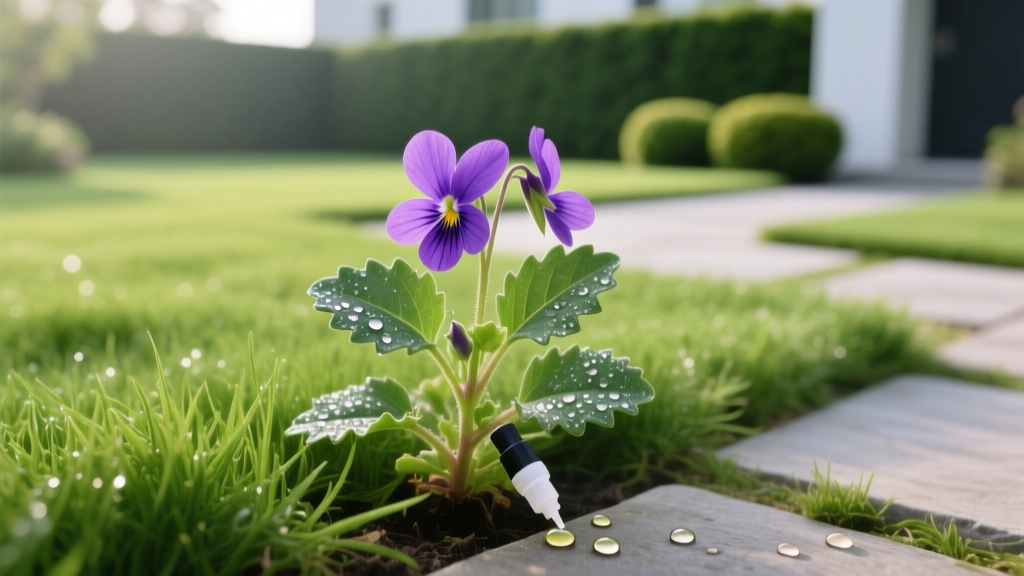
Best Wild Violet Weed Killer Guide for Effective Spot Treatment
The Biology of Resistance: Why Violets Survive Standard Sprays
Wild violets (Viola sororia) are perennial broadleaf weeds that frequently frustrate homeowners due to their remarkable resilience. When standard 2,4-D herbicides fail, the issue is rarely the chemical itself, but rather the plant's physical and biological defenses. According to the University of Minnesota Extension, wild violets possess two primary survival mechanisms that render basic weed killers ineffective.
First, the leaves feature a thick, waxy cuticle. This hydrophobic layer causes water-based herbicide droplets to bead up and roll off onto the soil before the active ingredient can penetrate the leaf tissue. Second, wild violets propagate via underground rhizomes. If a contact herbicide only burns the foliage, the rhizome stores enough energy to push up new, often more aggressive, growth within 14 to 21 days. To achieve total eradication, your wild violet weed killer must bypass the waxy cuticle and translocate systemically down to the root crown.
Active Ingredient Efficacy Matrix
Not all broadleaf herbicides are formulated to handle rhizomatous perennials. Below is a comparison of the most common active ingredients found in commercial and consumer weed killers, ranked by their specific efficacy against wild violets.
| Active Ingredient | Efficacy on Violets | Mechanism of Action | Best Product Example | Avg. Cost (2026) |
|---|---|---|---|---|
| Triclopyr | Excellent (90-95%) | Systemic auxin mimic; translocates to rhizomes | T-Zone SE / Ortho Weed B Gon Chickweed & Clover | $45 - $55 / gal |
| Quinclorac | Good (70-80%) | Systemic; disrupts cell division and growth | Drive XLR8 / Fertilome Weed-Out | $60 / 2.5 gal |
| 2,4-D (alone) | Poor (20-30%) | Contact/systemic; often fails to reach deep rhizomes | Generic Amine 2,4-D | $25 / gal |
| FeHEDTA (Chelated Iron) | Moderate (Requires 3 apps) | Oxidative stress; causes rapid broadleaf desiccation | Fiesta / Natria Lawn Weed Control | $40 / quart |
| Carfentrazone | Moderate (Burn-down only) | PPO inhibitor; rapid contact necrosis | SpeedZone / Weed Free Zone | $85 / gal |
For the highest success rate in a single application, Triclopyr is the undisputed industry standard for wild violet control. It is specifically effective against tough, waxy-leaved perennials that shrug off standard phenoxy herbicides.
The Ultimate Spot-Treatment Protocol
Spot-treating wild violets requires precision. Broadcasting herbicide over the entire lawn is wasteful, environmentally taxing, and unnecessary if the infestation is localized. Follow this exact protocol to ensure the wild violet weed killer reaches the rhizome.
Step 1: Timing and Environmental Conditions
The optimal window for treating wild violets is early to mid-fall (September through October). During this period, the plant is actively pulling carbohydrates down into its rhizomes to prepare for winter dormancy. This natural physiological process pulls the systemic herbicide directly into the root system. Ensure daytime temperatures are between 60°F and 80°F. Avoid spraying if rain is forecast within 24 hours, or if the lawn is currently experiencing drought stress, as closed stomata will prevent herbicide uptake.
Step 2: The Surfactant Requirement
CRITICAL STEP: Add a Non-Ionic Surfactant (NIS)
Because of the violet's waxy cuticle, mixing herbicide with water alone will result in failure. You must add a non-ionic surfactant to break the surface tension of the water droplets.
Because of the violet's waxy cuticle, mixing herbicide with water alone will result in failure. You must add a non-ionic surfactant to break the surface tension of the water droplets.
- Professional Grade: Use a dedicated NIS (e.g., Hi-Yield Spreader Sticker or Alligare 90) at a rate of 1 to 2 teaspoons per gallon of mixed solution.
- Household Hack: In a pinch, liquid dish soap (like Dawn) can act as a temporary surfactant. Use exactly 1/2 teaspoon per gallon. Do not exceed this, or you risk phytotoxicity to the surrounding turfgrass.
Step 3: Mixing and Application Technique
- Calibrate your sprayer: Use a 1-gallon or 2-gallon pump sprayer dedicated solely to herbicide application. Never use a sprayer that has previously held insecticides or fungicides.
- Mix the solution: For a Triclopyr-based concentrate (assuming a standard 8% to 16% active ingredient formulation), mix 1.5 fluid ounces of herbicide per gallon of water, plus your chosen surfactant.
- Apply a fine mist: Do not drench the plant until it is dripping. Dripping causes the chemical to run off into the soil, wasting the product and risking turf root damage. Spray a fine, even mist until the violet leaves are uniformly coated and slightly glistening.
- Mark the spot: Place a small landscaping flag next to the treated patch. Violets often take 14 to 21 days to show complete necrosis. Marking the spot prevents accidental double-application, which can harm the soil microbiome.
Organic and Iron-Based Alternatives
For homeowners managing lawns near sensitive waterways, or those who strictly avoid synthetic auxin herbicides, chelated iron (FeHEDTA) is the most viable organic-adjacent alternative. Products like Fiesta utilize iron toxicity to induce rapid oxidative stress in broadleaf weeds.
'While FeHEDTA provides excellent visual burn-down of wild violet foliage within 12 to 24 hours, it lacks the systemic translocation properties of Triclopyr. Expect to apply chelated iron treatments two to three times, spaced 21 days apart, to exhaust the underground rhizome's energy reserves.' — Michigan State University Extension
When using iron-based wild violet weed killers, apply during cooler morning hours. The rapid desiccation caused by iron is highly temperature-dependent, and applying it when temperatures exceed 85°F can cause severe burning to surrounding cool-season turfgrasses like Kentucky Bluegrass and Tall Fescue.
Post-Treatment Lawn Recovery
Once the wild violets have turned brown and brittle (usually around day 18 post-application), do not pull them manually. Pulling dead weeds can disrupt the surrounding turf root structure unnecessarily. Instead, mow the lawn at your standard height (2.5 to 3 inches for cool-season grasses) to mulch the dead organic matter back into the soil.
Wild violets thrive in compacted, poorly drained, and heavily shaded soils. To prevent recolonization, address the underlying environmental flaws. Core aerate the treated zones in the fall to alleviate compaction, and overseed with a shade-tolerant turf blend, such as a Fine Fescue mix. A dense turf canopy is the ultimate biological defense against future violet seed germination.
Frequently Asked Questions
Will horticultural vinegar kill wild violets?
No. While 20% to 30% acetic acid (horticultural vinegar) is an effective contact burn-down agent for small, soft-tissued annual weeds, it will fail against wild violets. The waxy leaf cuticle repels the acid, and vinegar possesses zero systemic activity. It will not reach the rhizome, guaranteeing a rapid resprout.
Can I use a pre-emergent to stop wild violets?
Pre-emergent herbicides (like Prodiamine or Dithiopyr) are highly effective at stopping annual grassy weeds like crabgrass, but they offer very poor control over established perennial broadleaves that spread primarily via rhizomes. While they may suppress some violet seed germination, they will not stop an existing infestation from spreading underground.
Is it safe to let my dogs walk on the lawn after spraying?
Keep pets and children off the treated areas until the herbicide solution has completely dried into the leaf tissue. Under standard 65°F conditions with low humidity, this takes approximately 2 to 4 hours. Once dry, the chemical is locked inside the plant tissue and poses minimal risk of secondary transfer to paws or fur.

