
Pest Control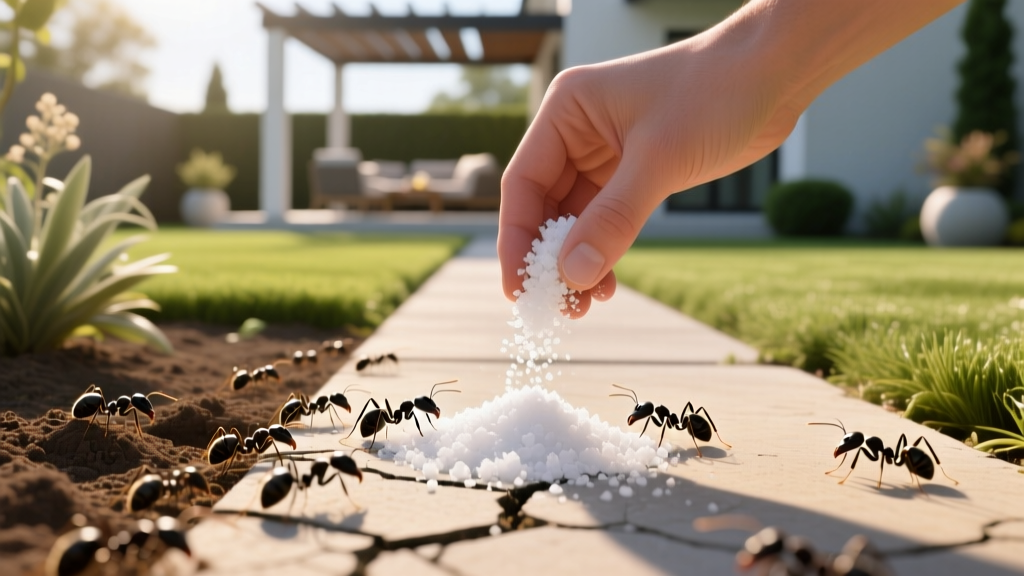
Will Salt Kill Ants? The Science, Soil Risks, and Proven Alternatives
The Short Answer: Does Salt Actually Kill Ants?
The persistent internet myth that table salt (sodium chloride) is an effective, natural ant killer is fundamentally false. While pouring a mound of salt on an ant trail might temporarily disrupt their pheromone path, salt does not kill ants on contact, nor is it a viable lethal bait. Relying on salt for pest control not only fails to eliminate the colony but introduces severe risks to your lawn's soil chemistry and long-term turf health.
The confusion typically stems from a misunderstanding of osmosis. Gardeners know that sprinkling salt on slugs or snails causes rapid dehydration and death. However, ants possess an entirely different biological architecture that renders this mechanism useless. Before reaching for the salt shaker, it is critical to understand the biology of the pest and the chemical impact sodium has on your landscape.
The Biology: Why Osmosis Fails Against Ant Exoskeletons
Slugs and snails are mollusks with highly permeable, mucous-coated skin. When salt contacts their skin, it creates a massive osmotic gradient, rapidly drawing water out of their cells and causing fatal dehydration. Ants, conversely, are arthropods protected by a rigid exoskeleton made of chitin.
The Chitin Barrier
- Impermeability: The waxy epicuticle layer of an ant's exoskeleton is specifically evolved to prevent water loss in dry environments. Salt crystals sitting on this surface cannot draw moisture out of the ant's internal tissues.
- Respiratory Isolation: Ants breathe through spiracles (tiny valves along their abdomen). While fine powders can clog these valves, coarse salt crystals are too large and heavy to effectively block respiration.
- Behavioral Avoidance: Ants possess highly sensitive chemoreceptors on their antennae. They can detect high concentrations of sodium and will simply route their foraging trails around salt barriers rather than walking through them.
Even if worker ants ingest trace amounts of salt while foraging, sodium is actually a necessary electrolyte for insect nerve and muscle function. While extreme, forced ingestion of pure sodium chloride could theoretically cause toxicity, ants will not voluntarily consume plain salt as a food source, rendering it useless as a bait matrix.
The Hidden Danger: Sodium Toxicity in Lawn Soil
For homeowners managing a lawn, the most critical reason to avoid using salt for pest control is the devastating impact of sodium on soil structure and turfgrass roots. Broadcasting salt along foundations, driveways, or garden beds initiates a destructive chemical chain reaction in the soil profile.
Cation Exchange and Soil Deflocculation
Healthy soil relies on a balance of positively charged ions (cations) like calcium (Ca2+), magnesium (Mg2+), and potassium (K+) bound to negatively charged clay and organic matter particles. This is known as the Cation Exchange Capacity (CEC). When you introduce massive amounts of sodium chloride to the soil, the monovalent sodium ions (Na+) displace the divalent calcium and magnesium ions.
⚠️ Soil Structure Warning: When sodium saturates the soil's CEC (measured as the Sodium Adsorption Ratio, or SAR), clay particles lose their ability to clump together. This process, called deflocculation or dispersion, causes the soil to collapse into a hard, impermeable crust when dry, and a waterlogged, anaerobic mud when wet.
Physiological Drought and Turf Death
High soil salinity increases the osmotic pressure of the soil solution. According to turfgrass pathology standards, when the soil's Electrical Conductivity (EC) exceeds 3.0 to 4.0 dS/m (deciSiemens per meter), grass roots can no longer extract water, even if the soil is physically moist. This induces 'physiological drought,' resulting in localized necrosis, yellowing, and eventual death of the turfgrass. Reversing sodium damage requires heavy applications of gypsum (calcium sulfate) and deep leaching with fresh water—a process that takes months.
Proven Alternatives: What Actually Kills Ants
To effectively manage ant populations without destroying your soil ecosystem, you must use compounds that target ant biology or exploit their social foraging behaviors. Below is a comparison of scientifically backed methods recommended by entomologists.
| Method | Active Mechanism | Kill Speed | Lawn Safety | Est. Cost (2026) |
|---|---|---|---|---|
| Borax Baits | Disrupts digestive tract; slow-acting to allow colony transfer. | Slow (48-72 hrs) | High (Safe in bait stations) | ~$6.50 / 2-pack |
| Diatomaceous Earth | Mechanical; silica shards pierce the waxy exoskeleton lipid layer. | Medium (12-24 hrs) | High (OMRI listed organic) | ~$12.00 / 4 lbs |
| Spinosad Baits | Neurotoxin derived from soil bacteria; highly attractive protein/sugar matrix. | Medium (24-48 hrs) | High (Targeted granular use) | ~$28.00 / 2 lbs |
| Fipronil (Liquid) | Non-repellent neurotoxin; creates a lethal transfer zone. | Fast (Hours to days) | Moderate (Trench application) | ~$45.00 / 20 oz |
| Table Salt | Osmotic disruption (fails on chitin) | None | Severe Risk (Soil toxicity) | $1.00 / lb |
Deep Dive: Borax (Sodium Borate) Liquid Baits
Borax is the gold standard for DIY and commercial sweet ant control (e.g., Terro T300B Liquid Ant Killer). Unlike salt, borax is ingested willingly when mixed with a carbohydrate attractant. It interferes with the ant's metabolism and digestive system. Because it acts slowly, foraging workers survive long enough to regurgitate the toxic bait and feed it to the larvae and the queen—a process called trophallaxis. This ensures the entire colony is eradicated, not just the visible surface workers.
Deep Dive: Diatomaceous Earth (DE)
If you need a contact killer for outdoor mounds or perimeter defense, Food-Grade Diatomaceous Earth (such as Safer Brand Ant & Crawling Insect Killer) is highly effective. DE consists of fossilized diatoms with microscopically sharp silica edges. When ants crawl over DE, the particles abrade the waxy outer layer of their exoskeleton, causing them to die from desiccation.
Critical Application Rule: DE only works when completely dry. Once it absorbs moisture from dew or rain, it loses its mechanical cutting properties. Apply it under eaves, inside dry crawl spaces, or reapply after rainfall.
Step-by-Step: Formulating a DIY Borax Ant Bait
If you prefer a custom approach over commercial products like Terro, you can formulate a highly effective liquid bait at home using 20 Mule Team Borax (available in the laundry aisle for roughly $5 per box).
- Prepare the Matrix: In a small saucepan, combine 1 part Borax powder with 3 parts granulated white sugar.
- Dissolve: Add 1 cup of warm water and stir continuously until the Borax and sugar are completely dissolved. (Undissolved Borax crystals will deter ants).
- Saturate Carriers: Soak standard cotton balls in the warm solution until fully saturated.
- Deploy: Place the soaked cotton balls inside plastic bottle caps or small, shallow dishes. Position them directly across active ant trails, near foundation cracks, or along patio edges.
- Monitor and Replenish: Do not kill the ants you see feeding on the bait. Allow them to return to the nest. Replace dried-out cotton balls every 3 to 4 days until ant activity ceases completely (usually 7 to 10 days).
💡 Pro-Tip for Protein/Grease Ants: If ants ignore the sugar/borax bait, you are likely dealing with a protein-foraging species (like Pharaoh or Carpenter ants). Swap the sugar for 2 tablespoons of peanut butter or bacon grease mixed with 1/2 teaspoon of Borax.
Frequently Asked Questions
Does Epsom salt kill ants?
No. Epsom salt is magnesium sulfate. It has no toxic effect on ants and will not act as a desiccant. In fact, dissolving Epsom salt in water and applying it to your lawn simply acts as a magnesium fertilizer, which can help correct chlorosis (yellowing) in grass without posing any sodium-related soil structure risks.
Will Himalayan pink salt or sea salt work better than table salt?
No. While these salts contain trace minerals like iron, potassium, and zinc, they are still 98%+ sodium chloride. They suffer from the exact same biological inefficacy against ant exoskeletons and pose the identical threat of sodium-induced soil deflocculation and turf burn.
Can I use salt to keep ants out of my potted plants?
Absolutely not. Potted plants have a closed drainage environment. Adding salt to potting mix will rapidly concentrate as water evaporates, spiking the EC levels and causing immediate root burn and plant death. Use a targeted DE dusting on the soil surface or a commercial liquid bait trap placed near the pot's base instead.
When should I call a professional exterminator?
If you are dealing with structural wood-destroying ants (like Carpenter ants) or aggressive species like Red Imported Fire Ants that pose a stinging hazard to children and pets, DIY baits may be insufficient. According to the EPA's guidelines on public health pests, professional application of non-repellent termiticides/ant baits is recommended for large-scale structural infestations to prevent costly wood damage or severe allergic reactions.
For comprehensive, region-specific identification and management strategies, consult the University of California Agriculture and Natural Resources IPM database or your local university extension office, such as the Penn State Extension ant management guide. Proper identification of the ant species is always the first step in selecting the correct bait matrix and active ingredient.

