
Pest Control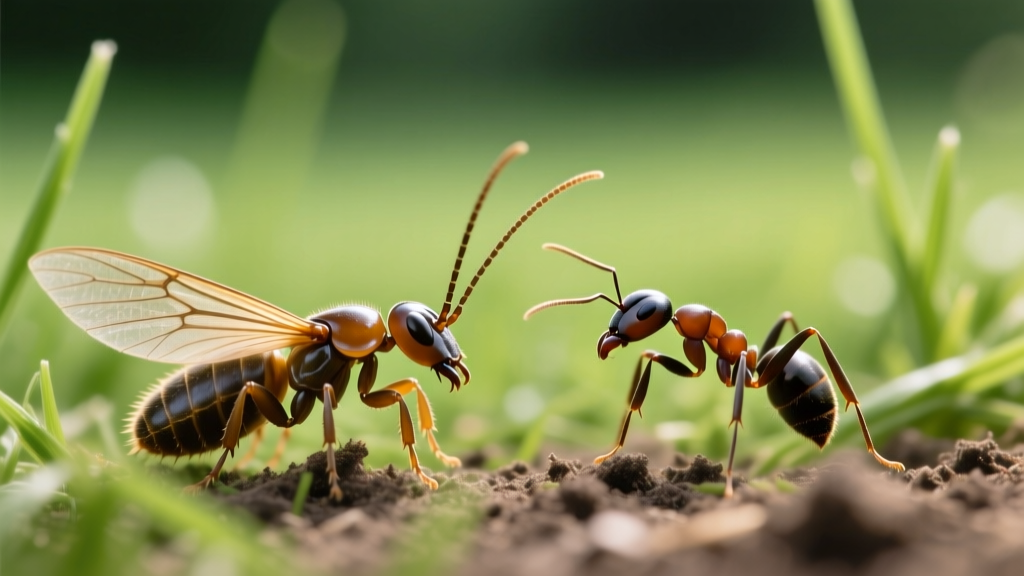
What Do Winged Termites Look Like? Swarmers vs Flying Ants
The Anatomy of a Winged Termite (Swarmer)
Winged termites, scientifically known as alates or swarmers, represent the reproductive caste of a termite colony. Their sole biological purpose is to leave the nest, mate during a nuptial flight, and establish new colonies. When homeowners ask, "what do winged termites look like," they are typically observing an insect that measures between 1/4 and 1/2 inch in total length, featuring two pairs of translucent, equal-length wings that extend well past its abdomen.
Unlike the worker and soldier castes—which are pale, soft-bodied, and entirely wingless—swarmers possess hardened exoskeletons and functional eyes to survive the brief exposure to light and air required for mating. To accurately identify a winged termite, examine these three critical anatomical features:
- Wings: Termites possess four wings of identical length and shape. The wings are fragile, milky-white or translucent, and feature distinct, raised veins. They typically measure twice the length of the insect's body.
- Antennae: Termite antennae are straight and bead-like (moniliform). They project directly forward from the head without any sharp bends or joints.
- Body and Waist: The termite body is uniform and cylindrical. There is no distinct separation between the thorax and abdomen, resulting in a thick, broad waist.
Winged Termites vs. Flying Ants: A Visual Comparison
The most common misidentification in pest control is confusing a termite swarmer with a reproductive carpenter ant. Both insects swarm in the spring, both have wings, and both can be found near window sills. However, their structural differences are stark when viewed up close. According to the National Pest Management Association, correctly distinguishing between the two dictates entirely different treatment protocols and urgency levels.
| Identification Feature | Winged Termite (Swarmer) | Flying Ant (Carpenter Ant) |
|---|---|---|
| Wing Structure | Four wings of equal length; translucent/milky; easily broken off. | Front wings noticeably longer than hind wings; brownish/tinted; sturdy. |
| Antennae Shape | Straight and bead-like (moniliform). | Elbowed or bent (geniculate). |
| Waist / Thorax | Thick, uniform, and broad; no pinching. | Pinched, narrow waist (petiole) between thorax and abdomen. |
| Body Color | Dark brown, black, or pale yellow (species dependent). | Usually black, red, or a combination of red and black. |
Species-Specific Variations in Swarmers
The exact color and size of a winged termite depend heavily on the species infesting your property. In the United States, three primary termite groups produce distinct swarmers:
Eastern Subterranean Termites (Reticulitermes flavipes)
The most destructive and widespread termite in North America. Subterranean swarmers are typically dark brown to almost black, measuring about 3/8 inch long including their wings. Their wings are grayish-translucent. As noted by Penn State Extension, these swarmers usually emerge in massive numbers on warm, sunny mornings following a spring rain, triggered when soil temperatures reach approximately 65°F to 70°F.
Drywood Termites (Incisitermes spp.)
Common in the southern and coastal states, drywood swarmers are larger than their subterranean counterparts, often reaching 1/2 inch in length. They feature pale yellow to light brown bodies and possess wings with distinct, dark brown veins. Unlike subterranean termites, drywood swarmers frequently emerge in the late summer or early fall and do not require soil contact to establish a colony.
Dampwood Termites (Zootermopsis spp.)
Found primarily in the Pacific Northwest and high-moisture environments, dampwood swarmers are the largest of the three, measuring up to 5/8 inch long. They have reddish-brown heads and dark brown bodies. Because they require wood with very high moisture content, their presence usually indicates a severe plumbing leak or direct wood-to-soil contact causing rot.
The Aftermath: Identifying Discarded Wings
Because termite swarmers are poor flyers, their nuptial flight is brief. Once they land, they perform a behavior called dealation—breaking off their wings along a natural suture line near the base. You are actually more likely to find the discarded wings than the live insects themselves.
A pile of termite wings looks like a scattering of translucent, 1/2-inch fish scales or flakes of mica. You will typically find these piles accumulated on windowsills, caught in spider webs, gathered near porch lights, or resting on basement floors near mud tubes. If you find a pile of identical, fragile wings, it is a definitive indicator that a mature colony is actively attempting to expand on your property.
⚠ CRITICAL WARNING: Do Not Use OTC Sprays on Swarmers
Homeowners often panic and spray visible swarmers with over-the-counter aerosols like Ortho Home Defense or Raid. Do not do this. Swarmers are merely the reproductive caste; they do not eat wood and cause zero structural damage. Spraying them only kills a few hundred reproductives while leaving millions of wood-destroying workers untouched inside your joists. Furthermore, chemical repellents contaminate the mud tubes and foraging trails, making it significantly harder for a professional to apply targeted liquid barriers or baiting systems later.
Actionable Next Steps and Treatment Costs
If you have confirmed the presence of winged termites or discarded wings, the colony has likely been established in or around your home for at least three to five years. The Environmental Protection Agency (EPA) strongly recommends professional intervention, as DIY surface treatments cannot penetrate the deep soil galleries where the primary colony resides.
- Collect Specimens: Use clear tape or a small ziplock bag to capture a few swarmers or a sample of the discarded wings. Do not crush them, as professionals need intact wings and bodies for species verification.
- Schedule a WDI Inspection: Hire a licensed pest control operator for a Wood Destroying Insect (WDI) inspection. Expect to pay between $75 and $150 for a comprehensive inspection, which includes probing baseboards, checking crawl spaces, and mapping mud tubes.
- Evaluate Treatment Options: Based on the species and infestation severity, choose between the two industry-standard eradication methods.
Liquid Soil Barriers (Fipronil)
The most common conventional treatment involves trenching the soil 6 inches deep and 6 inches wide around the entire foundation perimeter. Technicians apply a non-repellent termiticide, such as Termidor SC (9.1% Fipronil), at a rate of 4 gallons per 10 linear feet. Because Fipronil is non-repellent, foraging workers unknowingly pass through the treated soil, transferring the lethal dose to the rest of the colony via trophallaxis (food sharing). Average Cost: $1,200 to $2,500 for a standard 2,000 sq. ft. home, depending on linear footage and slab drilling requirements.
Cellulose Bait Stations
Systems like Sentricon Always Active involve installing plastic bait stations flush with the soil every 10 feet around the perimeter. These stations contain a cellulose matrix laced with noviflumuron, an insect growth regulator that prevents termites from molting. This method is less invasive (no trenching or concrete drilling) but takes slightly longer to achieve total colony elimination. Average Cost: $1,800 to $3,500 for initial installation, plus an mandatory annual renewal and monitoring fee of $150 to $250 to maintain the warranty.

