
Pest Control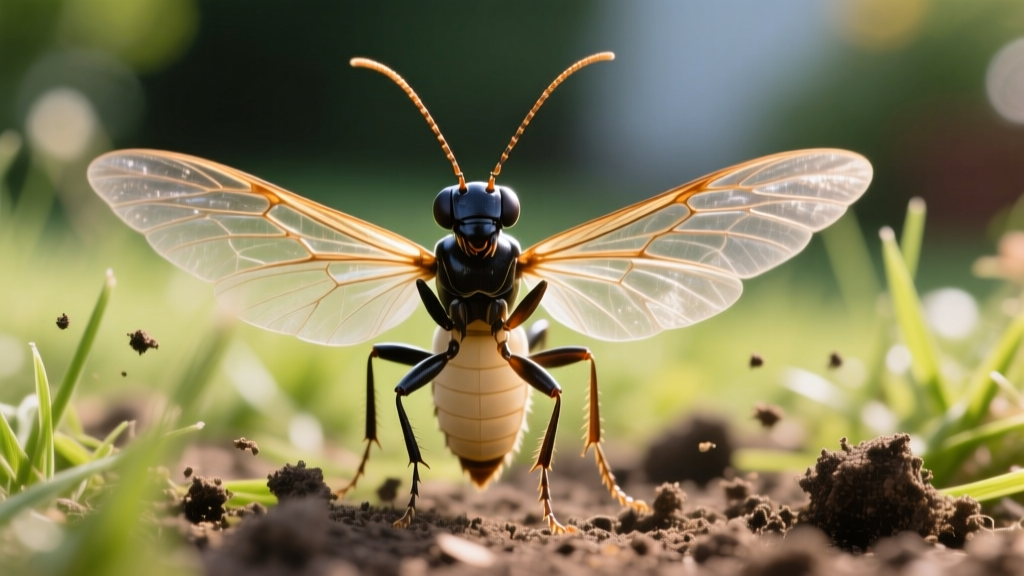
What Does a Winged Termite Look Like? Visual ID Guide
The Anatomy of a Winged Termite (Alate)
When homeowners ask what does a winged termite look like, they are typically dealing with an active reproductive swarm. Winged termites, scientifically known as alates, are the reproductive caste of the colony tasked with mating and establishing new nests. Identifying them correctly is the first critical step in preventing catastrophic structural damage.
A mature winged termite possesses three distinct anatomical features that separate it from other flying insects:
- Uniform Wings: Alates have two pairs of wings that are identical in length and shape. These wings are typically translucent, milky, or slightly smoky, and extend well past the abdomen—often measuring twice the length of the body itself.
- Straight Antennae: Unlike many other insects, termite antennae are straight and moniliform (beaded), resembling a string of tiny pearls extending directly forward from the head.
- Broad Waist: The most crucial identifier is the thorax-to-abdomen connection. Winged termites have a broad, uniform waist with no constriction, giving them a thick, cigar-like silhouette.
Critical Warning: Finding discarded wings on window sills or near foundation walls is a primary indicator of an active infestation. After mating, alates shed their wings to burrow into wood or soil. Do not ignore piles of translucent wings, even if you do not see live insects.
Winged Termites vs. Flying Ants: The Definitive Comparison
The most common misidentification occurs between termite swarmers and flying carpenter ants. Both emerge in large numbers during spring and early summer, but their structural threat levels are vastly different. Carpenter ants excavate wood to build nests but do not consume it, whereas termites digest cellulose, compromising the structural integrity of your home.
| Feature | Winged Termite (Alate) | Flying Carpenter Ant |
|---|---|---|
| Antennae | Straight, beaded (moniliform) | Elbowed (geniculate) |
| Wings | Two pairs, equal in length | Two pairs, front wings longer than hind wings |
| Waist | Broad, uniform thickness | Pinched, narrow constriction |
| Body Color | Dark brown to black, uniform | Black, red, or multi-toned |
| Flight Pattern | Weak, fluttering, poor navigators | Strong, direct, agile fliers |
Species Breakdown: Identifying the Swarmer
The exact appearance of a winged termite varies depending on the species infesting your property. According to the University of California Integrated Pest Management program, identifying the specific species dictates the required treatment protocol.
Eastern Subterranean Termites (Reticulitermes flavipes)
The most widespread and destructive species in North America. Swarmers are dark brown to black, measuring roughly 3/8 to 1/2 inch in length including their wings. Their wings are translucent with a slightly smoky tint. They typically swarm in the morning after a heavy spring rain when soil temperatures reach 70°F.
Formosan Subterranean Termites (Coptotermes formosanus)
Highly aggressive and prevalent in the Gulf Coast and southern states. Formosan alates are larger, measuring up to 5/8 inch, with a pale yellow-brown body and densely hairy, translucent wings. They are notorious for massive evening swarms attracted to exterior lighting in late May and June.
Drywood Termites (Incisitermes minor)
Common in coastal California and the deep South. These swarmers are larger than subterranean varieties (up to 1/2 inch body length) with dark brown bodies and dark, opaque wings. Unlike subterranean species, they do not require soil contact and swarm directly from infested attic framing or furniture, usually in late summer or early fall.
Dampwood Termites (Zootermopsis spp.)
The largest of the common termites, with swarmers reaching up to 1 inch in length. They feature a distinct reddish-brown head and thorax with dark brown wings. They are rarely a threat to sound structures, preferring severely water-damaged wood or decaying landscape timber.
The Swarming Trigger: Why They Emerge
Winged termites do not swarm randomly. The emergence of alates is tightly synchronized with specific environmental micro-climates. A colony will only produce swarmers once it has reached maturity, which typically takes 3 to 5 years for subterranean species and up to 7 years for drywood species.
Swarming is triggered by a combination of barometric pressure drops, recent precipitation, and specific soil temperature thresholds. Subterranean colonies utilize mud tubes to stage swarmers just below the surface, waiting for the exact moment humidity levels rise to prevent their delicate wings from desiccating. If you see a swarm inside your home, it indicates the colony is nesting within your structural framing or beneath your slab foundation.
Immediate Action Plan: What to Do When You Spot Swarmers
Panic and improper DIY treatments often exacerbate the problem. Follow this precise protocol when you discover winged termites on your property.
- Contain and Collect: Do not use over-the-counter aerosol sprays like Raid. Contact insecticides will only kill the visible swarmers and cause the hidden worker caste to retreat deeper into the walls, making professional detection harder. Use a vacuum cleaner to capture live swarmers and discarded wings, then seal the vacuum bag in a plastic trash bag.
- Document the Evidence: Take high-resolution photos of the insects, discarded wings, and any visible mud tubes on your foundation. Note the exact time of day and weather conditions, as this helps pest control professionals identify the species.
- Schedule a WDI Inspection: Contact a licensed pest control operator for a Wood Destroying Insect (WDI) inspection. Expect to pay between $85 and $150 for a comprehensive inspection, which is often credited toward treatment costs.
- Evaluate Treatment Options: Based on the 2026 market rates, you have two primary remediation paths:
- Liquid Soil Barrier: Products utilizing Fipronil 9.1% (such as Termidor SC) are applied by trenching and rodding around the foundation perimeter. Costs average $7 to $10 per linear foot. This creates a non-repellent transfer-effect barrier that eradicates the colony over 60 to 90 days.
- Bait Station Systems: Systems like Sentricon utilize hexaflumuron bait matrices placed every 10 feet around the structure. Costs average $8 to $12 per linear foot for installation, plus a $300 to $500 annual monitoring fee. This is ideal for properties with extensive hardscaping or well systems where trenching is prohibited.
Pro Tip: Always verify that your pest control contract includes a renewable annual warranty that covers both retreatment and structural damage repair. Standard chemical warranties only cover retreatment, leaving you liable for thousands of dollars in framing replacement if the termites return.
Frequently Asked Questions
Do winged termites bite humans or pets?
No. Termite alates possess mandibles designed for chewing wood and soil, not for defending against large mammals. They are entirely harmless to humans and pets, though their presence indicates a severe structural threat to your property.
How long do swarmers live?
If a winged termite fails to find a mate and suitable damp soil or wood to establish a new colony, it will typically die from dehydration or predation within 24 to 48 hours. However, if a pair successfully establishes a colony, the resulting queen can live for 15 to 25 years, laying up to 30,000 eggs per day.
Can I treat a termite swarm myself with DIY borate sprays?
Borate-based wood treatments (like Bora-Care or Tim-bor) are excellent for pre-construction framing or localized drywood termite prevention, but they will not stop an active subterranean swarm. Subterranean colonies reside deep underground, far beyond the reach of surface-applied DIY sprays. Professional soil trenching or baiting is required to intercept the worker caste before they consume your sill plates and floor joists. The Environmental Protection Agency strongly recommends hiring certified professionals for active subterranean infestations due to the complexity of soil application and groundwater protection regulations.

